Lit class notes - Ash
Fiction (lesson 2)
Primary source (artistic object) and secondary source (critical text)
Literature is a body of written works, especially those of outstanding artists/aesthetic merit
Novel is the most important form of fiction (emerged in 18th century), epics are what novels used to be before
Epics - focus on the hero fulfilling a task in national or cosmic significance. Connects to history, religion and myth. Reflects on self-contained world view of their nationalities/periods
Modern times - what happened? Epics got replaced by novels. Traditional epics are written in verses, poetry which is difficult. Broad scope. Protagonist: heroics ideals, no individual traits
Fiction: Romance
Appeared even in classical times like Apuleius The Golden Ass 2nd century CE
From Middle Ages
Scope of a romance: action/plot focuses on goal
More detailed protagonist with individual traits and point of view
Linear plot structure (climax, no national/cosmic problems)
Fiction: Novel
Established in Spain 17th century
And England in 18th century
Elements of the romance but also rooted epic
Some early English Novels are:
Robinson Crusoe, Pamela, Clarissa, Tom Jones…
Novel portrays individualism and realism. Settings are historical and geographical reality. But the protagonist: epic hero with individual/realistic traits. A real person instead of a hero who kills dragons. Reflects the social tendencies of the 18th century, problems of those times.
Literary criticism;
Literary history vs poetics
Reason for the rise of the literature;
Realistic
Personal
Mass production (available and cheaper books for the broad public)
Rise of the educated middle class
Economic basis - writing as a profession, new careers
Types of novels;
Picaresque novel - hero vs norm of the society
Bildungsroman - development from a child to adult
Epistolary novel - letters for first-person narration
Historical novel - realistic historical context
Satirical Novel
Utopian Novel
Gothic Novel - aesthetic of fear and haunting
Detective Novel
Short story (concise form of prose fiction. Less attention from scholars. Roots/forerunners) also 18th century
Tales, oral stories, narrative cycles for middle ages
George Eliot - she used a male name to sell her books. She was a novelist and a poet, also doing translations
Short stories - in medias res (jump right in without any specific beginning), one point of view, plot is highly selective, less details, written in one sitting
Novella/Novelette - not really a novel but neither a short story. Too short for a novel but too long for a short story
Important terms in prose fiction
Plot
Formalist focuses on plot and narrative
Logical interaction of thematic elements
Leads to change of original situation
Four (up to six) levels - linear plot line
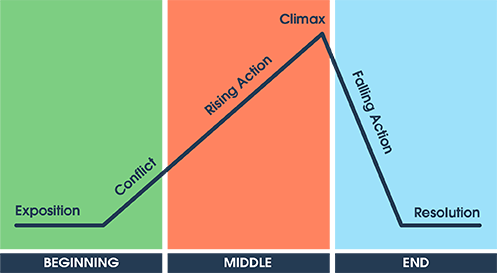
Examples (The Hobbit, Harry Potter, Red Dragon, Pride and Prejudice, Hunger Games)
Flashbacks and foreshadowing (past and future) like Secret History
The Drama of the Absurd/Experimental novel
Non linear narrative (Little Women, Secret History)
Time
Character
Psychological approach focuses on the characters (flat character or individualized/round character)
Characters are usually mixed up as both flat and round due to narrative’s filter
Dramatic characterization
Unreliable narrator
Setting
Identifies the location, historical period, social surroundings, time and place to support the action, the characters and the perspective
Narrative Perspective
Point of view
Events, settings and characters
Three basic form point of view (first person, third person)
First person focuses on the protagonist or minor character, told through their eyes, what is going on around them
“Call me Ishmael”
Omniscient point of view (third person):
Unspecified narrator
All knowing God-like protagonist
Stream of consciousness technique (what the narrator feels, inner dialogue - to show the inner world of the character)
(Post)Modernist novels mixes all those techniques
Style
Poetry
One of the oldest genres; Ancient Greek literature
Poetry related to the term lyric (connects to lyra), connected to music. Lyra used to be played to recite poetry
“Poeio” means to make in greek
Verse is first line
Traditional poetry;
Verse
Rhyme
Metre
Sub categories of poetry;
- Narrative poetry (tells a story)
- Lyric poetry (conveys emotions)
The precursors of ancient poetry can be found in riddles and charms (cultic spells). ALSO music as medium (medieval english songs; Sumer Is Icumen In)
Onomatopoeia - word formed to mimic a sound
Bob Dylan is considered “the poet” because his songs can be compared to poems. Won a nobel prize in literature
Classical forms of poetry:
- Sonnet
- Ode (to celebrate a person, place or am event)
- Elegy (ancient form of poetry used in the old english period, talking about death of a dear person)
Image(ry) “imago” is latin for picture. Refers to visual components of the poem.
Lexical-thematic dimension
- The issues of a narrator expect its voice or speaker. Author himself plays the big part in poems
- Structure difference, poetic form of language (rhyme rhymes) – Poetic language
- Concrete nouns/scenes/images
- Images can function as symbols
Conventional Symbol - a symbol that is commonly known
Private Symbol - when a poet or an author creates a symbol on their own
-Simile (a figure of speech comparison of two different things using like, as) and metaphors (equation is one thing with another without the actual comparison)
Tenor(object) and Vehicle (image) “my love is like a red rose”, tenor is love and vehicle is rose
20th century started - movement of imagism
“Condensation” (reducing poetry to powerful images)
Haiku
Visual dimension
- Poem’s shape and visual appearance
- Chiasmus comes from the Greek letter chi which is X ex; "Those that mind don't matter, those that matter don't mind”.
Rhythmic-acoustic dimension
- Elements that have their own meaning
- Poet can produce a sound or tone directly related to content of his statement
- Sounds
Meter and rhyme
Syllables
To analyze a poem:
Divide the line into syllables
Identify stressed and unstressed
Divide the line into feet (try find the pattern; like unstressed and stressed/unstressed stressed always connected with each other)
Iambus
Anapest
Trochee
Dactyl
Meter; Monometer, Dimeter, Trimeter and so on…
Internal rhymes;
Alliteration
repetition of the same sound at the start of a series of words in succession whose purpose is to provide an audible pulse that gives a piece of writing a lulling, lyrical, and/or emotive effect.
Assonance
the repetition of vowel sounds in words that are close together in a sentence or verse
End rhymes
Eye rhyme
Analyze a poem;
Divide the first line into syllables
Identify stressed and unstressed
Find pattern (unstressed and stressed and etc)
Find the number of feet in in the first line (to find the meter)
Drama
Originates from Ancient Greece.
Drama (dramatic or performing arts is another name)
William Shakespeare and Christopher Marlowe (revived and developed classical forms)
Types; tragedy, Comedy and History
Three interdependent levels of play;
Text
Transformation
Performance
Aside (when the character breaks away from the events of the play to talk to himself or the audience, unheard by the other characters)
Three unities connected to plot; Action, Place, Time (when, where, what)
Acts and Scenes help for a play to have linear and logical plot
Original dramas had five acts, then four and now we usually have three
The Theatre of Absurd forsakens all of that!
The director’s job is to make sure the target audience is satisfied
Different types of stages; classical Greek amphitheater, Elizabethan theater (Shakespeare performed there, the scenery was left for people’s imagination), Modern Theatre (props and scenery, took a shape of a box you look into)
Methodological training is a new modern thing, with training, methods and etc.
Two basic theoretical approaches (External method - showing but not actually feeling and internal - when the actor identifies and actually feels the emotions)
Chorus - centerpiece of classical drama (medea)
Choir - Elizabethan theater (filling time gasps and informing the audience)
Women used to not be allowed in theater
Film
Drama and film and both are “performing arts” since they both use actors.
Movie is a number of individual images played one after the other. Always 24 pictures.
Most essential elements; Space, Sound and Time
Framing (close up, medium, long shot (western)) distance between camera and object, arrangement of visual elements
Camera angle - makes a character appear in a certain way (high angle)
Spatial dimensions
Montage - effects similar to metaphor/simile in lit
Temporal Dimension; Slow motion, Fast motion, Passing of time, Temporal Dimension, Parallel, Actual length of movie, Dragging out