Chapter 7 - Linear Motion
7.1 Displacement, Speed and Velocity
Centre of Mass
Simplification of objects
Centre of mass or Centre of gravity (CoG)
The balance point
Position
Position - describes the location of an object at a certain point in time with respect to the origin
Vector quantity
Example →
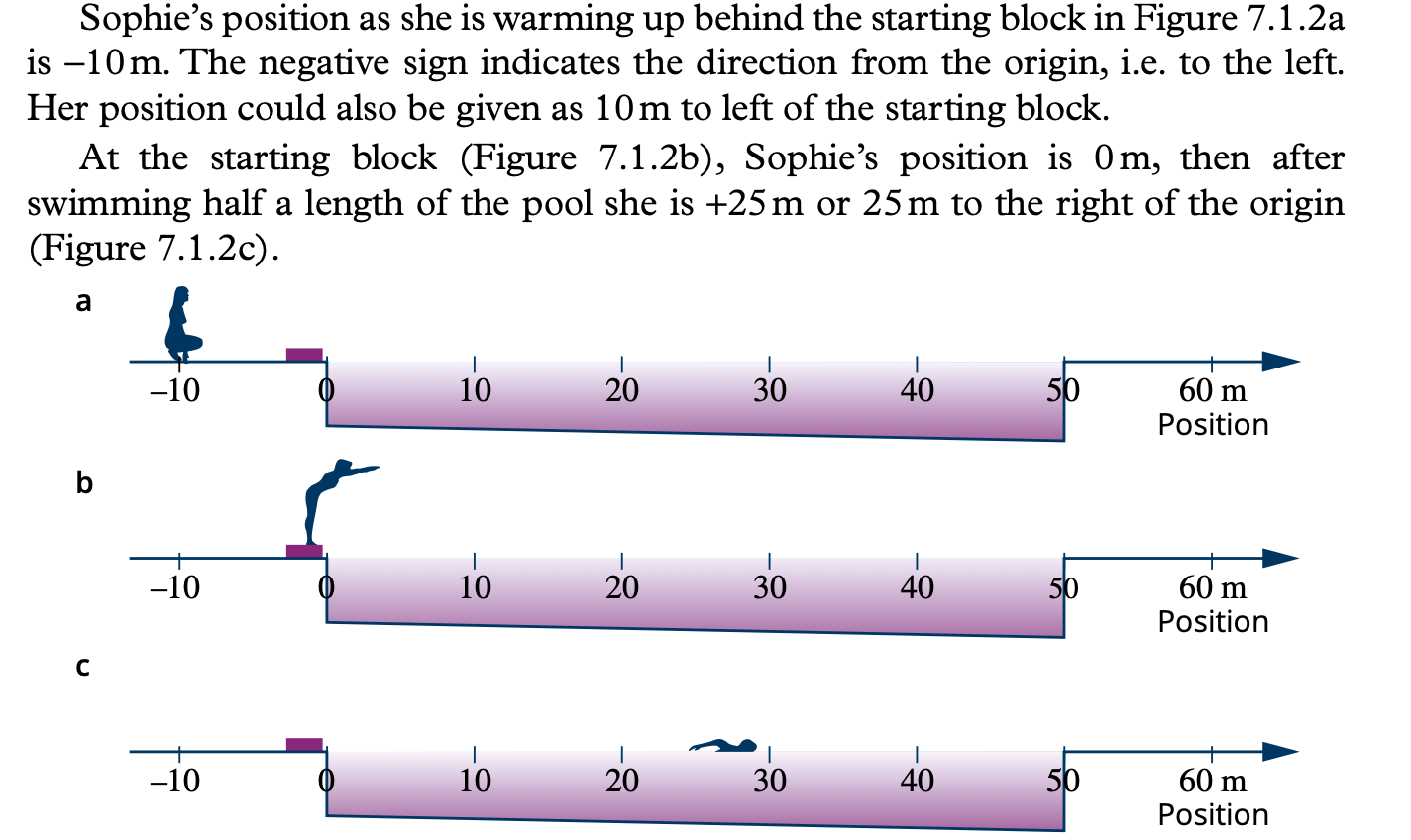
Distance Travelled
distance travelled (d) - describes the length of the path covered during an objects entire journey
scalar quanity
Example → sophie swim 3 laps of a 50m pool. 50 + 50 + 50 = 150m
Displacement
Displacement (s) - change in position of an object given direction.
s = final position - initial position
vector quantity
measured in meters
Example → Sophie swam 50 meters and then swam back 30. Final position is +20. Initial is 0. 20 - 0 = +20m
Magnitude, units and direction are required
Total displacement = su of individual displacements
Speed and Velocity
Speed - the rate at which distance is travelled. Is scalar
Velocity - the rate at which displacement changes. is Vector
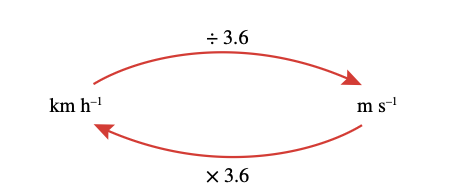
Units for both are m s-1 or km h-1
Instantaneous Speed and Velocity
Gives a measure of how fast something is moving at a point in time
Average Speed and Velocity
Gives an indication of how fast an object is moving over a time interval
average speed = distance travelled / time taken (vav= d / t)
average velocity = displacement / time taken (vav = s / t = v + u / 2)
⭐ ️give direction for velocity
Converting Between km h-1 and m s-1
7.2 Acceleration
Acceleration - measure of how quickly the velocity changes in an object.
Finding the change in Velocity and Speed
Δv = v – u
Δv → change in speed/velocity
v → final speed/velocity
u → initial speed/velocity
⭐️ Direction is required for velocity (vector)
Acceleration
Negative acceleration can mean an object is slowing down in direction of travel
Also, speeding up but in opposite direction
Vector quantity
a = change in velocity / time taken
= v / t
= (v - u) / t
7.3 Graphing Position, Velocity and Acceleration Over Time
When motion is 1D, info can be presented graphically
Nature of motion can be seen clearly
Position-Time Graphs (x-t)
Indicated the position of an object at any time over a period of time
Position, not displacement
Example →

For first 25 seconds, she swims at a constant rate. From 25 s to 35 s, her position doesn’t change (resting/stationary)
Swims in a negative direction from 35s to 60s, swimming back to starting point
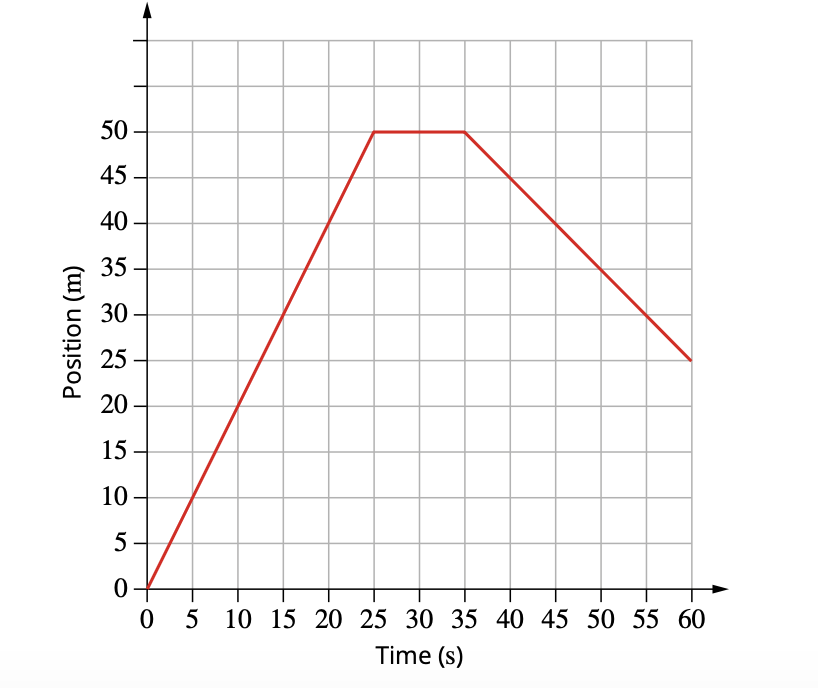
Displacement = 25 - 40 = -15m
Velocity = +2 ms-1 and then 0 ms-1 and then 1 ms-1
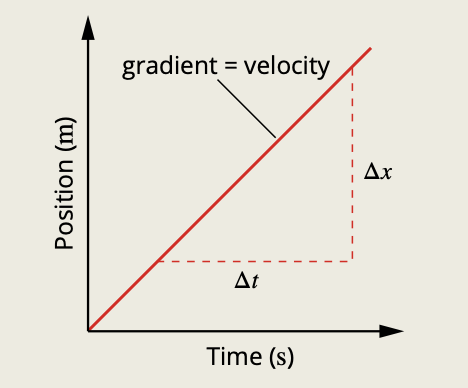
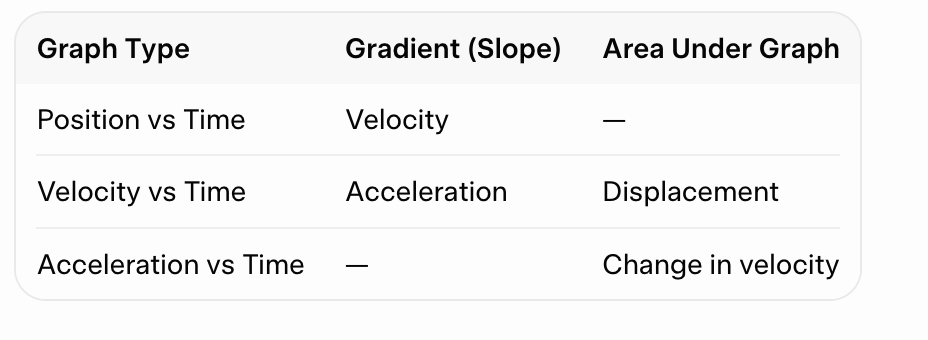
Gradient = velocity
Positive velocity = positive direction
Negative velocity = negative direction
gradient of x-t graph = rise / run = x / t
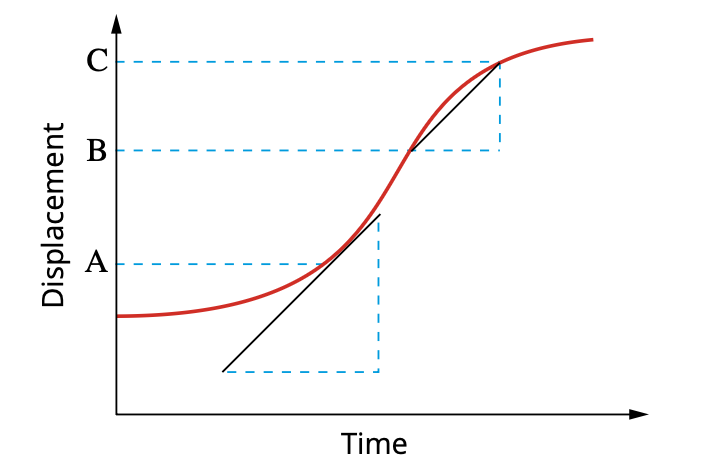
Non-uniform Velocity
For motion with constant velocity, the graph will be straight (uniform)
For motion with different velocity, graph will be curved (non-uniform)
Instantaneous velocity will be the gradient of the tangent to the line at the point of interest
Average velocity will be the gradient of the chord between these points
Velocity-Time Graphs (v-t)
velocity against time shows how the velocity of an object changes with time
Example →
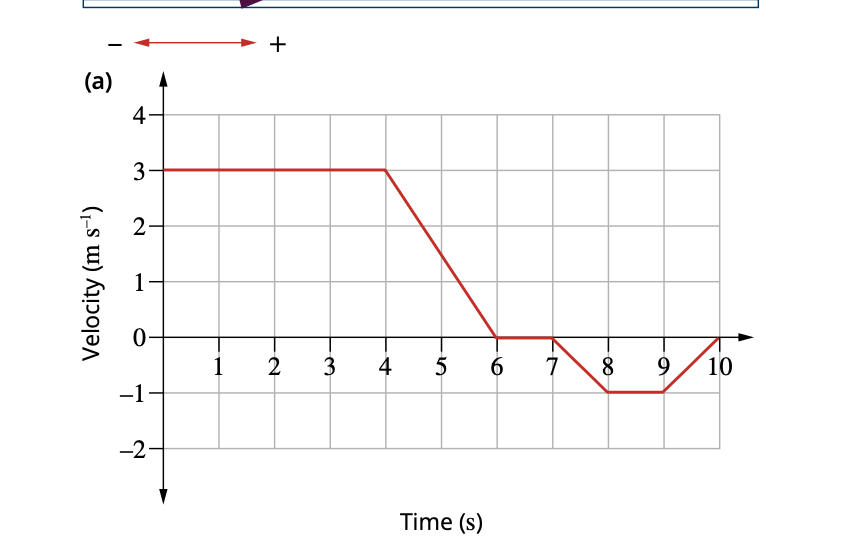
Moves positively at 3 ms-1 for first 4 seconds, then continues positively but slows down over the next two seconds, is stationary for 1 second, accelerates negatively for a second, then for another second at a velocity of -1ms-1 and then slows down and stops at 10 seconds.
⭐️When graph is below x axis, velocity is negative, which indicates travel in reverse direction
Finding Displacement
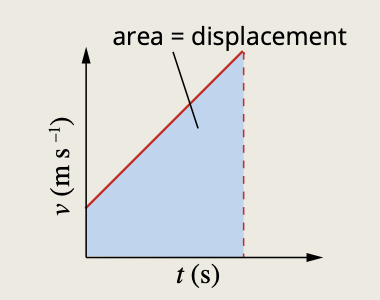
The area under a velocity-time graphs (area)
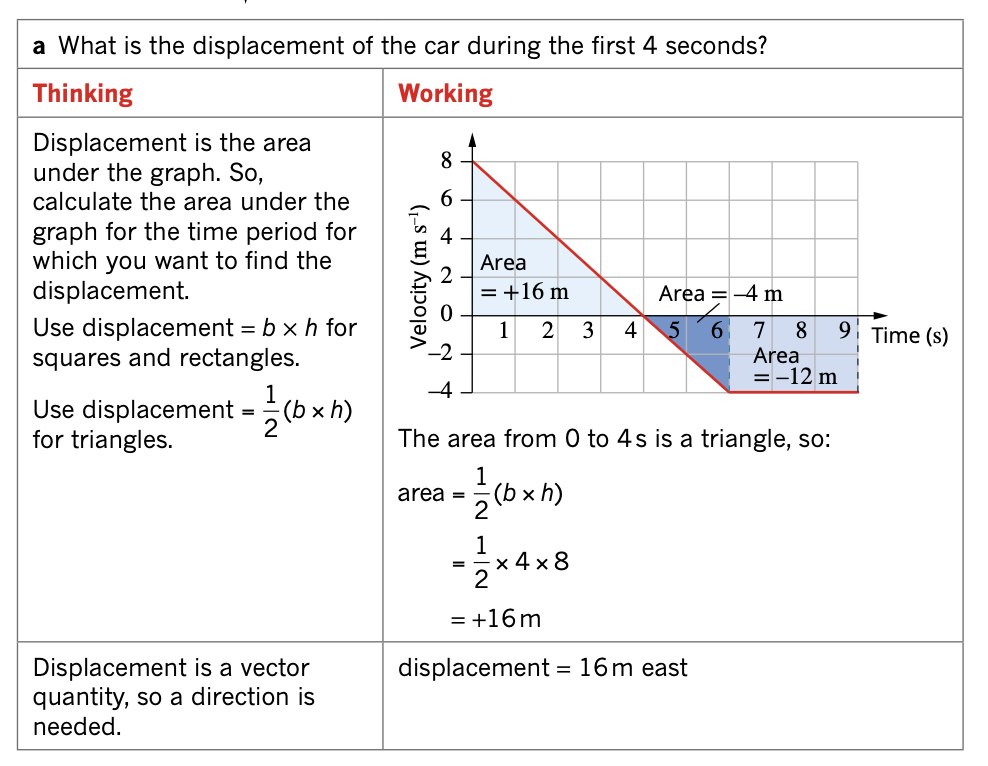
Area under the x axis indicates negative displacement
Seperate into simple equations
Rectangle = b x h
Triangle = ½ x b x h
Acceleration from a Velocity-Time Graph
Gradient = average acceleration
Gradient = rise / run
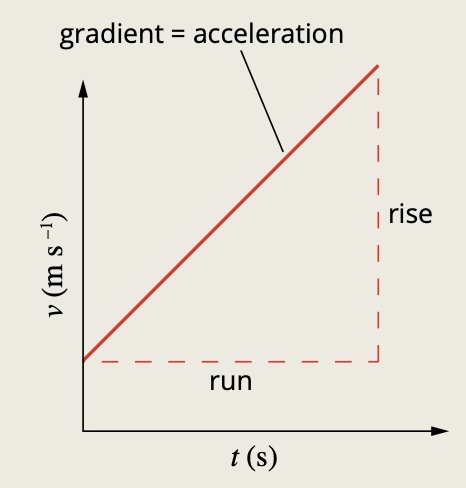
Example
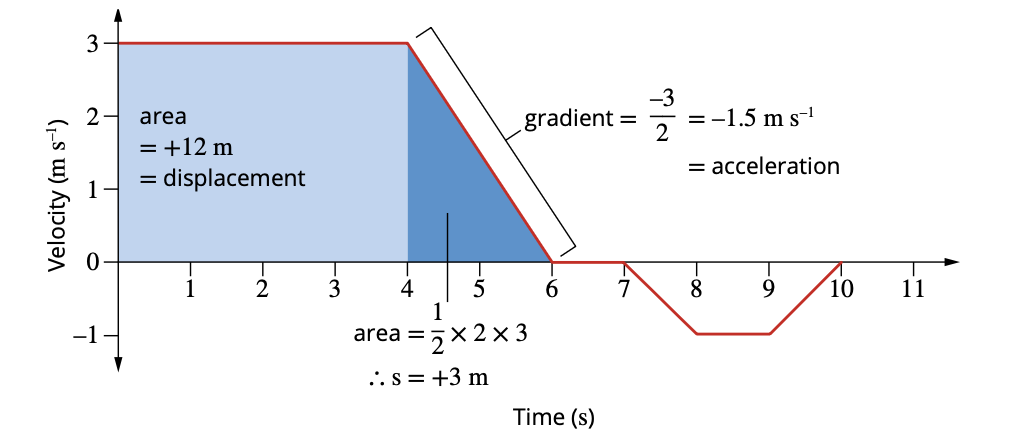
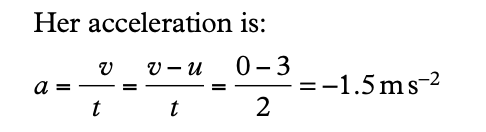
Distance travelled
Area under
Regardless of direction, area of all shapes must be ADDED up
As seen in example above
Non-Uniform Acceleration
For constant acceleration, motion will be straight (uniform)
Non-uniform will be curved
Instantaneous acceleration will be gradient of the chord between two points.
Displacement can be calculated, but will be an estimation.
Acceleration-Time Graphs (a-t)
Indicates the acceleration of the object during a time period
Area under = velocity
area = a × Δt = Δv
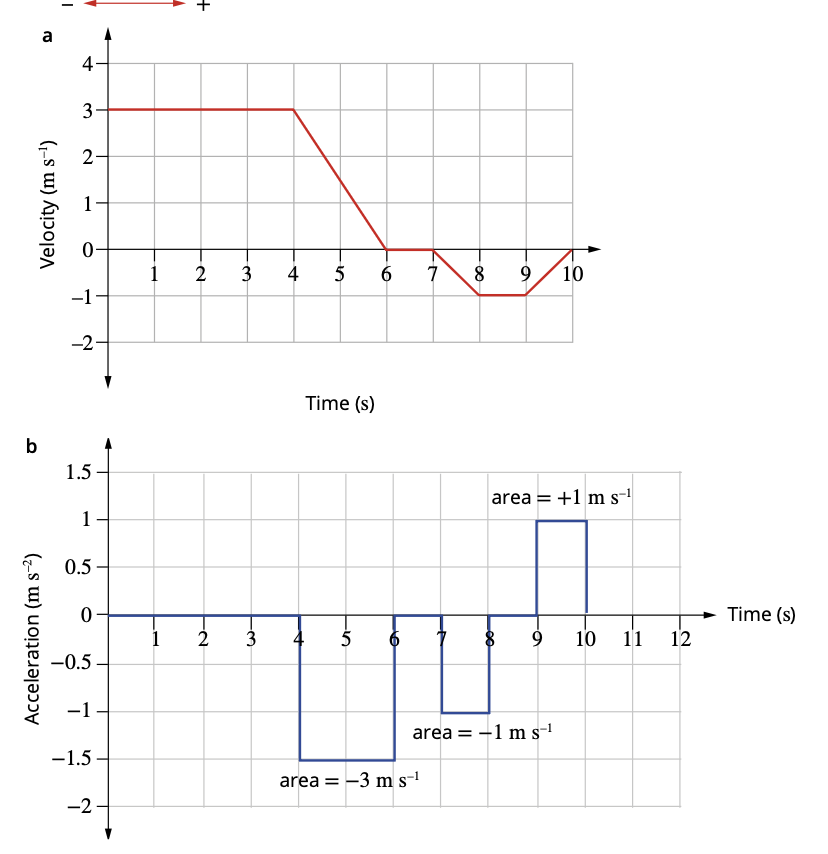
a) is v-t, and b) is a-t
From 4-6s the area shows a Δv of –3 m s−1
Indicates she has slowed down to 3 m s−1 during time
Initial speed is 3 m s−1 so she must be stationary after 6 seconds
7.4 Equations for uniform acceleration
Deriving the Equations
To logically obtain, deduce, or construct a mathematical formula from more basic principles, definitions, or known laws.
v = u + at
s = ½ (u + v)t
s = ut + 1/2 at2
s = vt - ½ at2
v2 = u2 + 2as
s is the displacement (in m)
u is the initial velocity (in m s−1)
v is the final velocity (in m s−1)
a is the acceleration (in m s−2)
t is the time taken (in s).
Solving Problems Using Equations
1) Draw diagram of situation
2) Write down information given (suvat)
3) select equation that matches data
4) Use appropriate number of significant figures
5) Include units and specify direction if vector.
7.5 Vertical Motion
Falling objects speed up because of gravity
Air resistance factor
Analysing Vertical Motion
Some objects effected by air resistance more than others
If air resistance can be ignores, all bodies in free fall near the earth’s surface will move with an equal downwards acceleration
Mass would not happen
Acceleration of a free falling body is constant, it is appropriate to use same equations for uniform acceleration