Chapter 6 - Phase Diagrams
Phases, components, and degrees of freedom
6.1 Definitions
- Phase - A state of matter that is uniform throughout, not only in chemical composition but also in physical state.
- Constituent of a system - A chemical species (an ion or a molecule) that is present.
- Variance of a system - The number of intensive variables that can be changed independently without disturbing the number of phases in equilibrium.
- Bivariant system - When in a single-component, single-phase system, the pressure and temperature may be changed independently without changing the number of phases.
6.2 The phase rule
- Phase rule - A general relation between the variance, the number of components, and the number of phases at equilibrium, for a system of any composition.
Experimental procedures
Techniques to detect a phase change
- Thermal analysis - It takes advantage of the effect of the enthalpy change during a first-order transition.
- Differential scanning calorimetry - Useful for solid-solid transitions, where simple visual inspection of the sample may be inadequate.
Two-component systems
6.3 Vapour pressure diagrams
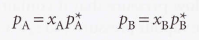

6.4 Temperature-composition diagrams
- Temperature-composition diagram - A phase diagram in which the boundaries show the composition of the phases that are in equilibrium at various temperatures.
6.5 Liquid-liquid phase diagrams
Critical solution temperatures
- Upper critical solution temperature - The highest temperature at which phase separation occurs.
- Lower critical solution temperature - Temperature in which the system mix in all proportions and above which they form two phases.
6.6 Liquid-solid phase diagrams
- Eutectics - The mixture with the lowest melting point.