Vascular Smooth Muscle (VSM) Contraction
Initiating Contraction
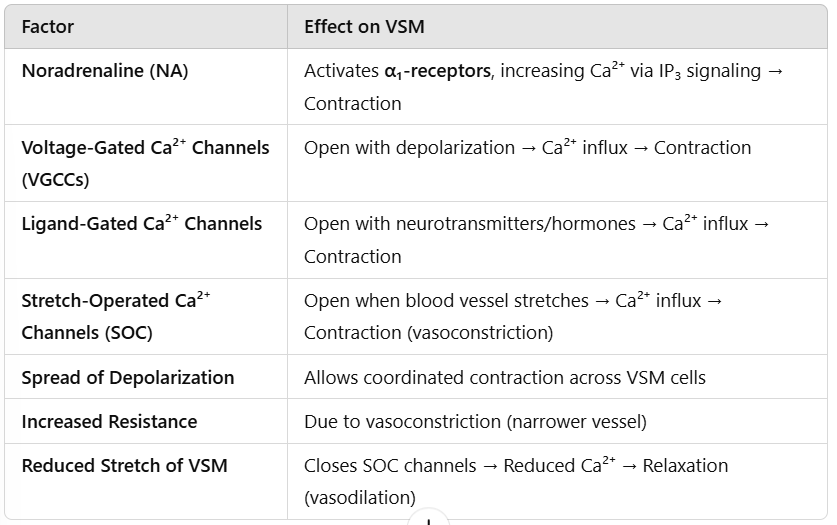
Noradrenaline (NA), released from a sympathetic nerve terminal, binds to a G coupled protein receptor on a VSM cell. This activates the phospholipase C (PLC) pathway, leading to the production of inositol triphosphate (IP₃). IP₃ binds to its receptors on the sarcoplasmic reticulum, causing Ca²⁺ release into the cytoplasm. The increased Ca²⁺ binds to calmodulin, activating myosin light chain kinase (MLCK), which phosphorylates myosin, leading to contraction.
Sustaining Contraction
To sustain contraction, extracellular Ca²⁺ entry is crucial. This occurs through different channels:
a) Voltage-Gated Ca²⁺ Channels (VGCCs)
Depolarization of the VSM membrane (due to nerve signals or local factors) opens L-type voltage-gated Ca²⁺ channels.
This allows Ca²⁺ influx, further increasing cytosolic Ca²⁺, reinforcing contraction.
b) Ligand-Gated Ca²⁺ Channels
These channels open in response to hormones or neurotransmitters (like noradrenaline, angiotensin II, or endothelin-1).
When activated, they allow Ca²⁺ entry, contributing to contraction independently of membrane potential.
c) Stretch-Operated Ca²⁺ Channels (SOC)
These mechanosensitive channels respond to mechanical stretching of the blood vessel wall.
When the vessel is stretched (e.g., due to increased blood pressure), SOC channels open, allowing Ca²⁺ influx, promoting contraction and increasing vascular resistance.
Spread of Depolarization
Depolarization in one VSM cell can spread to adjacent cells via gap junctions, ensuring coordinated contraction.
This is important in arterioles and resistance vessels, where synchronized contraction regulates blood flow.
Resistance
Contraction of VSM leads to vasoconstriction, reducing vessel diameter and increasing resistance (per Poiseuille’s Law).
Higher resistance reduces blood flow to downstream tissues.
Relaxation of VSM
When blood pressure decreases or vasodilatory signals dominate, reduced stretching of VSM occurs.
This causes stretch-operated Ca²⁺ channels to close, reducing Ca²⁺ influx.
Lower Ca²⁺ levels reduce MLCK activation, leading to dephosphorylation of myosin light chains by myosin phosphatase, resulting in relaxation (vasodilation).
Vasodilation reduces vascular resistance, allowing increased blood flow.
In this image:
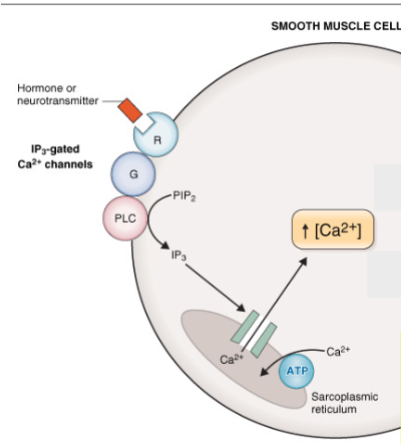
R = G protein coupled receptor
G = G protein
PLC = Phospholipase C
Hormone/neurotransmitter (e.g., noradrenaline) binds to the GPCR (R).
GPCR activates the Gq protein (G).
Gq protein activates phospholipase C (PLC).
PLC cleaves PIP₂ into IP₃ and DAG.
IP₃ binds to IP₃-gated Ca²⁺ channels on the sarcoplasmic reticulum.
Ca²⁺ is released into the cytoplasm, increasing intracellular Ca²⁺ levels and triggering contraction.
Sure! Let’s turn the process of vascular smooth muscle (VSM) contraction into a story. Imagine a bustling city of Smoothmusclia, where the blood vessels are roads, and the smooth muscle cells are traffic controllers. The goal? To regulate blood flow and keep the city running smoothly.
The Story of the Great Muscle Contraction in Smoothmusclia
One day, the Kingdom of Blood Pressure received a message from the Brain Empire. The message was carried by Noradrenaline the Messenger, a well-known courier who worked for the Sympathetic Nervous System Post Office.
Noradrenaline rushed to the gates of Smoothmusclia’s Vascular Stronghold, where he found a special door labeled R, the Royal Receptor of Contraction (GPCR). Since Noradrenaline was an official messenger, the guards allowed him to deliver his message by binding to the receptor.
Upon receiving the message, R the Receptor called upon his trusted Gq Protein Assistant (G). “Wake up, G! We need to prepare for battle. The Kingdom of Blood Pressure demands that we tighten our roads (vasoconstriction) to keep the blood flowing at the right speed.”
Gq sprang into action and ran to Phospholipase C (PLC), the Royal Engineer. “PLC! We need more energy and power! The King demands it!”
PLC, being a brilliant scientist, knew exactly what to do. He ran to the Power Storage Facility (the cell membrane) and found a special energy source called PIP₂ (Phosphatidylinositol 4,5-bisphosphate). He quickly split PIP₂ into two powerful weapons:
IP₃ (Inositol Triphosphate) – a special key to the Calcium Vault in the Sarcoplasmic Reticulum.
DAG (Diacylglycerol) – an energy source for Protein Kinase C (PKC), which helps sustain contraction.
The Calcium Flood Begins
IP₃, holding the key, rushed to the Mighty Calcium Vault (Sarcoplasmic Reticulum). He inserted the key into the IP₃-Gated Calcium Channels, and suddenly, a flood of Calcium (Ca²⁺) warriors was released into the battlefield (the cytoplasm).
These Ca²⁺ warriors had one mission: Activate Myosin Light Chain Kinase (MLCK), the Master General of Contraction. MLCK, upon receiving the signal, ordered the Myosin Soldiers to grab onto Actin Fibers and pull the muscle tight—leading to contraction of the smooth muscle and narrowing of the blood vessel (vasoconstriction).
The Role of Extra Reinforcements: Calcium Channels
Meanwhile, the Voltage-Gated Calcium Channels (VGCCs), stationed at the outer walls of the muscle cell, sensed that the battlefield needed more calcium warriors. Responding to membrane depolarization, they opened their gates, allowing even more Ca²⁺ warriors to flood in from the outside.
Additionally, if the blood vessels were being stretched (due to high blood pressure), the Stretch-Operated Calcium Channels also opened their gates, calling in even more calcium reinforcements to ensure contraction continued.
The Great Relaxation (When the Battle Ends)
As the blood pressure stabilized, the Stretch-Operated Calcium Channels began to close, reducing the number of calcium warriors on the battlefield. The Myosin Light Chain Phosphatase (MLCP), the Peacemaker, arrived and deactivated the Myosin Soldiers, leading to relaxation of the smooth muscle and widening of the blood vessel (vasodilation).
With the roads now open again, blood could flow more freely through the city, ensuring that oxygen and nutrients reached all the districts of Smoothmusclia.
Moral of the Story
The Kingdom of Blood Pressure depends on the careful balance between contraction and relaxation in the city of Smoothmusclia. When necessary, Noradrenaline and the Calcium Warriors tighten the roads, ensuring that blood flows efficiently. But when the danger passes, the Peacemaker (MLCP) and the Relaxation Forces ensure the city can rest.
Would you like me to add more details or make any part of the story clearer? 😊