biologie tw4 notities
mendel’s laws
character: heritable feature that varies among idv. (eg. flower colour)
trait: each variant for character (eg: purple, white)
self-fertilization: pollen grains from stamen (sperm)→carpel (egg)
cross-fertilization: one plant by pollen to a diff. plant
true-breeding: self-fertization→offspring identical to parent
hybrid: offspring of 2 diff. var., cross fert.→cross
P gen. →F1 gen.→F2 gen.
monohybrid cross: parent plants diff. one char. (PP, pp)
F2 gen. (F1 x F1)→, ¼ PP, ½ Pp, ¼ pp
Phenotypic ratio: 3 purple : 1 white
Genotypic ratio: 1 PP: 2 Pp : 1 pp
allele: alt. vers. of genes, account for var. in inhr. char. (eg: gene for flower color has two ver.)
homozygous: organism has two identical alleles for a gene→homozygote
heterozegous: ‘‘ different alleles for that gene→heterozygote
dominant allele: allele that determines appearance
recessive allele: no noticeable effect on the apperance
law of segregation: sperm/egg carries one allele for each inherited char. bc allele pairs segregate during production of gametes
P plants gametes: All P & all p; F1 gametes: ½ P & ½ p, F2 gametes: punnett square
loci: specific locations of genes
dominant phen.→homozyg. genot.(AA)/heterozyg. genot. (Aa)
rec. phen.→homozyg. genot. (aa)
pedigree = family tree
testcross: dom. phen. (RR/Rr) × rec. phen rr:
if egg RR: all offspring Rr
if egg Rr, F1 ½ rr
dihybrid cross: 2 genes
homologous chromosones: each gene 2 diff alleles (pprr, ppRr…)
homozygous:
pprr: 2 rec.
PPRR: 2 dom.
heterozygous:
PrRr
dependent assortment: if genes of two characters inherited tgt
P (RRYY, rryy) gametes: RY × ry
F1 gen.: RrYy gametes: ½ RY ½ ry
F2 gen.: phen. ratio 3 : 1
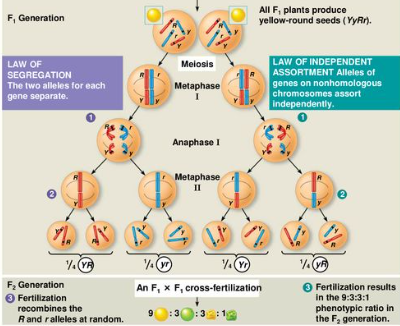
law of independent assortment:
P gen. (RRYY × rryy) gametes: RY × ry
F1 gen. (RrYy) gametes: ¼ RY, ¼ rY, ¼ Ry, ¼ ry
2 char. segregate independently→4 gamete genot.
F2 gen. phen. ratio 9 : 3 : 3: 1
each pair of alleles segregates independently of other pairs of alleles during gamete formation
rule of multiplication:
product of probabilities of each independent event
F1 (Bb genot.)→egg/sperm: ½ B allele, ½ b allele
prob. F2 bb genot.: ½ (b egg) × ½ (b sperm) = ¼
rule of addition:
prob. of event that can occur in >1 ways→sum of seperate prob.
prob. F2 heterozygous: 2 ways that F1 gametes produce Bb
B from egg + b from sperm or vice versa (¼ prob. each)
thus: ¼ × ¼ = ½
3 diff genes (PYR) on diff. chromosones (indep. assort.), 2 heterozyg. crossed (PpYyRr)
prob. offs. rec. monozyg. all genes:
pp, yy, rr: ¼ each→(¼)³ = 1/64
reccesive disorders:
born to heterozygous carrier parents, phen. normal
inbreeding: more likely offs. homozygous for rec. traits
dominant disorders:
lethal dom. disorders < lethal rec. disorders
variations on Mendel’s laws
complete dominance: dom. allele same phen. effect→offs. looks like one of the two parental varieties
heterozygote same phen. as hetero dom. individuals
incomplete dominance: phen. of F1 hybrid is in between 2 parental varities
F1 (Rr) phen. of P (RR × rr) (R = red, r = white) is pink
pleiotropy: single gene affects many phen. traits, many genes→single character
epistasis: expression of 1 gene modigied by the expression of ≥1 genes
cc genot.→white rats, brown + black phen. only when C
genes ≥ 2 alleles:
ABO→3 alleles of single gene
various combinations of IA, IB, and i→4 blood groups
6 possible genot., IA + IB dominant to i allele
IA + IB are codominant: both alleles are expressed in heterozyg. (AB blood)
codominance ≠ incomplete dominance
chromosonal basis of inheritance
chromosome theory of inheritance: genes occupy specific loci on chromosones→chromosones undergo segregation and indep. assort. during meiosis→behaviour of chromosomes during meiosis + fertilization that accounts for inheritance patterns
linked genes: do not follow law of indep. assort.
genes for the two characteristics are on the same chromosone
meiosis in the heterozyg. (PpLl)→mostly 2 genot. of gametes (PL + pl)
DNA crossover→more genetic variation
Recombination frequency:
GgLl × ggll
further genes→↑ chance of combine→ ↑ recom. freq.
Recom. freq. formula: rf = no. of recombinants / total no. of offsp.
sex chromosomes and sex-linked genes
male karyotype (46, XY), female karyotype (46, XX)
gamete: 1 sex chromosome (X or Y)
egg: X, sperm: X or Y
on sex chromosomes, the rec. genes goes on the X chromosone are X-chromo
darwin’s theory of evolution
artificial selection: modifying species by selecting and breeding idv that have desired traits
natural selection:
members of pop. vary in traits, most traits inherited from parent to offspring + all species are capable of producing more offs. than envir. can support
leads to: idv whose inherited traits give them ↑ probability surviving and reproducing leave tend to leave more offs. than other idv + unequal production of offs. will cause favourable traits to accumulate in pop. over generations
occurs through interactions between idv organisms and envir., idv do not evolve
can amplify/diminish only heritable traits (acquired traits cannot be passed onto offs.)
does not lead to perfectly adapted organisms
fossil record: sequence in which fossils appear within layers of sedimentary rocks
strata: layers of rock, younger on top of older
oldest: prokaryotes
fish → amphibians →
biogeography: geographic distribution of species
comparative anatomy: anatomical similarities between many species → common descent
homology: similarity in characteristics that result from common ancestry (divergent evolution)
anatomical homology
embryological e__?
vestigial organs: structures that have little importance, but are remnants of structures that served functions in ancestors (eg appendix)
molecular biology: > sequence diff. between species, > distant last common ancestor; homologies help identify common ancestry
the evolution of populations (13.7-13.10)
pop.: group of idv of same species living same place at same time
gene pool: total collection of genes in a pop. over time, 2-3 alleles per gene in gene pool usually
microevolution: when relative freq. of alleles in pop. change over generations
genetic variation: genetic component of variation is relevant to natural selection,
Hardy-Weinberg equilibrium:
describes gene pool of non-evolving pop.
freq. of alleles and genot. constant unless acted upon by agents other than mendelian segregation
genot. freq.: p² + 2pq + q²
p²: frac. homozyg. dom. idv (RR)
2pq: frac. heterozyg. idv (Rr)
q²: frac. homozyg. rec. idv (rr)
allele freq: p + q = 1
p: # dom allele (R)
q: # rec allele (r)
assumption: sexual reproduction does not lead to evolution, no. of allele and genot. doesn’t change
conditions: very large pop, no gene flow between diff. pop., no mutations, only random mating (no sexual selection of certain characteristics), no natural selection → no pop. irl
Natural selection
selection for genetic traits that result in survival of a species and ↑ reproduction
envir. determines which characteristics are advantageous, so over time pop. adapt to a changing env.
Anthropocene
early earth and the origin of life
conditions on early Earth:
impact of meterorites + compaction by gravity→immense heat
molten mass→layers of diff. densities→least dense on surface
atmopshere: thick with water vapour
stromatolites: layered rocks built up by ancient photosynthetic prokaryotes
prokaryortes: 3.5 bil years ago, simpler life form 3.9 bil years ago
how simple cells on early earth came to be:
1. the abiotic synthesis of small organic molecules such as amino acids, nucleotides, nitrogenous bases
2. the joining of these small molecules (monomers) into polymers, includ. proteins and nucleic acids
3. the origin of self-replicating molecules that eventually made inheritance possible
4. the packaging of these molecules into “protocells”, droplets with membranes maintained in internal chemistry
abiotic synthesis of polymers: by dropping dilute solutions of amino acids or RNA (ribonucleic acid) monomers onto hot sand, clay, rock
heat vaporizes the water and concentrates monomers→some may spontaneously bond together in chains
waves might have splashed organic monomers onto lava/hot rocks then rinsed polymers back onto sea
formation of protocells:
vesicles (small membrane-enclosed sacs) form when lipids are mzied with water
when EE clay is added, such vesicles form at a faster rate
organic molecules become concentrated on the surface of this clay→interact more easily
these abiotically created vesicles absorb clay particles to which RNA and other molec. are attached→they can grow and divide
self-replicating RNA:
short RNA molecules can assemble spontaeneously from nucelotide mononers
when RNA is added to an RNA monomer solution→new RNA molec. complementary to parts of starting RNA sometimes assemble
1. RNA monomers adhere to clay particles and become concentrated
2. some monomers spontaeneously join→first small “genes”
3. an RNA chain complementary to one of these genes assembles
on EE, some protocells contained self-replicating RNA molecules→natural selection
mutations, errors in copying RNA “genes”