Plant reproduction:
Asexual and sexual reproduction:
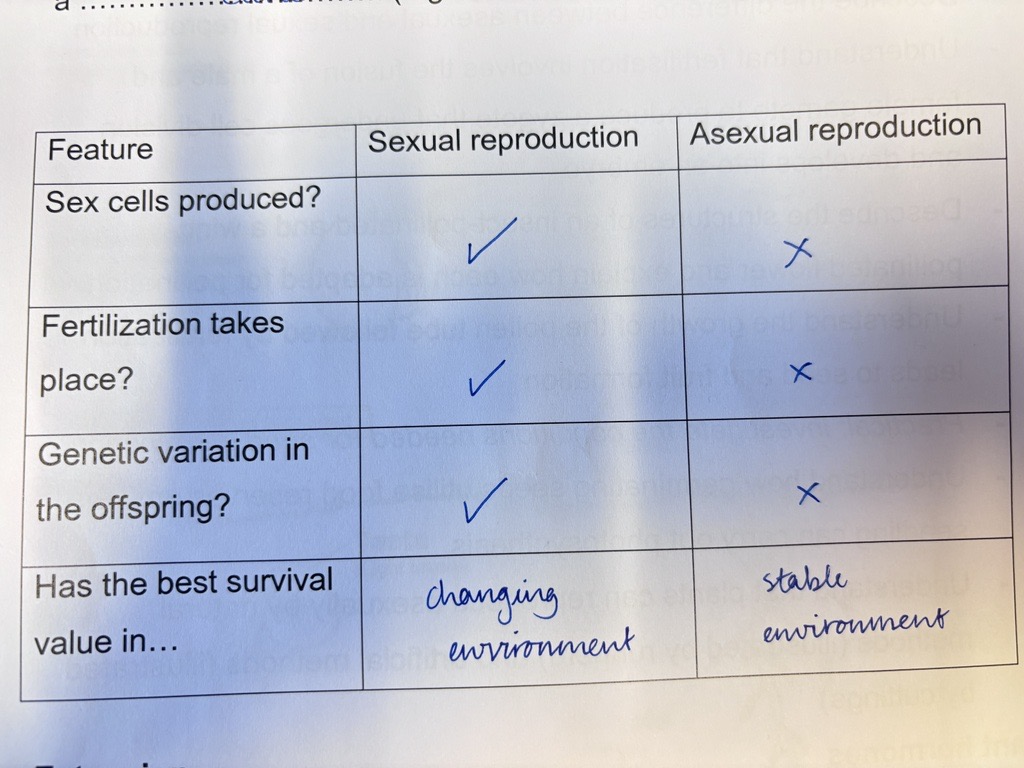
There are different ways organism can reproduce - sexual (with gametes) and asexual (no gametes).
Sexual reproduction involves gametes (special cells) and can involve one or two parents.
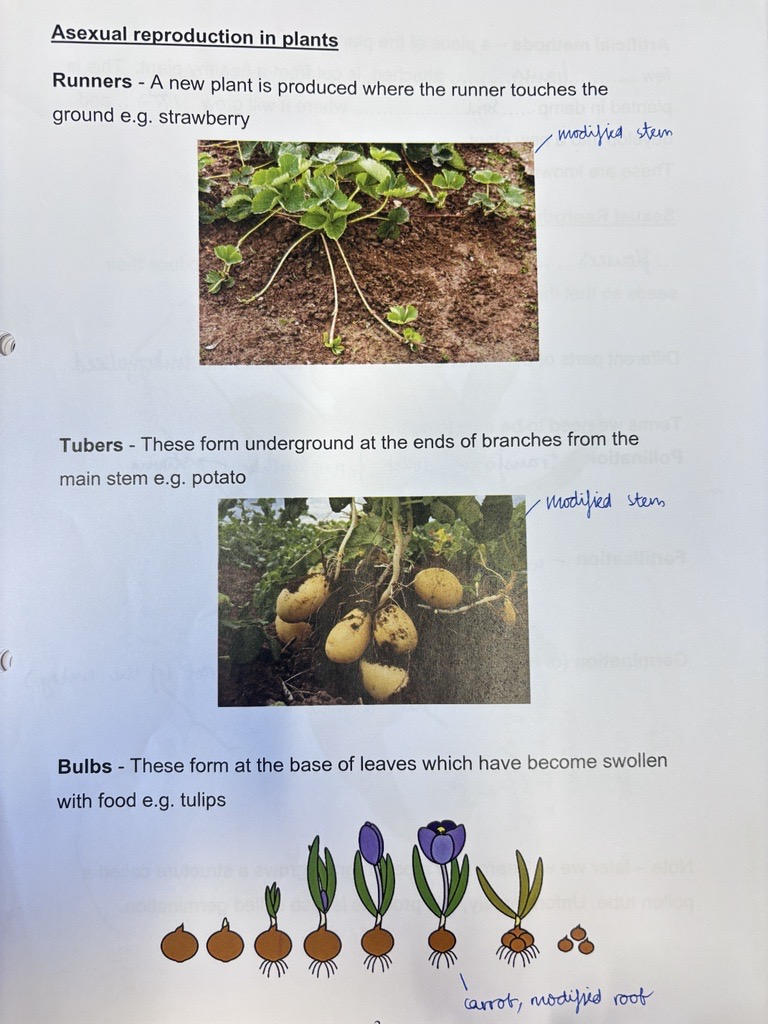
Asexual reproduction involves one parent, producing a clone (genetically identical offspring).
Artificial Methods
Cuttings: A piece of a plant's stem with leaves is cut from a healthy plant, then planted in damp soil where it grows roots and develops into a new plant.
Sexual Reproduction in Flowering Plants
Flowers are the organs used by plants to produce seeds for reproduction.
Different parts of the flower have specific roles in making the embryo/seed.
Key Terms:
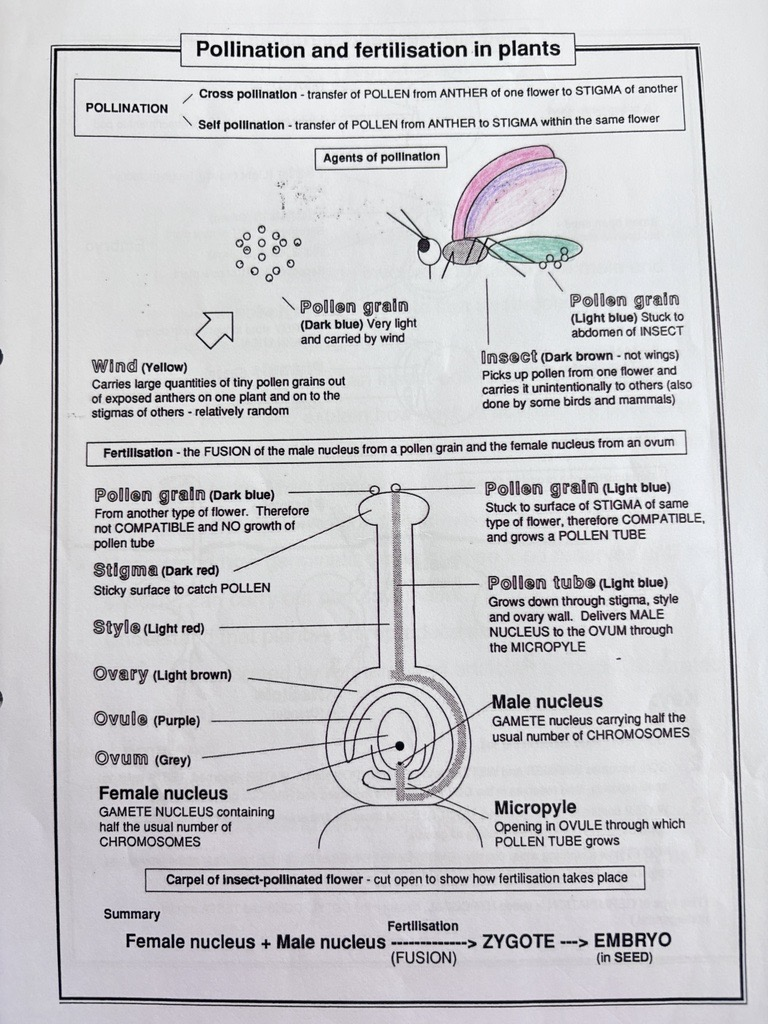
Pollination: Transfer of pollen from the anther to the stigma.
Fertilisation: The fusion of the gametes' nuclei.
Germination: When the shoot and root of the embryo start to grow.
Structures of a flower:
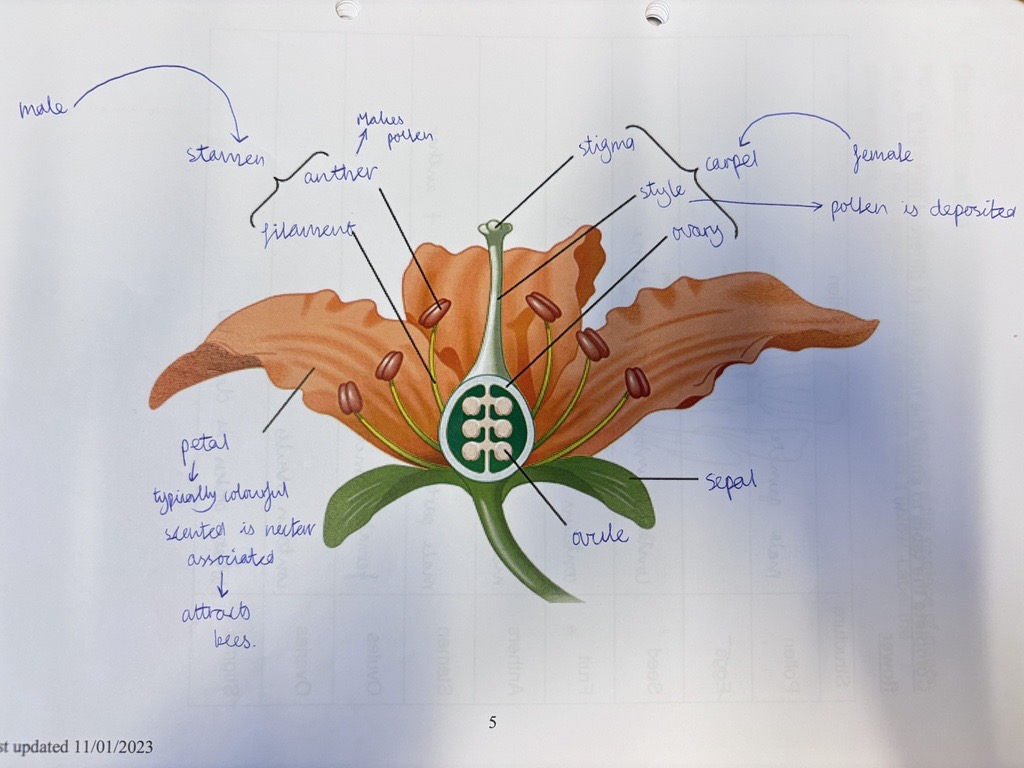
Pollen: male gamete
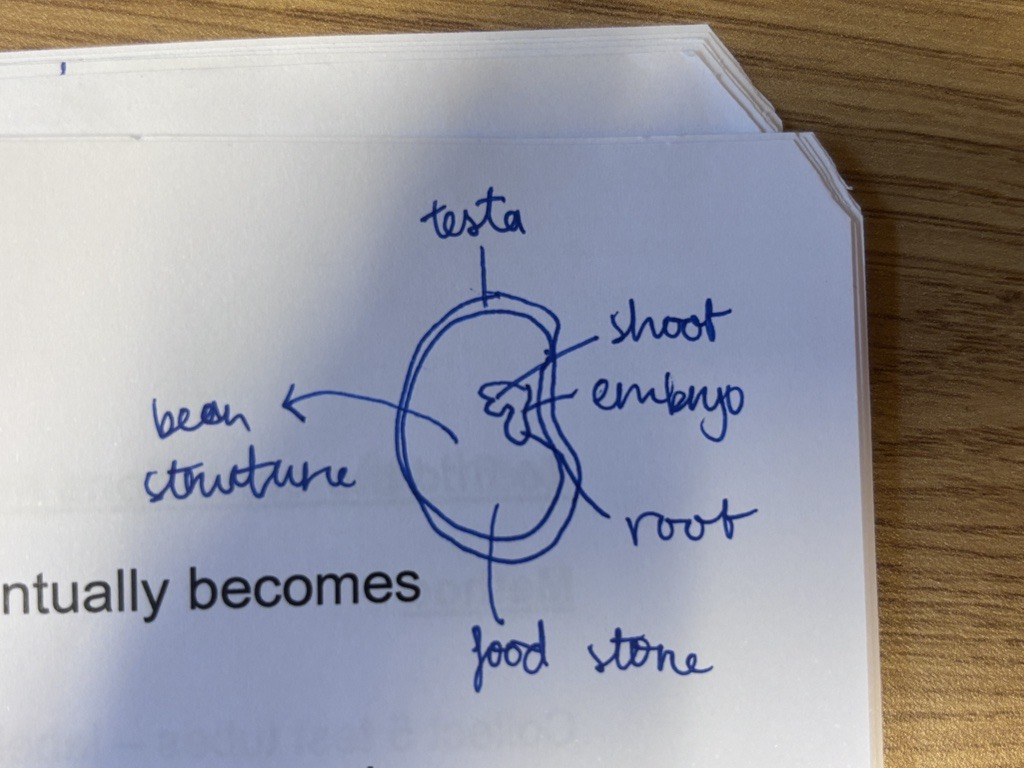
Seed: contains embryo as well as the food store
Fruit: contains seeds and develops from ovary
Anthers: Male organ that makes pollen
Stamen: Male part of the flower - filament + anther
Ovules: Female gametes (eggs)
Ovaries: contains ovules
Stigma: where the pollen is deposited
Self pollination: the transfer of pollen from the anther to stigma of the same flower or plant
Cross pollination: The transfer of pollen from the anther to stigma of a different flower or plants
What attracts insects to flowers?
Large coloured petals, scent, sweet nectar.
What is the advantage of the plant ensuring cross pollination by maturing its male and female parts at different times?
It promotes genetic variation.
Wind/insect pollinated flowers:
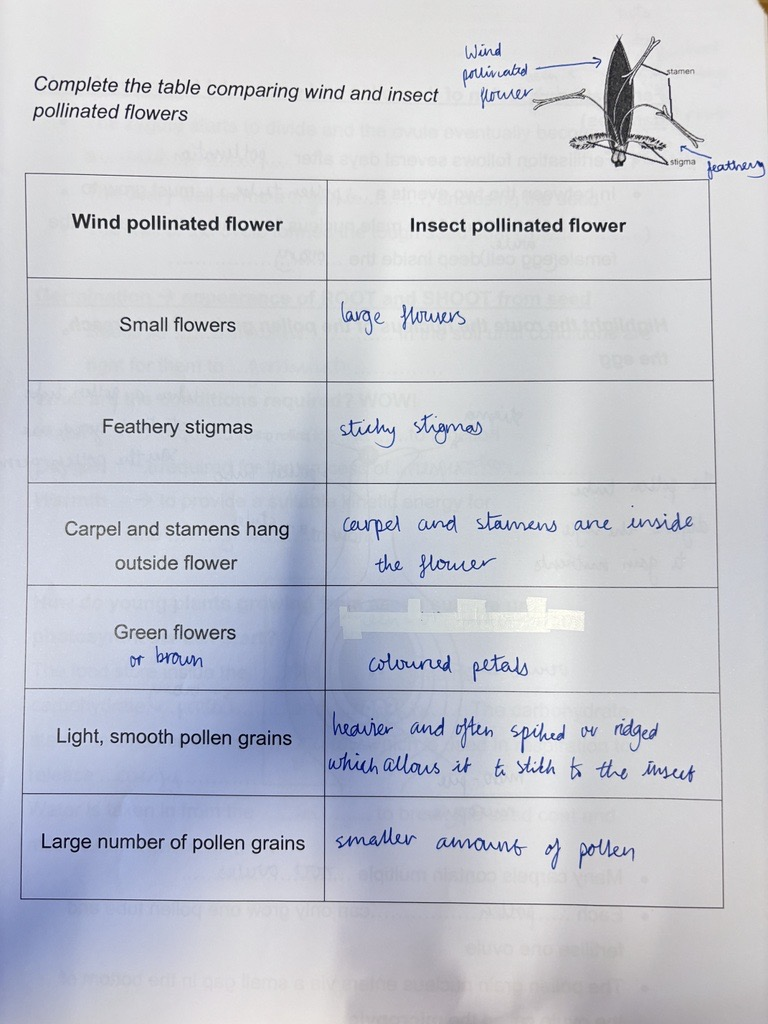
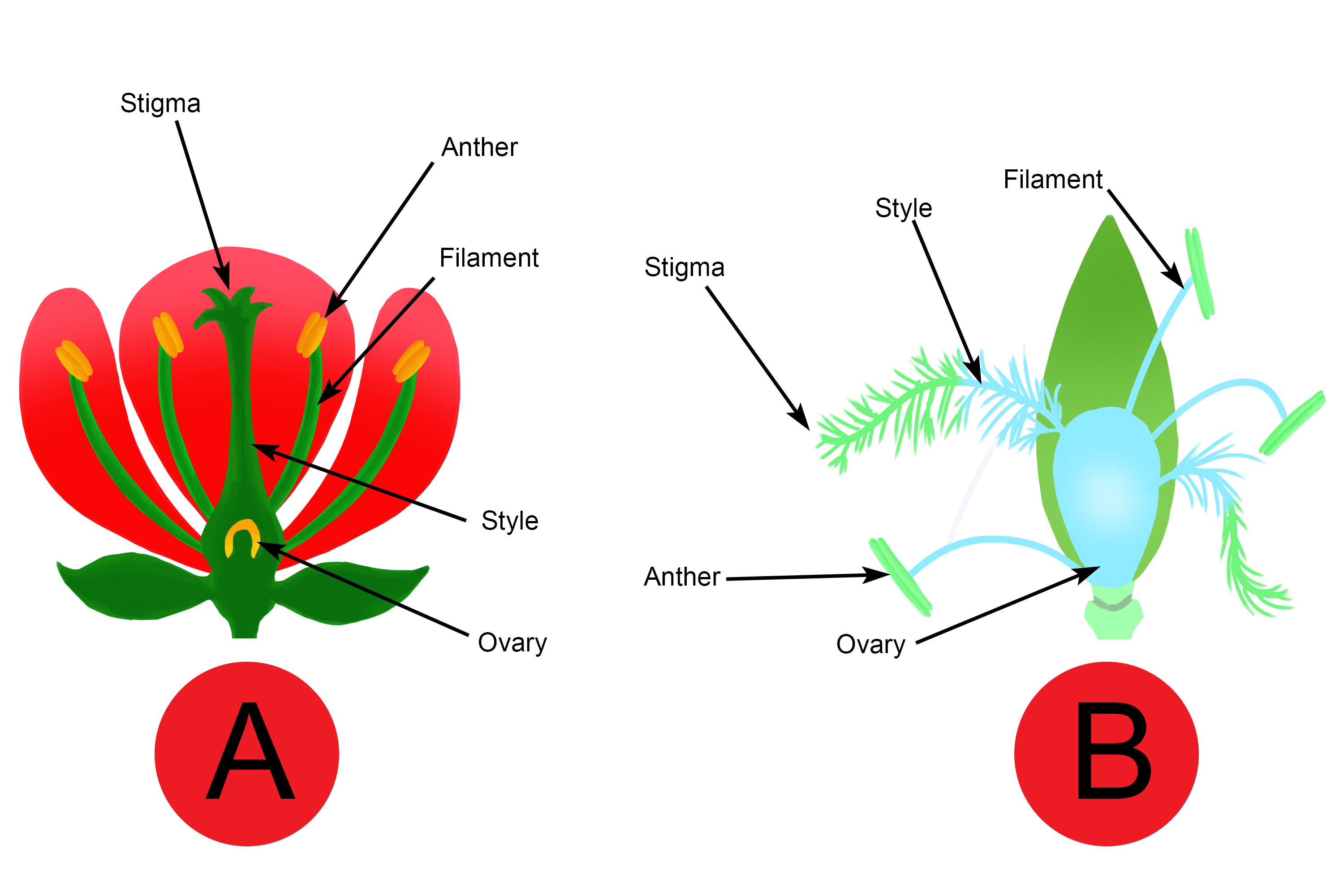
Differences in characteristics:
A=insect pollinated
B=wind pollinated
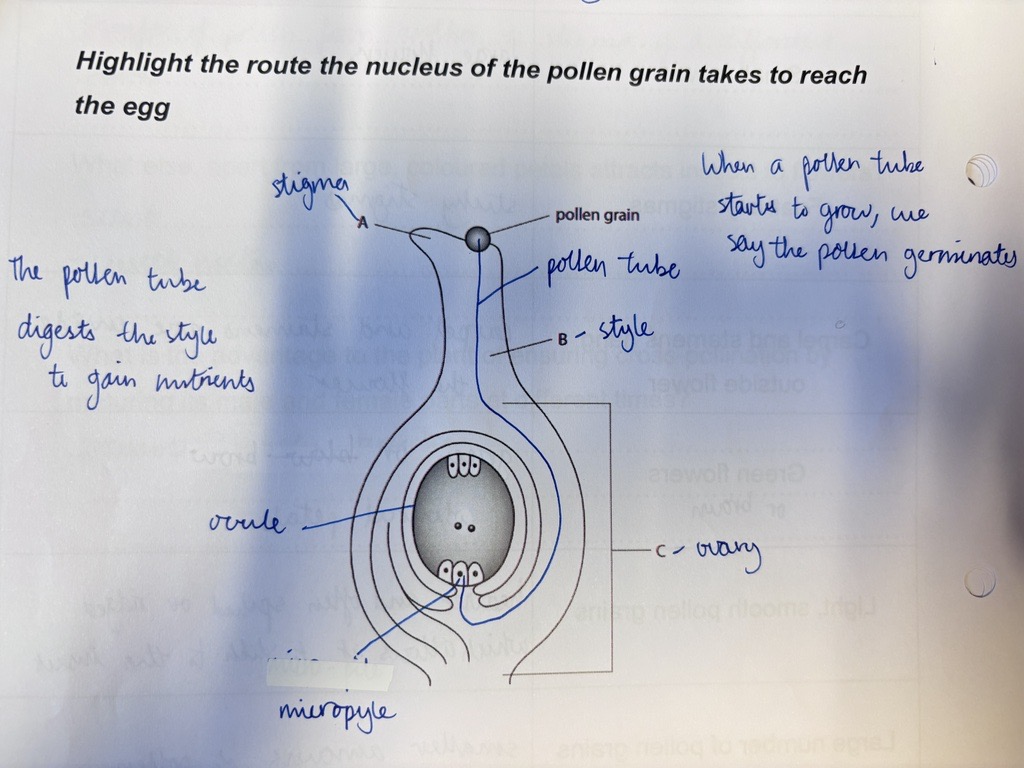
Fertilisation
Fertilisation occurs several days after pollination.
In the meantime, a pollen tube grows to transport the male nucleus from the pollen grain to the female egg cell (ovule) inside the ovary.
Many carpels contain multiple ovules.
Each pollen grain grows only one pollen tube and fertilises one ovule.
The pollen grain nucleus enters the ovule through a small gap at the bottom called the micropyle.
Fertilisation occurs when the male nucleus travels along the pollen tube to the ovule, where it fuses with the female nucleus.
Seed Formation:
The zygote divides, and the ovule eventually becomes a seed.
The ovary wall forms a fruit, enclosing the seed.
The ovule wall forms the tough seed coat (the testa).
Germination:
Germination is when the root and shoot appear from the seed.
Seeds remain dormant in the soil until conditions are right.
Conditions Required for Germination:
Water: Needed for enzymes to function.
Oxygen: Required for respiration.
Warmth: Provides kinetic energy for enzymes.
How Young Plants Survive Until Photosynthesis Starts:
The food store in the seed (carbohydrates, proteins, and fats) is used.
Starch is digested into glucose, which is used in respiration to release energy.
Water from the soil helps break the seed coat and activate enzymes.
Image of a seed planted in the soil:
Conditions necessary for seed germination:
To find the conditions necessary for the germination of cress seeds – WOW
Method
Collect 5 test tubes – label them with your initials.
Set up a cotton wool pad with around 15 cress seeds in each tube.
Place them in the following conditions:
A. light, warmth, moisture and oxygen
B. dark, cold, moisture and oxygen
C. dark, warmth, moisture and oxygen
D. light, warmth, moisture and no oxygen
E. light, warmth, dry and oxygenYou are provided with cotton wool, oil, water, tin foil, and a fridge.
Leave the test tubes for 7 days and then examine them to see if the seeds have germinated or not.
Results table
Test Tube | Did they have WOW? | Why did they not germinate? |
|---|---|---|
A | Yes | – |
B | No (missing warmth) | No stable kinetic energy for enzymes to work |
C | Yes | – |
D | No (missing oxygen) | Oxygen is required for respiration |
E | No (missing water) | Water is required for enzymes to function |
The dispersal of seeds:
Each plant species packages its seeds in a characteristic type of fruit.
The fruit’s form depends on how it helps carry the seeds far from the parent plant to find space for growth.
The seed contains the embryo plant for the next generation.
The seed remains dormant in the ground until conditions are right, typically in the spring, for the embryo to begin growing.
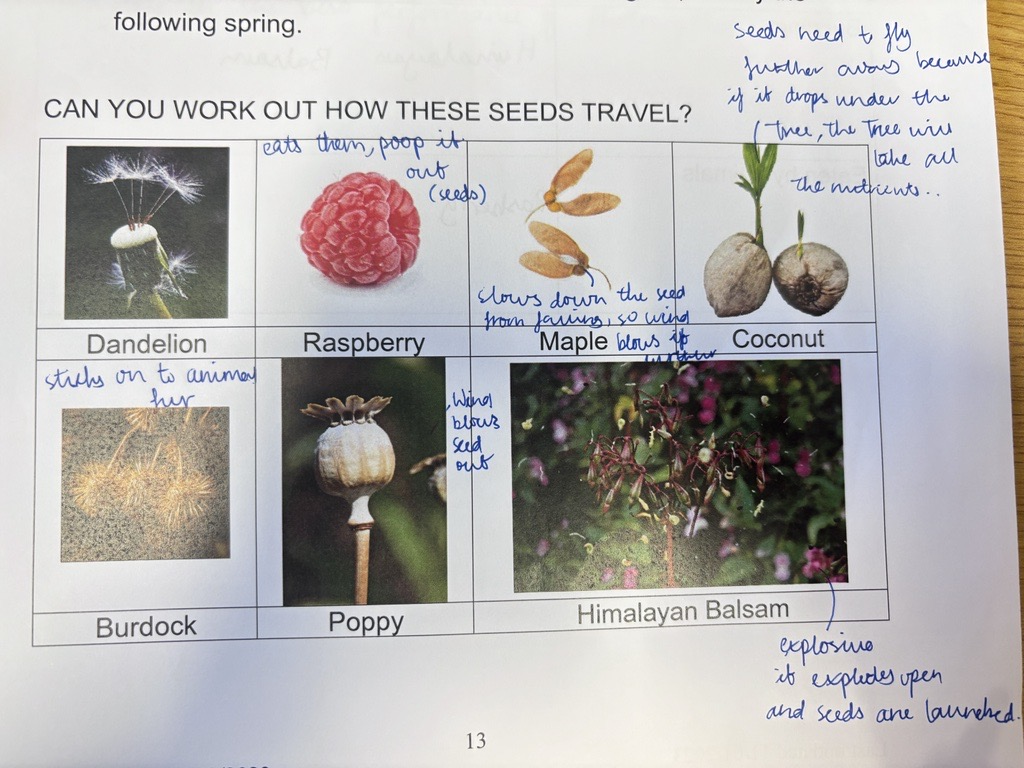
How seeds travel:
Wind: Poppy, dandelion and maple
Animals: Burdick
Water: Coconut
Bursting: Himalayan Balsam
Eaten by animals: Raspberry
Plant hormones:
Plant Hormones and Responses
Plant hormones control plant activities and are chemicals that diffuse from where they are made to where they are needed.
Plants can respond to both light and gravity.
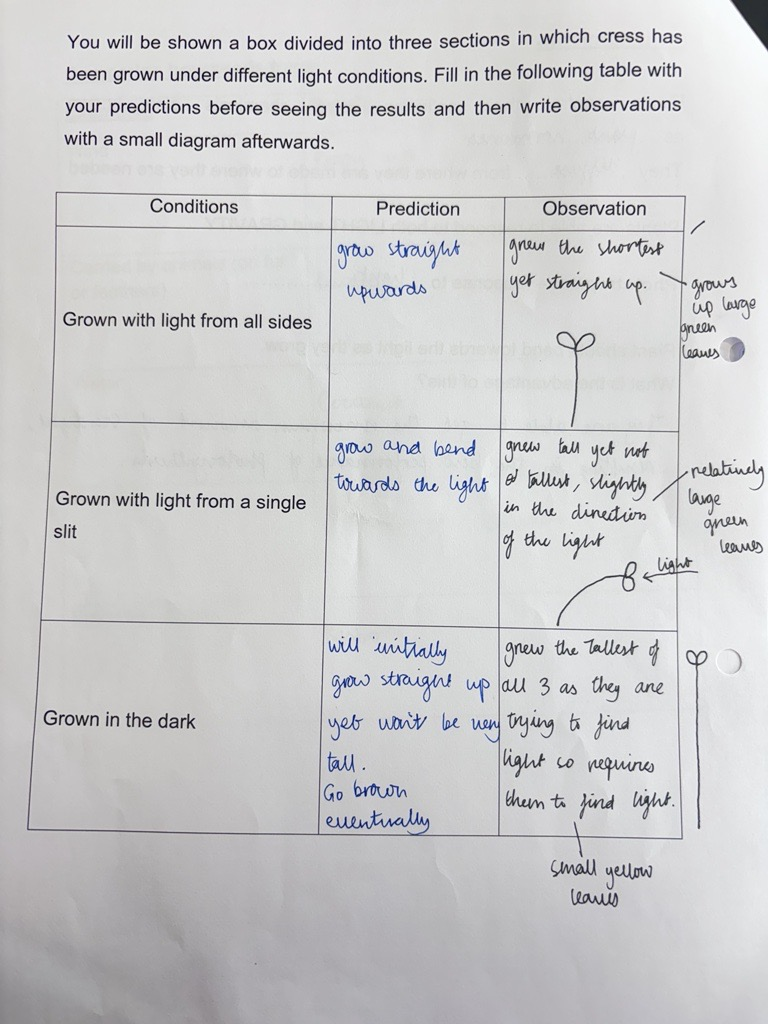
Phototropism (Response to Light)
Phototropism is the plant's response to light.
Plant shoots bend towards the light as they grow.
Advantage of Phototropism
By bending towards light, plants maximize sunlight exposure, improving photosynthesis and overall growth.
Geotropism (Response to Gravity):
Geotropism is the plant's response to gravity.
A shoot grows away from gravity, and a root grows towards it.
This behaviour helps the roots burrow deeper into the soil, making the plant stronger against external forces like wind and rain.
It also allows roots to access better nutrients and water from the soil.
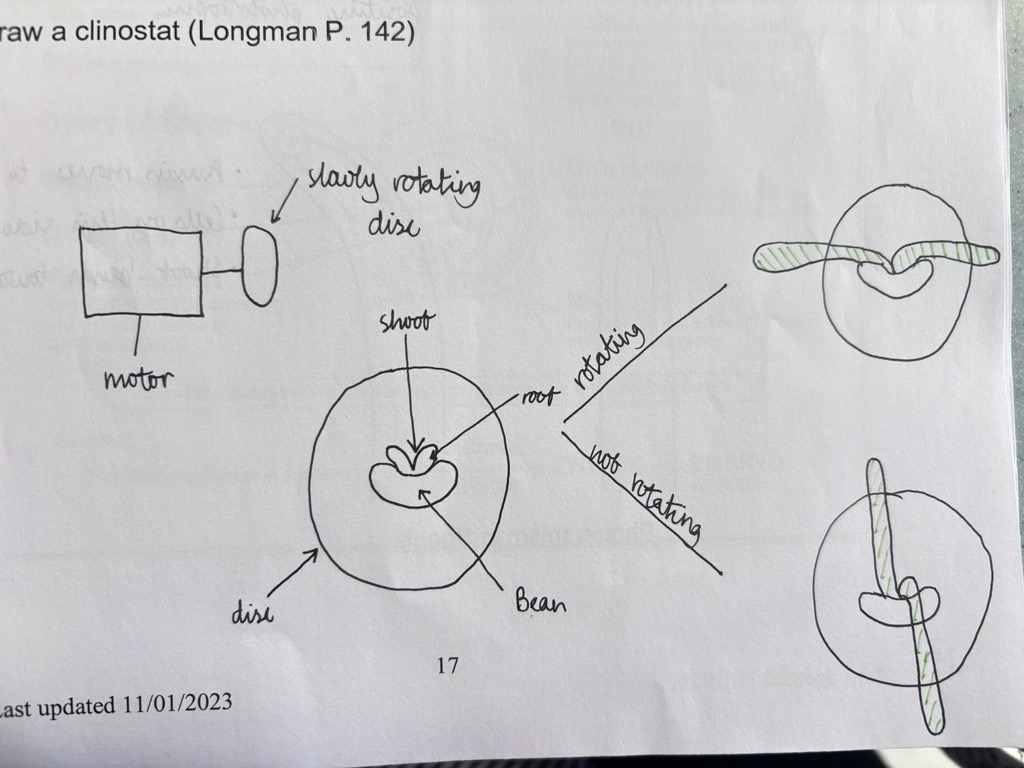
How does a clinostat show that gravity is needed for successful plant growth:
A Clinostat is used to show that gravity is essential for successful growth.
When the Clinostat rotates, the plant does not know which direction is down and grows straight.
When not rotating, the shoot grows up and the root grows down.
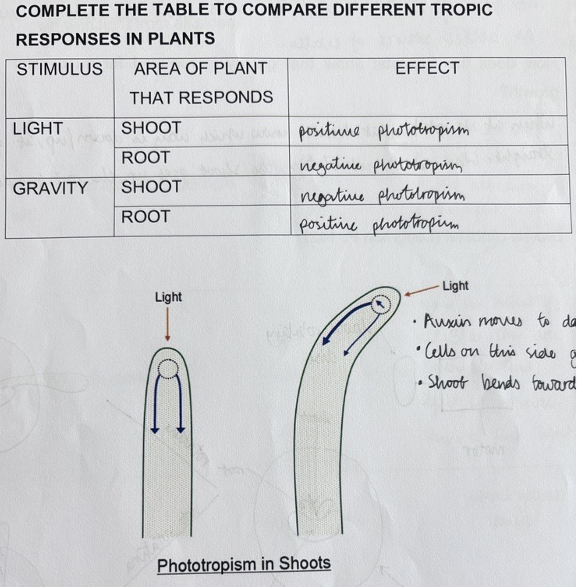
Tropism – Plant growth in response to a stimulus.
Positive tropism: Growth towards a stimulus.
Negative tropism: Growth away from a stimulus.
Auxin – A Key Plant Hormone
Auxin stimulates plant growth, especially in response to light.
It is produced in the tips of shoots and travels downwards.
When light hits one side of the shoot, auxin accumulates on the shaded side.
This causes faster growth on the dark side, making the shoot bend towards the light.
Pollination graph: