Exam Tips Questions + look back at to study topics
FROM ANA’S QUIZLET:
What passes through the optic canal?
CNV2 passes through the inferior orbital fissure
Do you know what is happening to the valves during systole and diastole?
Diastole the AV valves are open and relaxed, allowing for flowing of blood. this is between the dub and second lub. Systole the AV valves are closed and causing tension. The semilunar are opposite.
Do you know the muscles of mastication and their actions?
Temporalis: Closing jaw/elevation
Masseter: closing jaw/elevation + retraction
Medial Pterygoid: closing jaw/elevation + protrusion
contralateral
Lateral Pterygoid: opening jaw/depression + protrusion
medial and lateral also do side to side grinding motion
Do you know the borders of the anterior and posterior triangles and the struxcturea found in them?
Anterior: SCM, Mandible, medial boarder
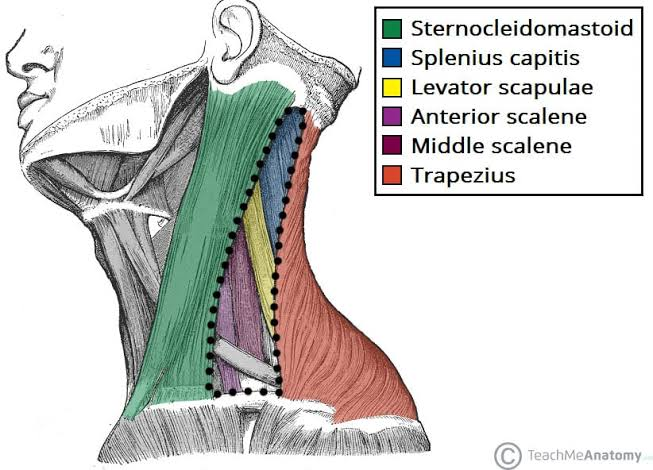
Posterior: SCM, trapezius, clavicle
contains the subclavian artery and veins, and the brachial plexus.
Can you identify the salivatory glands and their main function?
parotid
submandibular
sublingual
main functions to moisturize food and mouth and form saliva, helps start digest, form a bolus.

Do you know the lacrimal apparatus and its main function?
tear production
lacrimal gland - duct - canal - lake - lacrimal sac - nasolacrimal sac
Do you know the conducting system of the heart: know the path?
SA Node - AV Node - Bundle of HIS - Bundle Branches down both sides - perkinje fibers
Do you know the joints of the back and can you identify them?
Do you know the dermatomes on the anterior UE?
Know muscles of neck: Sternocleidomastoid and Trapezius (ID)?
Do you know the spinal nerve and how it branches off?
spinal nerve branches into two branches: the posterior and aneterior rami
posterior supplies joints of the vertebrae, deep muscles of the back and the underlying skin
anterior supplies anterior and lateral regions of the trunk and upper extremities and lower etremeties.
there are anterior and posterior roots that meet at the intervertebral foramen to create the spinal nerve
there are nerve rootlets that come to form nerve roots and they can be motor or sensory.
Do you know the movement of the thorax during forced inspiration and during forced expiration?
forced inspiration: elevation
forced expiration: depression
Do you know the different stages of swallowing?
bolus formed and pushed against the soft palate
soft palate moves up to close off the nasopharynx, the suprahyoid muscles elevate the larynx and the epiglottis moves down to seal off the airway. the pharynx opens to receive the bolus
there are peristalsis contractions to move the bolus down the esophogus