Biology
Classification
Procaryotes/Eucaryotes
| }}Procaryotes}} | }}Eucaryotes}} | |
|---|---|---|
| %%d%%na | naked | bound to protein |
| circular | linear | |
| ussually no introns | usually has introns | |
| %%o%%rganelles | no nucleus | has nucleus |
| no membrane bound | membrane bound | |
| 70s ribosomes | 80s ribosomes | |
| %%r%%eproduction | binary fision | mitosis and meiosis |
| single chromosome | paired chromosomes | |
| %%a%%verage size | smaller (1-5um) | larger (10-100um)hierarchy of taxa |
Hierarchy of taxa
- a system of classification in which similar species are put in progressively larger and larger groups
%%taxon%% - any unit of classification (kingdom, class)
| {{{{ | {{katy pepsi{{ |
|---|---|
| domain | dear |
| kingdom | katy |
| phylum | perry |
| class | come |
| order | over |
| family | for |
| genus | grape |
| species | soda |
- }}Simmilarities in species}}
- interbreeding (produces fertile offspring)
- adaptation (same lifestyle)
- {{Domains{{
- Archea - No nucleus, drastyczne confitions
- Bacteria - No nucleus, can get rid of it
- Eukarya - membranę bound nucleus
Animals/Plants
| Property | [[==Plants==[[ | [[==Animals==[[ |
|---|---|---|
| Nucleus | Yes | Yes |
| Cell organization | Multicellular | Multicellular |
| Cell wall | Yes (cellulose) | No |
| Nutritional class | Autotrophic | Heterotrophic |
| Mode of nutrition | Absorption | Ingection |
| Example | Mosses, Ferns, Flowers |
Plants
| mosses | no vascularity |
|---|---|
| ferns | no seeds, vascularity |
| flowering plants | seeds, flowers |
| plants with cones | seeds, cones |
Vertebrates (kręgowce)
| mammals | fur, internal fertilization |
|---|---|
| fish | gills, external fertilization |
| birds | feathers |
| reptiles | internal fertilization |
| amphibians | no gills, external fertilization, antiban |
Types of classification
==Artificial classification==
analogous method
based on external apearence
many possible mistakes
using single feature (like the place the organisms live in)
no predictive value
==Natural classificstion==
analizing dna
analazing clades
many features
predicts a pattern,
phylogenetic classification (best one)
Traits
- - traits that develop through evolution, are studied using , are based on real relationships and are derived from
- %%Analogous traits%% - traits that are studied using %%artificial systems%% (room for mistakes), are based on superficial ways of simmilarity (like looking simmilarly), %%are not related%%.
Naming
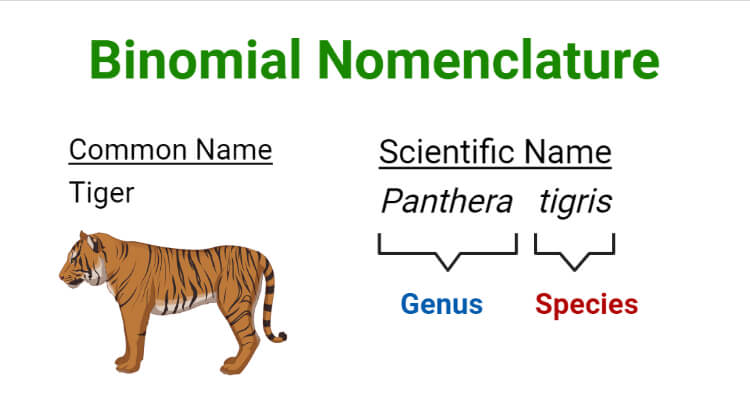
1st part → genus
2nd part → species
1st part same = closely related
1st part not same = not related
+ globally recognized scheme
+ easier to sort and group organizms
+ comparison based on well recognized characteristics
+ shows the level of relation of organizm
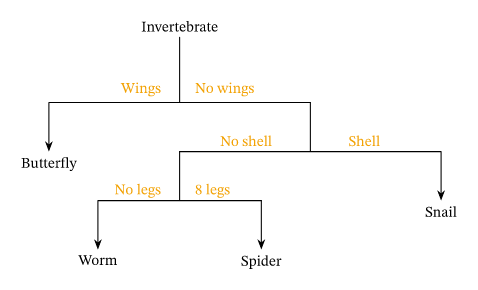
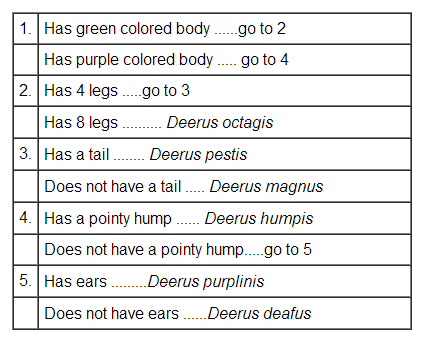
Dichotomous key
- Graphic
- List
Clades
[[==Cladogram== - graphical representation of clades[[
2 feutures hemofilię in clssifucatipn
- physical strukturęs (number of legs)
- Biological processes (reproduxtion metgods)
D - eukaryia
K - animalia
P - chordata
C - mammalia
O - carnivora
F - canidas
G - canis
S - lupus
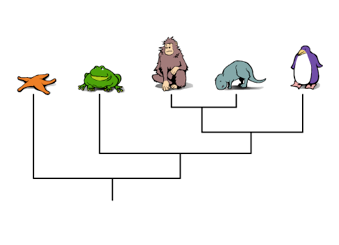
Its only clade when it shows the ancestor and all of its offspring