Social Perception, Cognition, Attribution, and Judgements - Week 4 (copy)
We want to explain events and behaviour, and we have beliefs about their causes:
What were the causes for COVID pandemic?
Why didn’t they come to the lecture today?
Why did they cheat?
Why did she not say ‘sorry’ for bumping into him?
Why has she forgotten my birthday?
Social beleifs can influence:
Our perception of events
Our memory/recall of events
Our explanation of events and how we attribute
Perception of events
Priming
Priming reflects the influences of attended-to or even unattended-to stimuli on perception and recall
Bargh, Chen and Burrows (1996): students who completed sentences with words associated with old age (“old”, “retired”, “wise”) walked slower from test room to elevator than students not priemd with ageing related words.
Holland, Hendricks and Aarts (2005): students exposed to scent of all-purpose cleaner are faster to identify cleaning rrelated words/recall cleaning activities.
In both cases participants were unaware of priming
Preconceptions
Social information is often ambiguous/multiple interpretations are possible, therefore preconceptions of the observer influence perception and interpretation.
A friend responding with short texts or taking a long time to reply may be interpreted as being distant to reply may be interpreted as being distant or disinterested if one is already feeling vulnerable about the relationship. Others might attribute it to the friend being busy or preferring to communicate in person.
A person’s choice of a profile picture on professional networks like LinkedIn could be interpreted in various ways. A casual photo might seem unprofessional to some, while others mgith see it as a refreshing display of authenticity.
Vallone, Ross and Lepper (1985)
Pro-Israeli and pro-Palestinian students saw same 6 television news segments on killings in refugees camos.
Both sides saw the news coverage as hostile to their side.
Manipulation of preconceptions has a strong effect on interpretation
Rothbart and Birrel (1977): same face interpreterd very differently when told the man was:
Gestapo leader responsible for cruel medical experiments in a concentration camp.
Leader in anti-Nazi resistance movement responsible for saving the lives of many Jews.
Perception & Attribution
Multiple ways to ‘perceive’ the world
Multiple ways to ‘make sense’ of the world
to explain cause & effect
to ‘attribute’ meaning
Attributions
Attributing casuality to the person or the situation
Internal attribution: caused by the environmental conditions
Social behaviour can often be explained in different ways:
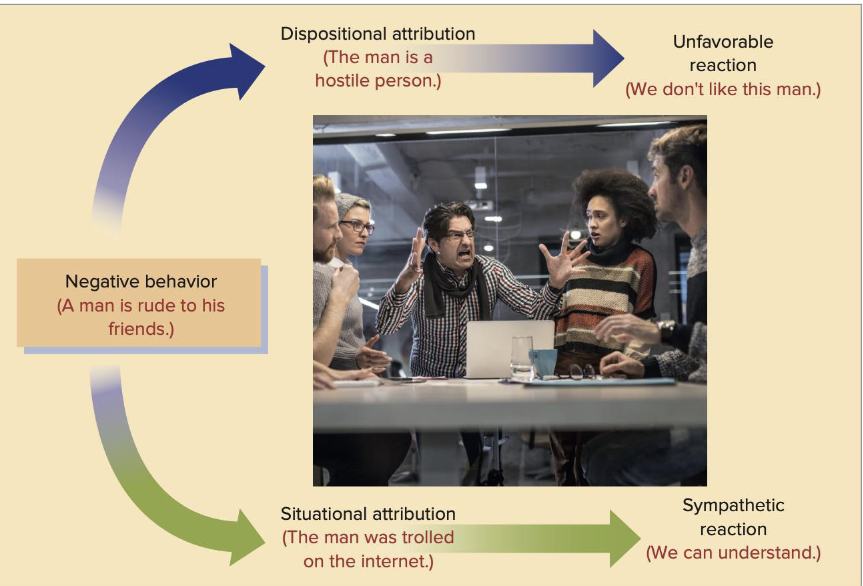
She forgot my birthday because she doesn’t like me/is an airhead (internal), or because she’s very busy right now and is under a lot of stress (external).
Misattribution: attributing the cause of behaviour to the wrong source
Attribution theory: tries to explain internal and external attributions andd misattributions in accounting for behaviour
Dispositional attribution: attributing behaviour to internal cause
Situational attribution: attributing behaviour to external cause
When do we use internal or external attribution? How to judge?
Jones and Davis (1965):
Was behaviour freely chosen? → internal attribution more likely
Is behaviour unusual? → internal attribution more likely
Is behaviour socially undesireable? → internal attribution more likely
Does behaviour serve the interests of the person? → internal attribution more likely
Does behaviour have high impact on us personally? → internal attribution more likely
The fundamental attribution error
Heider (1958): overall preference for dispositional - ‘internal’ - attribution over situational - ‘external’ - attribution
People have prefernece for internal attributions in explanations of behaviour (at leasts in Western cultures)
The fundamental attribution error: underestimate the influence of the situation and overestimate the influence of the person’s traits and attitudes
When explaining behaviour of others
Not when explaining own behaviour
Ross et al. (1977) Contestants and observers of a stimulated quiz game assumed that a person who had been randomly assigned the role of questioner was more knowledgeable than the contestant.
Why do we make the fundamental attribution error? Why underestimate the influence of situation to explain other people’s behaviour, but not our own.
Actor-Observer difference
Difference in perspective:
For the actor - the environment and its influence is obvious
For the observer - the person who is acting is the focus of their attention
False consensus effect
Consensus: other people will behave as we would; our behaviour is normal.
Someone who does not behave as we do/would; their behaviour explained by their (odd) traits
Self-knowledge
We know ourselves better than any other person
Therefore, better able to give external attributions for our behaviour (especially undesireable behaviour)
Social Judgements
Previously
Our perceptions of events & people not always objective/neutral
Perceptions easily influenced
We categorize people
‘pigeonhole’ them?
New information can distort memory traces
We use perceptions to attribute meaning - distorted perception > misattributions
How do we judge ourselved/others/events?
Cognitive mechanisms used in social judgments:
typically efficient
often accurate
important for choosing appropriate social responses
However, mis-judgments can occur for several reasons:
Intuitive judgments
Overconfidence
Heuristics
Counterfactual thinking
Illusory thinking
Mood
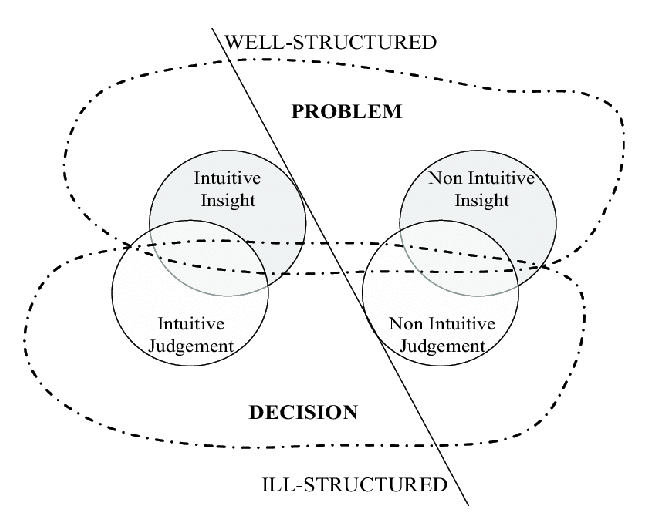
Intuitive judgments
Intuition: important information is available immediately without deliberate, conscious analysis
Distinction taken from cognitive psychology:
Controlled processing - conscious, relective, effortful
Automatic processing - outside awareness, effortless (intuition)
But 2 is often the product of 1
Benefit:
Choosing schema requires little controlled processing
Once activated, a schema can prescribe how to behave in the situation, again requiring little controlled processing.
Risk:
Situation or person is wrongly categorised and resulting behaviour is inappropriate (e.g., mistaking the new manager for a new assistant)
Overconfidence
Overconfidence phenomenon: tendency to overestimate the accuracy of one’s belief.
Overconfidence can lead to mis-judgment
More positive expectations of fuutre performance, even if the past gives no reason for so much confidence.
Confidence is seen as marker of accuracy
Accuracy of eyewitness judged on their confidence:
more confident, assumed more accurate…
…but little evidence to support a relationship between confidence of eyewitness and accuracy of testimony.
What makes overconfidence arise and persist
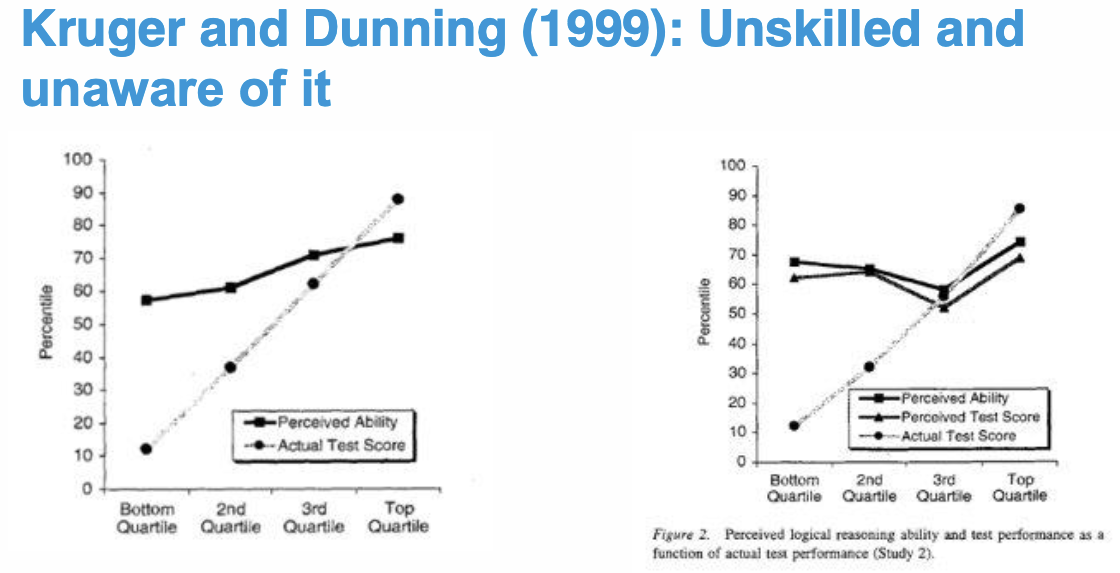
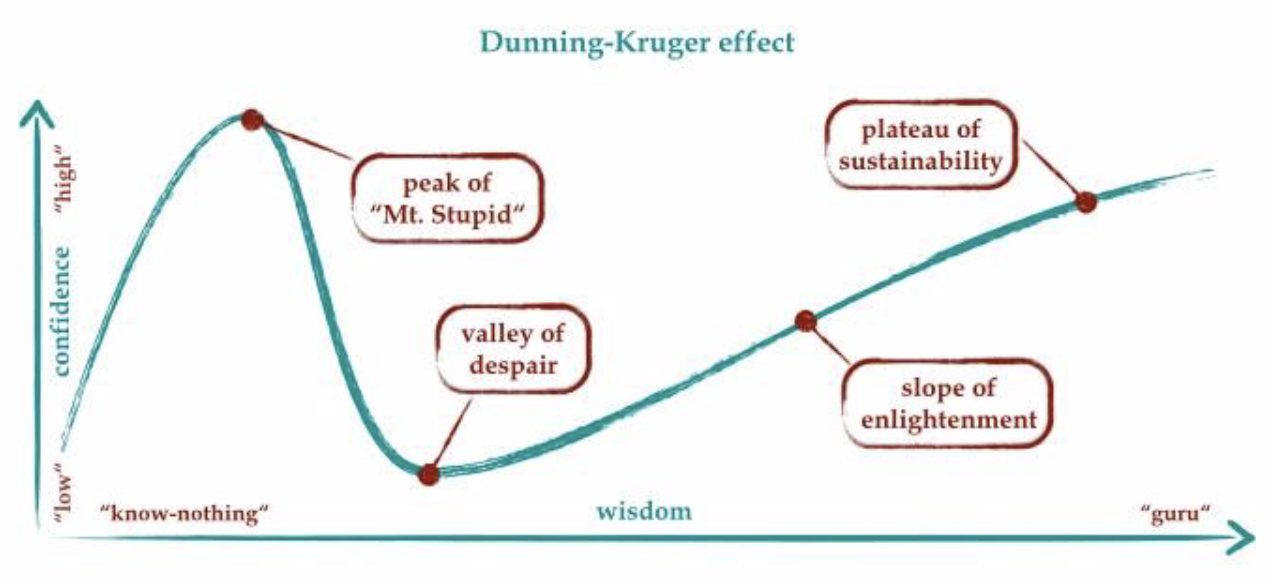
Dunning Kruger Effect
Bias in which people with limited competence in a particular domain overestimate their abilities
Ignorance of incompentence feed overconfidence (Dunning, 2005)
When we are unaware of our own flaws
People tend to remember mistaken judgments as almost right (Tetlock, 1998) rather than simply wrong.
Confirmation bias: we are eager to find evidence that confirms our views and reluctant to seek evidence to disprove them.