joints
Joints
Articulations
Functions:
Support
Movement
Fibrous joints:
Joined by dense connective tissue
Immobile
Ex: sutures & teeth
Cartilaginous:
Joined by cartilage
Either hyaline or fibrocartilage
Slightly mobile
Ex: pubic symphysis, costochondral joints
Synovial:
Joint cavity slightly enclosed by joint capsule
Articular cartilage
Freely mobile
Most joints in the body
General structure:
Joint capsule composed of fibrous layer (outer) & synovial layer (inner)
Synovial layer produces synovial fluid (cushions bones in joints)
Joint cavity is the space where synovial fluid rests
Ligaments strengthen joint
Articular cartilage provides cushioning at ends of joints
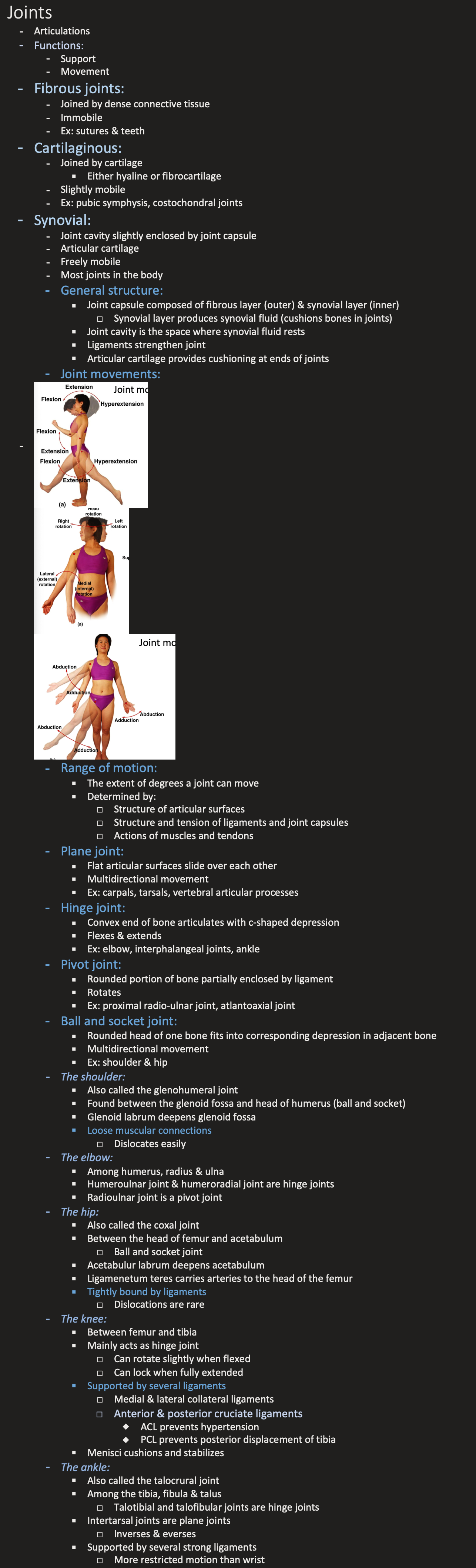
Joint movements:
Range of motion:
The extent of degrees a joint can move
Determined by:
Structure of articular surfaces
Structure and tension of ligaments and joint capsules
Actions of muscles and tendons
Plane joint:
Flat articular surfaces slide over each other
Multidirectional movement
Ex: carpals, tarsals, vertebral articular processes
Hinge joint:
Convex end of bone articulates with c-shaped depression
Flexes & extends
Ex: elbow, interphalangeal joints, ankle
Pivot joint:
Rounded portion of bone partially enclosed by ligament
Rotates
Ex: proximal radio-ulnar joint, atlantoaxial joint
Ball and socket joint:
Rounded head of one bone fits into corresponding depression in adjacent bone
Multidirectional movement
Ex: shoulder & hip
The shoulder:
Also called the glenohumeral joint
Found between the glenoid fossa and head of humerus (ball and socket)
Glenoid labrum deepens glenoid fossa
Loose muscular connections
Dislocates easily
The elbow:
Among humerus, radius & ulna
Humeroulnar joint & humeroradial joint are hinge joints
Radioulnar joint is a pivot joint
The hip:
Also called the coxal joint
Between the head of femur and acetabulum
Ball and socket joint
Acetabulur labrum deepens acetabulum
Ligamenetum teres carries arteries to the head of the femur
Tightly bound by ligaments
Dislocations are rare
The knee:
Between femur and tibia
Mainly acts as hinge joint
Can rotate slightly when flexed
Can lock when fully extended
Supported by several ligaments
Medial & lateral collateral ligaments
Anterior & posterior cruciate ligaments
ACL prevents hypertension
PCL prevents posterior displacement of tibia
Menisci cushions and stabilizes
The ankle:
Also called the talocrural joint
Among the tibia, fibula & talus
Talotibial and talofibular joints are hinge joints
Intertarsal joints are plane joints
Inverses & everses
Supported by several strong ligaments
More restricted motion than wrist