Geography
TERM ONE : unit 1
>Why does the Earth and atmosphere heat up?
Sun heats earth and earth heats atmosphere.
Latitude affects the angle of sunlight received, influencing temperature and climate patterns across different regions.
-LAT= distance from equator measured in degrees.
→Lat effects at what angle the sun hits earth.
→how far rays travel to hit the earth.
The seasons
MID LAT = Area that lie between Tropics and Poles.
2 reasons for seasons
→Earth orbits the sun.
→Earth axis is tilted.
How’s heat transferred to balance energy?
ocean currents and wind
ocean current → large scale circulation of sea water.
Warm water from equator to poles.
Cold water from poles to equator.
Winds→ Horizontal movement of air across the earths surface.
Equator to Poles
Land to Sea
Unit 2
Global air circulation = large scale movement of air.
World pressure belts
3 types of pressure belts.
→Equatorial low (Intertropical convergence zone)
→Subtropical high (MID LATS)
→Subpolar lows (Poles)
NB figure 1.2.2 pg23
Worlds Pressure belts a product of Tri cellular model
TRI cellular mode = global circulation of air in 3 cells.
Hadley cell: The tropical cell that extends from the equator to about 30 degrees latitude, characterized by rising warm air at the equator and descending cooler air at higher latitudes.
Ferel cell : The mid-latitude cell that exists between 30 and 60 degrees latitude, where air flows poleward and eastward, influenced by both the Hadley and Polar cells, resulting in variable weather patterns.
Poler cell: The cell located at the poles, extending from 60 degrees latitude to the poles, where cold air sinks and moves towards the equator, contributing to the polar easterlies and characterized by consistently cold temperatures.
Abiotic cooling= Air looses heat as it expands
Abiotic warming= Air gains heat as it contracts.
GLOBAL WINDS
Why do winds curve?
Because of the coriolis effect
Pressure gradient
→Diff in air pressure creates a pressure gradient , which causes air to flow from high-pressure areas to low-pressure areas, influencing the wind's direction as it moves.
Coriolis effect→ the apparent deflection of moving objects, such as air currents, caused by the rotation of the Earth, resulting in winds curving to the right in the Northern Hemisphere and to the left in the Southern Hemisphere.
Winds related to Global circulation?
Tropical easterlies = in tropics (trade winds)
westerlies = mid lats
polar easterlies = polar regions
These are winds that blow across earths surface between pressure belts.
Air masses role in global air circulation
Giant pockets of air, they take on the temp of surface they rest over.
1st letter
C= Continental (Land)
M= Maritime (water)
2nd letter
E = Equatorial (warm)
A = Artic (cold)
Rising air masses are unstable
Monsoon
Global prevailing wind that reverses direction in summer and winter
Monsoons are associated with the rainy season in tropics
WESTERN AFRICAN MONSOON
Jan = Desert air mass dominates. hot by day cool by night.
July = Sea air mass dominates, brings moist air and rain.
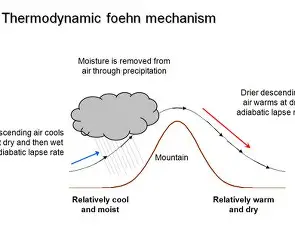
FOHN WINDS
Warm dry wind that blows down a mountain.
Adiabatic cooling and warming
Fohn wind produses this