laws of reflection
LIGHT: MIRRORS & LENSES
Light exhibits two fundamental properties:
Reflection: The process by which light bounces off a surface.
Refraction: The bending of light as it passes from one medium to another.
REFLECTION
Reflection is the bouncing off of light rays when it strikes a plane mirror.
Important terms to remember in the context of reflection:
MAGNIFICATION FORMULA
The formula for magnification (M) is expressed as:
M = h'/h = -q/ph' =height of the imageh= height of the objectp= object distanceq= image distance
1. INCIDENT RAY
Definition: The ray approaching the mirror, represented by an arrow approaching an optical element like mirrors.
2. REFLECTED RAY
Definition: The ray of light that leaves the mirror, represented by an arrow pointing away from the mirror.
3. NORMAL LINE
Definition: An imaginary line drawn perpendicular to the surface of the mirror at the point of incidence where the ray strikes the mirror.
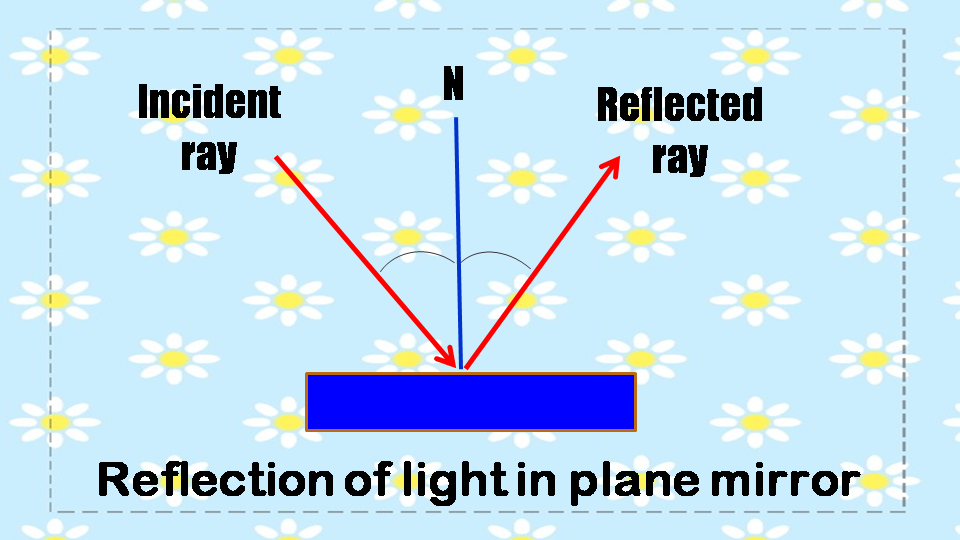
ANGLES IN REFLECTION
Note:
The angle between the incident ray and the normal line is referred to as the angle of incidence.
The angle between the reflected ray and the normal line is known as the angle of reflection.
LAWS OF REFLECTION
The angle of incidence is equal to the angle of reflection.
The Incident Ray (IR), Normal Line (NL), and Reflected Ray (RR) all lie in the same plane.
PERISCOPE
A periscope is an instrument for observation over, around, or through an object, obstacle, or condition that prevents direct line-of-sight observation from the observer's current position.