Chemical Reactions
🔹 Physical & Chemical Changes
Physical change: No new substance, reversible (e.g. melting ice).
Chemical change: New substance formed, irreversible (e.g. rusting).
Signs of chemical reaction:
Gas produced (bubbling/fizzing)
Colour change
Temperature change
Precipitate forms
Example equation:
Word: Magnesium + Hydrochloric acid → Magnesium chloride + Hydrogen
Balanced: Mg(s) + 2HCl(aq) → MgCl₂(aq) + H₂(g)
🔹 Synthesis & Decomposition Reactions
Synthesis: 2 or more substances → 1 product
Two or more reactants combine to form one product
Example: 2H₂(g) + O₂(g) → 2H₂O(l)
Decomposition: 1 compound → 2 or more simpler substances
One compound breaks into simpler substancesExample: 2H₂O₂(aq) → 2H₂O(l) + O₂(g)
Observations: colour change, gas produced, temperature change.
aqueous: dissolves in water/soluble
🔹 Precipitation Reactions
Precipitate: Insoluble solid formed in a liquid reaction.
Identification: Cloudy mixture or solid appears.
Use solubility table: If one product is insoluble → precipitate forms. if not than it’s aqueous
Example: NaCl(aq) + AgNO₃(aq) → AgCl(s) + NaNO₃(aq)
Observation: White precipitate (AgCl).
Double displacement reaction:
The anions swapped spots
Each product must be written again from scratch
AX + BY → AY + BX
usually precipitate
🔹 Observations in Double Displacement Reactions
1. Precipitate Formation
Most common evidence of double displacement.
A solid (precipitate) appears when two clear solutions are mixed.
Observation examples:
Solution turns cloudy.
Solid particles form and settle at the bottom.
Colour change in the mixture.
Example:
NaCl(aq) + AgNO₃(aq) → AgCl(s) + NaNO₃(aq)
Observation: White precipitate of AgCl forms.
2. Gas Formation
Some double displacement reactions produce a gas that bubbles or fizzes.
Example:
Na₂CO₃(aq) + 2HCl(aq) → 2NaCl(aq) + H₂O(l) + CO₂(g)
Observation: Bubbling or fizzing (CO₂ gas released).
3. Temperature Change
The reaction can be exothermic (gives off heat) or endothermic (absorbs heat).
Observation:Beaker feels warm → exothermic.
Beaker feels cold → endothermic.
4. Colour Change
Colour of the solution changes due to new ions or precipitate formation.
Examples:Blue → green when copper ions are replaced.
Clear → coloured (or vice versa).
5. Change in Clarity
Solution becomes cloudy or opaque when a precipitate forms.
Or becomes clear again if the precipitate dissolves (in rare cases).
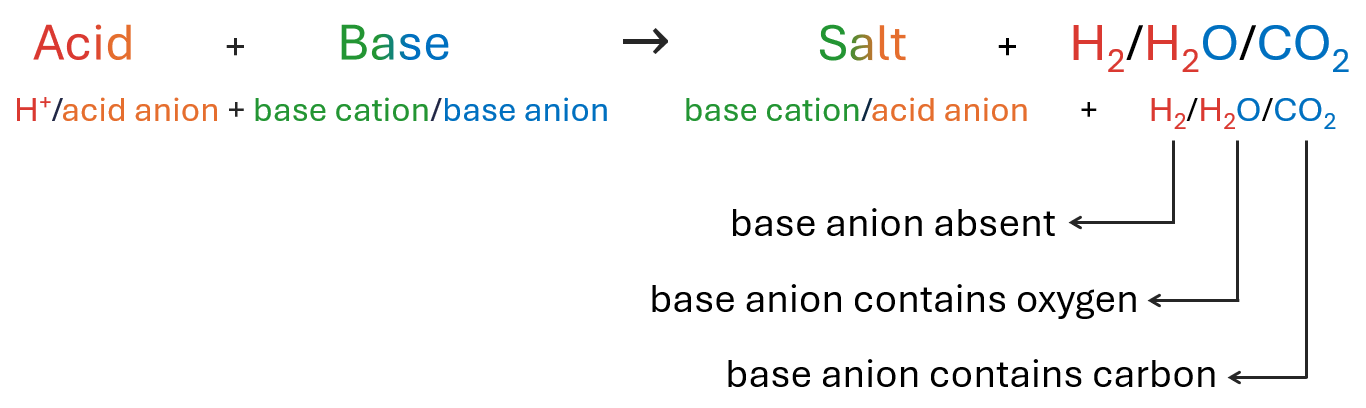
🔹 Acid Reactions
1. Acid + Metal → Salt + Hydrogen
Mg(s) + 2HCl(aq) → MgCl₂(aq) + H₂(g)
2. Acid + Metal Hydroxide → Salt + Water
HCl(aq) + NaOH(aq) → NaCl(aq) + H₂O(l)
3. Acid + Metal Carbonate → Salt + CO₂ + H₂O
2HCl(aq) + CaCO₃(s) → CaCl₂(aq) + CO₂(g) + H₂O(l)
Reaction Type | Equation Type | Main Observations | Gas Produced | Test for Gas |
|---|---|---|---|---|
Acid + Metal | Salt + H₂ | Bubbling, metal disappears, warmth | Hydrogen (H₂) | Squeaky pop test |
Acid + Metal Hydroxide | Salt + H₂O | No bubbles, temp ↑, indicator colour change | None | — |
Acid + Metal Carbonate | Salt + H₂O + CO₂ | Bubbling, solid dissolves, warmth | Carbon dioxide (CO₂) | Limewater turns milky |
🔹 Reaction Energy & Collision Theory
Exothermic: Releases heat → feels hot (e.g. combustion). Total chemical energy of the products is less than the total chemical energy of the reactants.
Excess energy is released into the surrounding environment generally as heat
Endothermic: Absorbs heat → feels cold (e.g. photosynthesis). Total chemical energy of the products is greater than the total chemical energy of the reactants. Additional energy is absorbed from the surrounding environment for the reaction to occur.
Activation energy: Minimum energy needed for particles to react. Energy needed to break bonds between atoms of reactants so products can form. During a reaction, old bonds must be broken and new bonds formed. . Breaking bonds requires energy — this is why particles need enough activation energy. If particles don’t have enough energy, they simply bounce off each other without reacting.
Reaction rate: Speed with which reactants become products, also depends on how frequently particles successfully collide.
Collision theory:
“According to collision theory, reactions occur when particles collide with enough energy and the correct orientation. Increasing the number of successful collisions increases the rate of reaction.”
Unsuccessful collision
Particles bounce off each other or don't react due to low energy or poor orientation (not aligned correctly)
Successful collision
Have enough kinetic energy to break bonds within the reactant particles. Requires particles to collide in the right direction
🔹 Factors Affecting Reaction Rate
Temperature ↑ → faster particles → more collisions.
Concentration ↑ → more particles → more collisions.
Surface area ↑ → more exposure → faster rate.
Catalyst present → lowers activation energy → faster rate.

Soluble
| A substance that dissolves in water to form a clear solution. Also called aqueous (aq). |
Insoluble
| A substance that doesn't dissolve in water and remains a solid |
Precipitate
| Forms when two aqueous things come together and form a solid that separates from the liquid. |
Clear
| Liquid that is fully transparent, you can see through it |
Colourless
| A liquid that is transparent and has not colour at all |
🔹 How We Know the Chemical Formula for Sulfuric Acid
1. Name Tells You the Ions
The name “sulfuric acid” comes from the sulfate ion (SO₄²⁻).
All acids contain hydrogen ions (H⁺) because acids release H⁺ in water.
So sulfuric acid contains:
→ H⁺ (hydrogen ion)
→ SO₄²⁻ (sulfate ion)
2. Balance the Charges
The sulfate ion has a –2 charge.
Each hydrogen ion has a +1 charge.
To make the total charge = 0 (neutral compound):
→ You need 2 H⁺ to balance one SO₄²⁻.
Therefore:
H₂SO₄
3. Check Naming Pattern
Acid Name | Derived Ion | Formula |
|---|---|---|
Hydrochloric acid | Chloride (Cl⁻) | HCl |
Nitric acid | Nitrate (NO₃⁻) | HNO₃ |
Sulfuric acid | Sulfate (SO₄²⁻) | H₂SO₄ |
Phosphoric acid | Phosphate (PO₄³⁻) | H₃PO₄ |