PM153 Lecture 3 - Non-covalent forces and forces between molecules
Non-covalent forces
Weaker than covalent or ionic bonds (10-50 times weaker)
Allow for tweaking of molecular shapes and interactions
Electrostatic in nature generally
Requires close proximity to have an effect
Main cause: non-polar nature of bonds and electronegativity
Consists of
Dispersion forces
Hydrophobic forces
Permanent dipole interactions
Hydrogen bonds
Ionic interactions
Dispersion forces
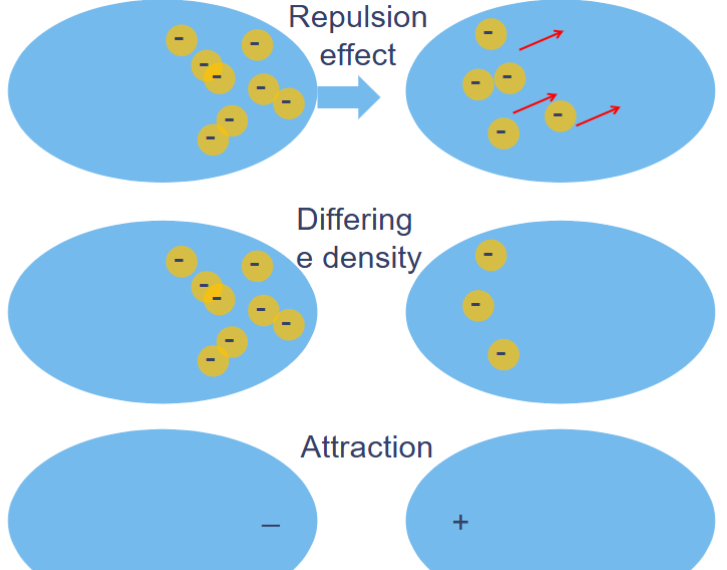
Electrons move within their orbitals
An uneven distribution causes electrical charge in the molecule
A negative area caused in this way can attract a positive area, causing an induced dipole
Characteristics of dispersion forces
Short lived
Very weak
Only work over very short distances
Prevalence is due to shape and size:
How many electrons are around to cause the force and how close can they get to each other
They are important as:
Any molecule can exhibit them as they are not limited by nature of the molecule
Can occur between two non-polar molecules
Hydrophobic forces