Week 6: Univariate and Multivariate
Introduction to Data Preparation Pt 2
Last week's module covered preliminary procedures for preparing a data file for analysis.
This module focuses on procedures to complete before conducting inferential analyses.
Univariate Profiling: Getting Familiar With the Data
Inspect univariate distributions to identify potential problems.
Restricted range.
Univariate outliers.
Shape of the distribution.
Univariate profiling: becoming familiar with each variable.
Check for Restricted Range
Restricted range: Occurs when scores do not cover the entire possible range or are concentrated in a narrow range.
Consequences of restricted range:
Reduced sensitivity: Insufficient variation in scores. Difficult to distinguish between participants.
Distorted effects: Increased risk of Type II errors. Effects may appear smaller than they are.
Sample bias: Limits generalizability and external validity.
Identifying Restricted Range
Inspect descriptive statistics (min/max values) and histograms for each variable.
Descriptive Statistics Example
Variables: Compensation, Leadership, Work Demands, Collegiality (measured from 1 to 10).
Observe minimum and maximum scores.
Compensation: Maximum score is only 5, indicating restricted range.
Smaller standard deviation due to less room for variability.
Histograms
Restricted range is evident when there is a gap in the histogram where scores are expected.
Example: Satisfaction with compensation measured from 1 to 10, but histogram stops at 5.
What To Do If You Have Variables with Restricted Range
If due to missing data:
Collect more data (case substitution).
Estimate missing values (estimation maximization and multiple imputation).
If you can't collect more data or estimate the missing values:
Conduct inferential analyses with caution.
Acknowledge potential impacts: higher likelihood of Type II error, suppressed effect sizes, and/or sample bias.
This is the main approach if working with Jamovi, as it can't perform estimation maximization or multiple imputation.
Univariate Outliers
Extreme scores on a single variable.
For ungrouped data: include all participants.
For grouped data: check for outliers within each group.
Identifying Univariate Outliers Statistically
Transform scores into Z scores.
Z-scores: standardized scores representing the number of standard deviations a data point is from the mean.
Sign indicates if the data point is above or below the mean.
Magnitude indicates how many standard deviations from the mean.
Example:
: 1.50 standard deviations above the mean.
: 2.30 standard deviations below the mean.
scores of are considered significantly different from the mean.
Identifying Univariate Outliers Graphically
Box plots: Depict median, 25th and 75th percentiles, and whiskers (1.5 x Interquartile Range).
Values outside the whiskers are flagged as outliers.
What To Do If You Have Univariate Outliers
Do Nothing: Common with large samples; analyses are often robust.
Remove the outliers: Delete or filter out participants if the outlier is not a genuine participant.
Windsorise the outlier: Replace the outlier with the next highest value that isn't an outlier.
Transform the variable: Apply a formula to make the distribution more normal, squashing the tail closer to the center.
Evaluate Univariate Normality
Assess if each variable is normally distributed.
Ideal for sufficient variability and sensitivity.
Check normality within each group for grouped data.
When is Non-Normality A Problem?
Not always an issue for assumption testing; the central limit theorem applies with large sample sizes ().
Problematic if it impacts multivariate normality or indicates floor/ceiling effects.
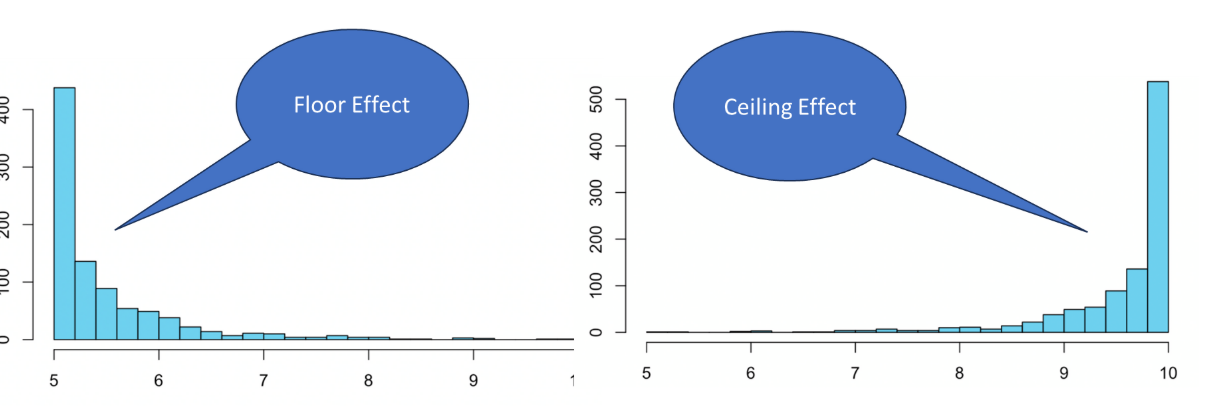
Floor effect: A floor effect occurs when a large number of participants score at or near the lowest possible value on a measurement scale. This results in a substantial positive skew (a peak to left-hand side with a tail extending up to the right of the distribution).
Ceiling effect: A ceiling effect occurs when a large number of participants score at or near the highest possible value on a measurement scale. This results in a substantial negative skew (a peak on the right-hand side with the tail extended down to the left of the distribution).
Why are Floor and Ceiling Effects a Problem?
Reduce sensitivity of a measure.
Lead to reduced variability, reduced power, higher risk of Type II error, and suppressed effect sizes.
Evaluating Univariate Normality Statistically
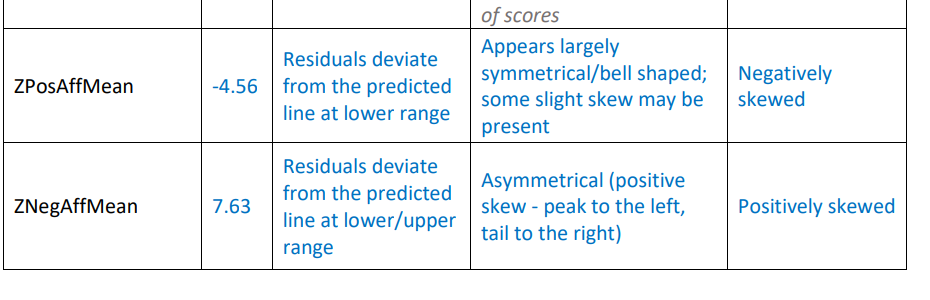
Use standardized skewness scores (ZSkew).
Score of zero: perfectly symmetrical distribution.
Higher magnitudes: greater deviations from normality.
Sign: indicates positive or negative skew.
scores greater than indicate significant deviation from normality (significant skew).
Evaluating Univariate Normality Graphically
Histograms: Normal distribution appears bell-shaped and symmetrical.
Q-Q (Quantile-Quantile) plots: Compare the distribution shape against a normal distribution; points should fall along the diagonal line.
What To Do If Variables Are Not Normally Distributed
Not necessarily a problem unless it causes issues with multivariate normality.
Address problems with univariate normality:
Remove outliers.
Transform the variable.
If normality cannot be fixed, consider non-parametric analyses or robust methods (e.g., bootstrapping).
Checking Univariate Outliers and Normality Within Groups
For group data, check univariate outliers and normality within each group separately.
Split the sample into groups using the grouping variable.
Multivariate Outliers
Unusual combinations of scores on two or more continuous variables.
Not always a problem, especially in large samples.
When are Multivariate Outliers a Problem?
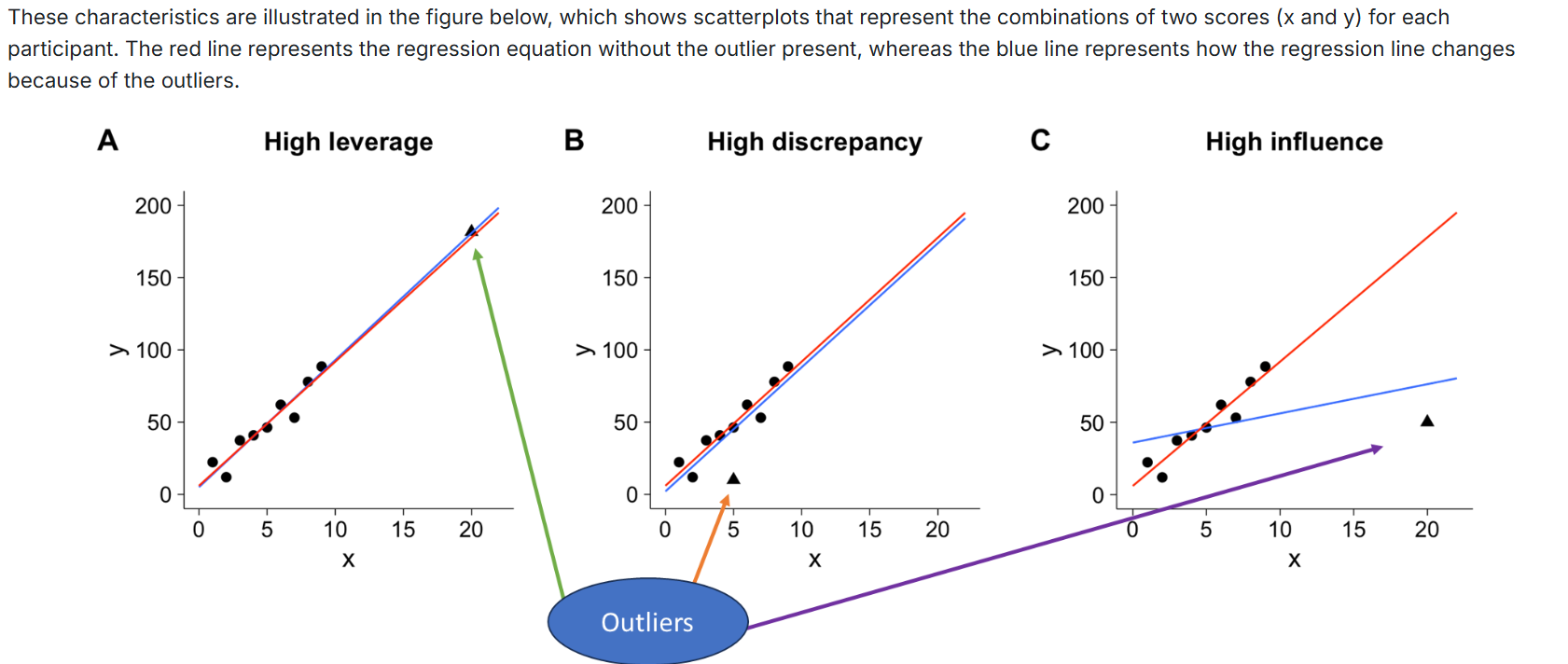
The problem occurs when outliers have high influence.
Influence: Degree to which an outlier distorts the regression equation.
Combination of leverage (distance from other data points) and discrepancy (how far out of line the data point is from others).
Evaluating Multivariate Outliers
If working with grouped data, evaluate outliers separately within each group.
Step 1: Identify Multivariate Outliers
Use Mahalanobis Distance: measures the distance of each participant from the centroid, accounting for covariance.
A significant Mahalanobis Distance indicates a multivariate outlier.
Step 2: Inspect the Outliers
Check if the outlier is a genuine participant.
Check for data entry errors.
Check if they are a member of the population of interest.
If the multivariate outlier appears genuine, evaluate their influence.
Step 3: Evaluate Influence
Calculate Cook's Distance scores: measure of influence. is a cause for concern.
Run analyses with and without the outlier to see if the results change.
If the significance, effect size, magnitude, and precision of estimates change substantially, the outlier has high influence.
Step 4: Decide What to Do About Outliers
If outliers appear genuine, but influence the results:
Check if scores are also univariate outliers; consider winsorizing or transforming.
If not univariate outliers, decide whether to remove the participant or retain them.
Assumption Testing: Multivariate Normality
Most multivariate analyses assume multivariate normality.
All linear combinations of all variables are normally distributed.
Evaluate by examining the distribution of the residuals of a model.
If residuals are normally distributed, multivariate normality can be assumed.
Use Q-Q plots of residuals.
Violations of multivariate normality impact some analyses more strongly than others.
What To Do If Multivariate Normality is Violated
ANOVA models are robust to violations, especially with larger sample sizes; consider non-parametric alternatives if the violation is extreme.
Analyses based on correlation can be heavily impacted.
Strategies to address problems with multivariate normality
Remove univariate and/or multivariate outliers.
Try fixing univariate problems using data transformations.
Other Assumptions of Multivariate Analyses
Regression models:
Linearity: The relationship between the residuals and values predicted by the regression model are linear.
Homoscedasticity: the variability or spread of residuals is equal at all levels of the predicted values.
Independence: Residuals are independent.
Collinearity: Independent variables are not collinear.
Factor Analysis (Exploratory Factor Analysis):
Sampling adequacy: The variables must be sufficiently correlated for a factor analysis.
Between-Groups Factorial ANOVA:
Homogeneity of variance: The variance in the dependent variable is equal between each group.
Repeated Measures and Mixed Factorial ANOVA:
Homogeneity of variance.
Sphericity: there is equal variance in the difference scores between each time point/measurement.
Data Transformations
Statistical techniques used to modify the distribution of a skewed variable to make it closer to a normal distribution.
Squashes the tail of the skewed variable back towards the rest of the data.
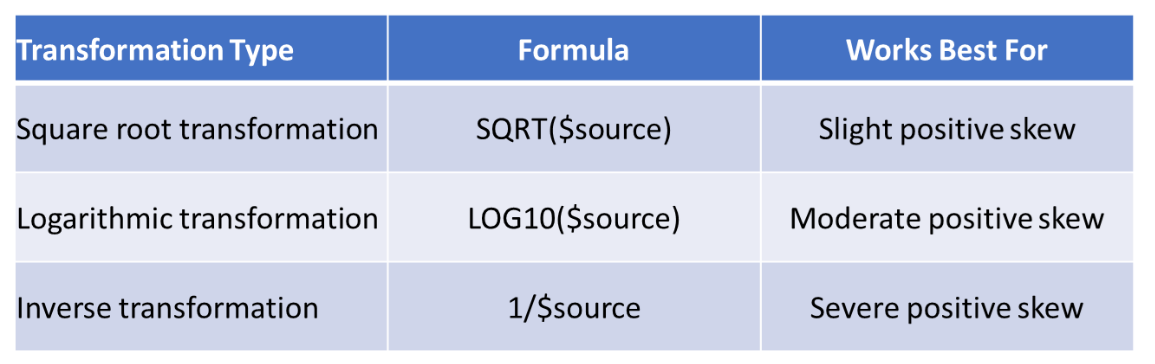
Common normality transformations:
Square root.
Logarithmic.
Inverse.
Follow this order of transformations to avoid over-transformation.
Common normality transformations Formulas in Jamovi
Square root:
SQRT($source)Logarithmic:
LOG($source)Inverse:
1/$source
Formula to reflect a variable
(f(x) = (highest
value + 1 - $source))To reflect a variable, we apply the following formula:
fx = (highest value + 1 - $source)
A Word on Caution on Normality Transformations
Can be controversial.
Transformed variables can be difficult to interpret.
Transformations are not necessary if analyses are robust to violations of normality.
Transforming won't always fix problems with multivariate assumptions.
Final Stages
Prepare data and conduct inferential analyses to test hypotheses