Connecting cells in tissues
Key Terms
Apical membranes - The top surface of a cell, facing the outside environment
Adherens junctions - Connections between cells that hold them together using proteins linked to the cell’s cytoskeleton
Adhesion belts - A belt-like ring of Adherens junctions around a cell that helps keep neighbouring cells attached.
Desmosomes - Strong connections between cells that provide mechanical strength and prevents cells from pulling apart.
ECM - A network of proteins and other molecules outside cells that supports and connects them
Basal membranes - The bottom surface of a cell, usually attached to the basement membrane
Introduction
Challenges of structure and communication
Cells must Adhere strongly to one another and function in a coordinated manner for tissues and organs to operate effectively.
The support structure must remain adaptable to stress and changing conditions, allowing for repairs.
Effective communication among cells is vital
cells must relay information to fulfill their roles appropriately.
Tissues
Group of cells working collaboratively to achieve specific functions
specialised cells within multicellular organisms are organised into tissues
The organisation pattern of these is tailored to the tissues function
Types of tissues
adipose (fat)
bone
skin
skeletal muscle
cartilage
intestine
Ways Cells Connect
Apical membranes - The top surface of a cell, facing the outside environment
Adherens junctions - Connections between cells that hold them together using proteins linked to the cell’s cytoskeleton
Adhesion belts - A belt-like ring of Adherens junctions around a cell that helps keep neighbouring cells attached.
Desmosomes - Strong connections between cells that provide mechanical strength and prevents cells from pulling apart.
ECM - A network of proteins and other molecules outside cells that supports and connects them
Basal membranes - The bottom surface of a cell, usually attached to the basement membrane
Cell Junctions
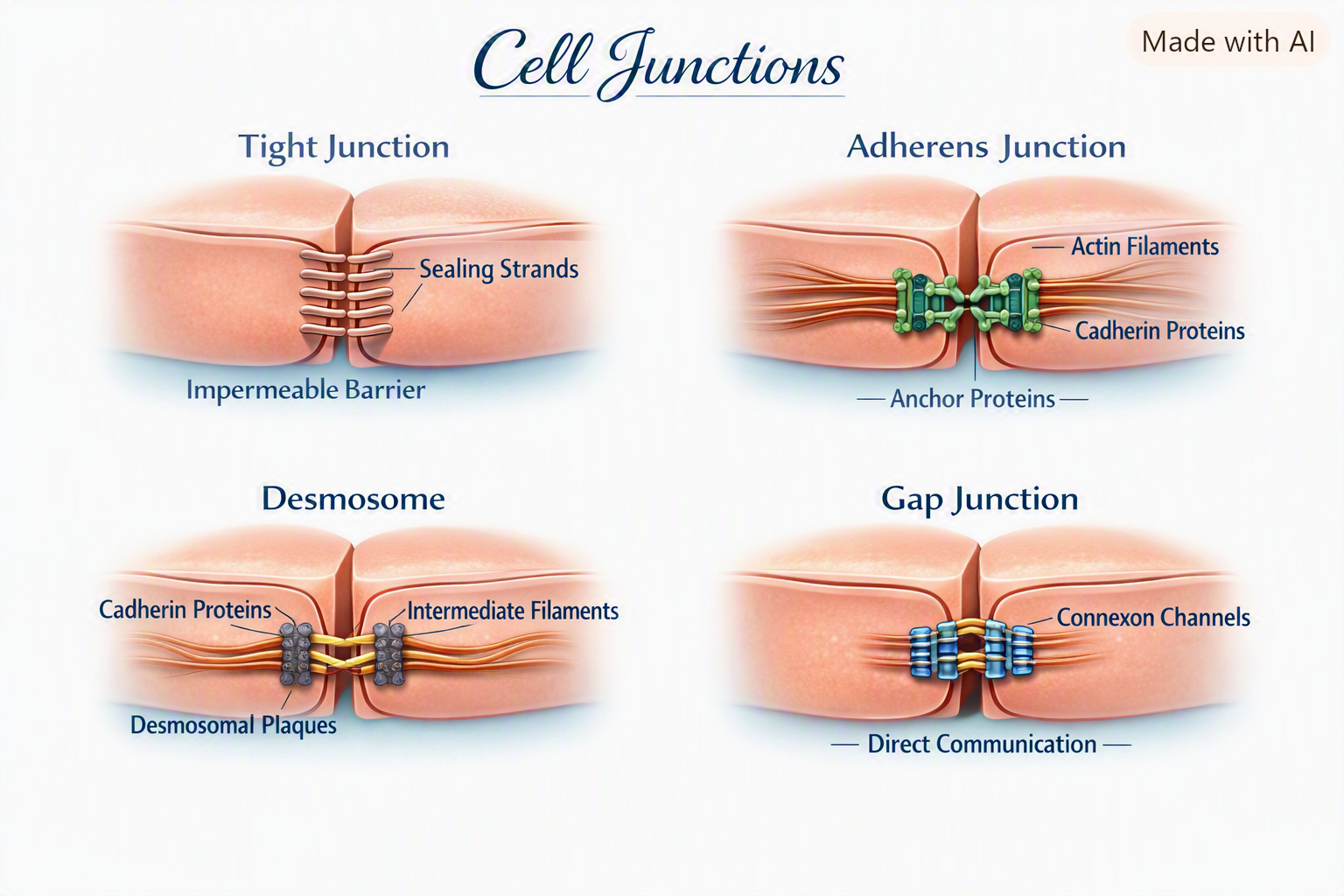
Cells are connected to other cells via cell junctions
Most types of junctions connect cell surface molecules on neighbouring cells with component of the cytoskeleton.
Types
Gap junctions
Tight junctions
Desmosomes
Adherens Junctions
Gap Junctions
Channel proteins that align between 2 cells
They directly connect the cytoplasm’s of the 2 cells and allow direct communication between them.
they don’t connect to the cytoskeleton
Functions:
Exchange of Metabolites
Passage of communication signals
Adhesion between cells, providing mechanical strength to tissues
Tight Junctions
Produce a virtually impermeable barrier between cells
neighbouring cells are connected via cell surface proteins
called claudins and occludins
connected to actin cytoskeleton to provide strength
ZO complex anchor proteins connect the claudin and occludin molecules to actin filaments
Functions:
Regulates movement of water, ions and molecules through the space between cells
separates the apical (top) of the cells from the basal (bottom)
Desmosomes
Cadherins that allow similar calls to recognise each other and form connections
interactions between 2 identical cadherin molecules on different cells leads to the cells forming a junction between them.
Different types of cadherin molecules join different types of cells together.
They link cells through intermediate filaments
Functions:
strong attachment between cells
Help tissues withstand stretching and pulling forces
Prevents the cells from separating
Adherens Junctions
cadherin molecules and anchor proteins to connect cells
they connect to actin filaments
The Extracellular Matrix (ECM)
ECM - The scaffolding system surrounding cells that they attach to. It consists of fibres of large proteins such as collagen
Cells attach to the ECM through cells surface molecules called integrins.
ECM provides structure and both mechanical and biochemical support for tissues
also forms the basement membranes (Skin)
Components
fibrous structural proteins
collagen
elastin
Proteoglycans and glycosaminoglycans
Adhesive glycoproteins
Fibronectin
Laminin
Collagen
most abundant protein, in the body
Structure
Structural role - forms molecular cables to strengthen tendons and calcified tissues like bones and teeth via mineral integration.
composed of tightly wound chains in a triple helix configurations
Types of collagen
Type I: 90% of collagen; found in skin, bones, tendons, ligaments.
Type II: Found in elastic cartilage for joint support.
Type III: Present in muscles, arteries, and organs.
Type IV: Constitutive of basement membranes.
Type V: Located in cornea, skin layers, hair, and placental tissue.
Proteoglycans
proteins that are heavily glycosylated and contain very long chains of sugar molecules branching off of the main protein chain.
there are at least 43
they can be found on the cell surface or in the ECM
they lubricate the ECM
Modify the activity and stability of other proteins in the ECM.
Fibronectin
is a glycoprotein that has binding sites for multiple ECM proteins has as well as binding sites for cell surface integrins.

Integrins and ECM attachment
Integrins - cell surface molecules that act as matric receptors
they connect to the ECM, but also transmit signals into the cell allowing the cell to sense and respond to tis environment.
They consist of alpha and Beta chains and different combinations of these subunits allows them to recognise a wide range of ECM components
when they bind to the ECM they change shape into an open conformation.
Adhesion Complex
Cytoplasmic tails of integrins bind with the actin cytoskeleton via anchor or adaptor proteins, forming an adhesion complex that enhances cell stability.
Hemidesmosomes
Hemidesmosomes - connect the ECM to intermediate filaments in the cell
through integrin molecules
they provide additional mechanical strength to the cells and tissues

Fibroblasts & ECM Maintenance
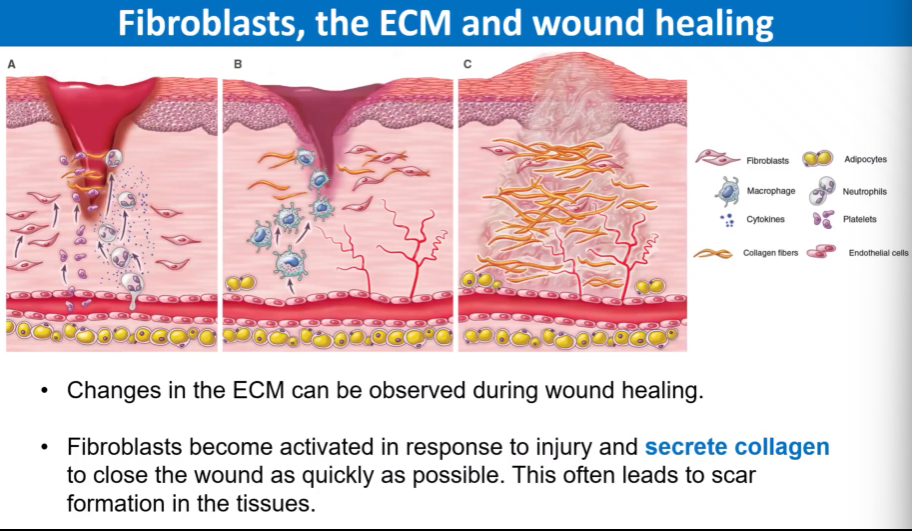
Fibroblasts are key cells responsible for ECM production and maintenance.
During wound healing, fibroblasts are activated to secrete collagen, which can lead to scar formation as part of the healing process.
Multicellularity
Multicellularity exists across life forms
animals, plants, most fungi, and certain algae; with some organisms alternating between unicellular and multicellular stages based on conditions.
Advantages
Improved resource acquisition.
Enhanced resistance to physical and chemical stresses.
Greater protection from predation.
More effective colonization of new environments.
Opportunities for specialized functions across different cell types through differentiation.
Disadvantages
Increased energetic costs associated with the production of adhesion and communication molecules.
Physical constraints due to limited mobility and proliferation.
Vulnerability to exploitation by non-cooperative cells or “cheaters.”
Examples Algae
Chlamydomonas: Unicellular but forms multicellular colonies under favorable conditions.
Gonium: Multicellular with 4-16 cells.
Volvox: Forms colonies with thousands of cells, exhibiting specialized cell types for different functions.