Chapter 14 Money Supply Process
Money Supply Overview
The chapter provides extensive information on the processes through which commercial banks create deposits.
It discusses the fundamental principles regarding the creation of the money supply.
What is Money?
Conceptual Definition:
Money is defined as something that is utilized to purchase goods and services.
Monetary Aggregate M1:
M1 is defined as the sum of Currency + Demand deposits (checking accounts)
Monetary Base:
MB = Bank Reserves = currency in circulation
Mechanism of Money Distribution:
The involvement of three key players in the money supply process:
The Central Bank (Federal Reserve System)
Banks (Depository Institutions and Financial Intermediaries)
Depositors (Individuals and Institutions)
Role of the Central Bank
Central Bank Overview:
Examining the Central Bank's balance sheet is essential for clarifying its role in the money supply process.
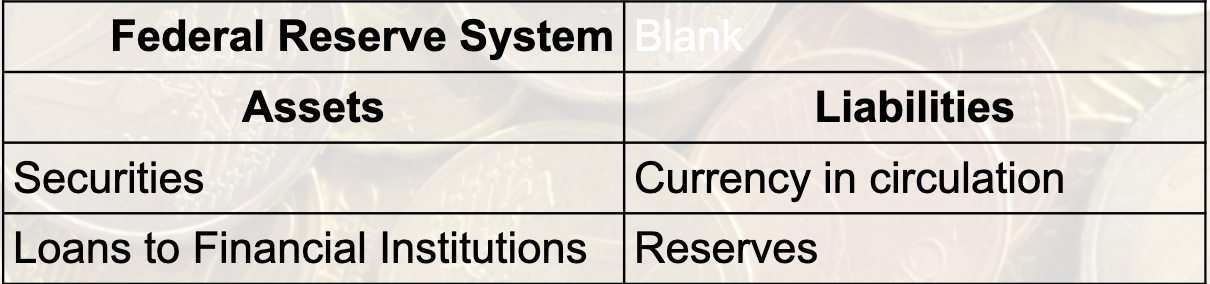
Balance Sheet Components:
Liabilities:
Currency in circulation: The cash held by the public
Reserves: Bank deposits at the Fed and vault cash
Assets:
Government Securities: Holdings by the Fed impacting the money supply and earning interest
Discount Loans: Provide reserves to banks and earn interest at the discount rate
Central Bank & Money Supply Control
Monetary Base Control:
The Central Bank controls the monetary base, defined as:
Mechanisms for Increasing Monetary Base:
The Central Bank increases the monetary base through:
Open market operations (buying bonds or making loans to banks).
Open Market Operations Explained:
Open Market Purchase Process:
A bond as an asset (not money) is sold to the Central Bank, which pays cash.
The individual receiving cash experiences an increase in currency in circulation, resulting in a larger monetary base.
Open Market Sale Process:
Conversely, when selling a bond, the Central Bank receives cash, which decreases currency in circulation, thus lowering the monetary base.
Impact of Open Market Operations on Money Supply
Effects on Currency and Reserves:
The outcome of operations depends on whether the buyer is a bank or an individual:
Reserves increase if a bank receives cash and keeps it in the vault.
Currency supply remains stable as vast majority transactions impact bank deposits.
Involvement of Banks and Depositors:
The results of an open market purchase on reserves depend on how proceeds are dealt with (kept as currency or deposited).
The monetary base always increases by the purchase amount regardless.
Multiple Deposit Creation
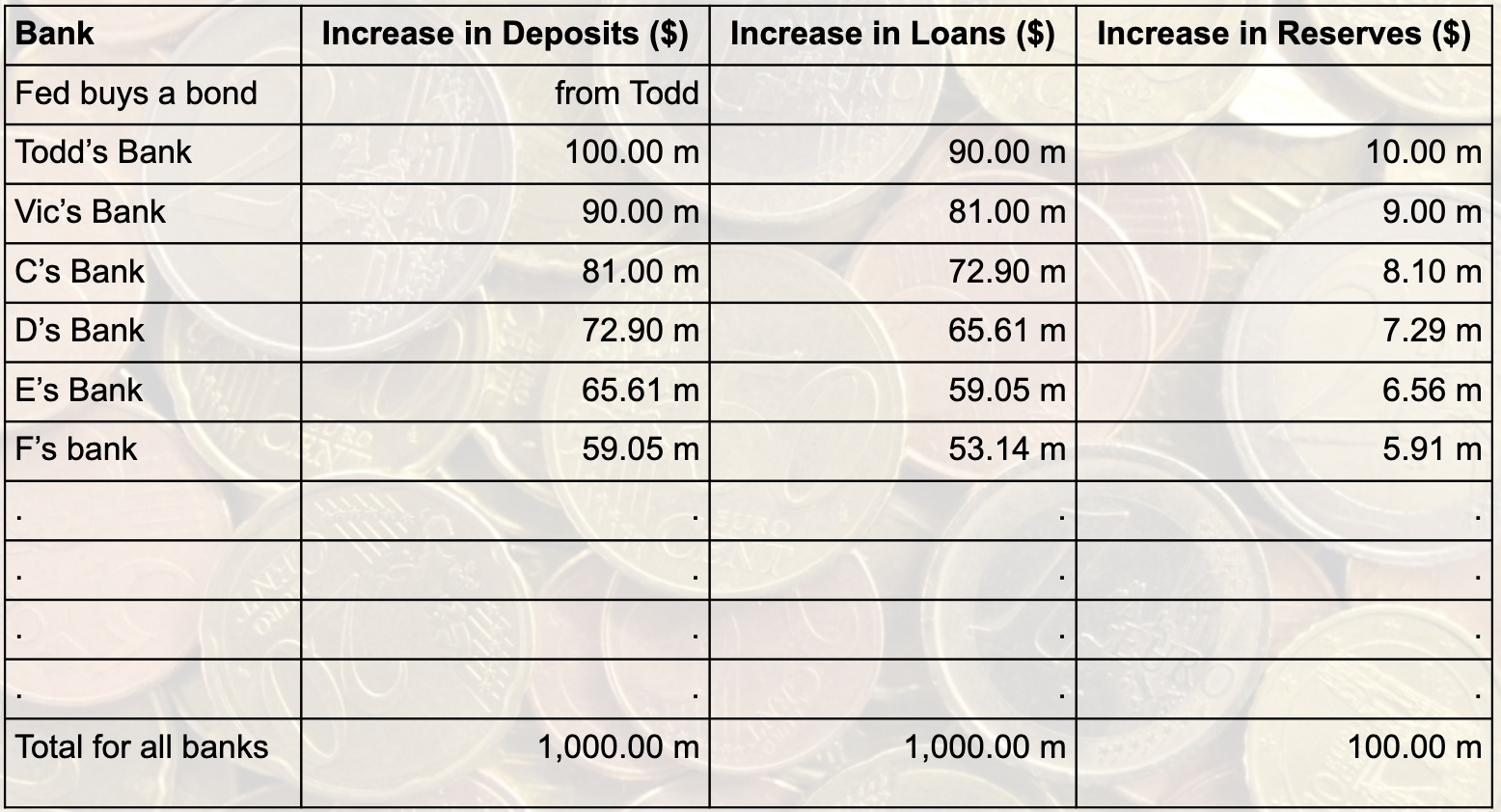
Illustrative Example of Multiple Deposit Creation:
If the Fed buys a $100 bond from Todd:
Todd deposits this $100 in his bank, which increases reserves; monetary base increases by $100.
Todd's bank lends $90 to Vic, who then deposits this amount in his bank:
Vic's bank reserves also increase.
Total checkable deposits rise:
Todd’s account: $100; Vic’s account: $90; Total: $190 increase in deposits.
Continuity of Process:
This process continues with others obtaining loans, thereby increasing total money in circulation.
Data on Deposit Creation
Summary of Bank Transactions:
The following structure illustrates the flow of funds:
Total Impact:
The model demonstrates the cumulative effect on deposits, loans, and reserves throughout various banks leading to a substantial increase in the overall money supply (M1).
Determinants of Money Supply Change
Components Analysis:
The overall money supply increases depends on:
The initial purchase by the Fed
How much money bank customers choose to keep as currency versus deposit
Lending practices of banks
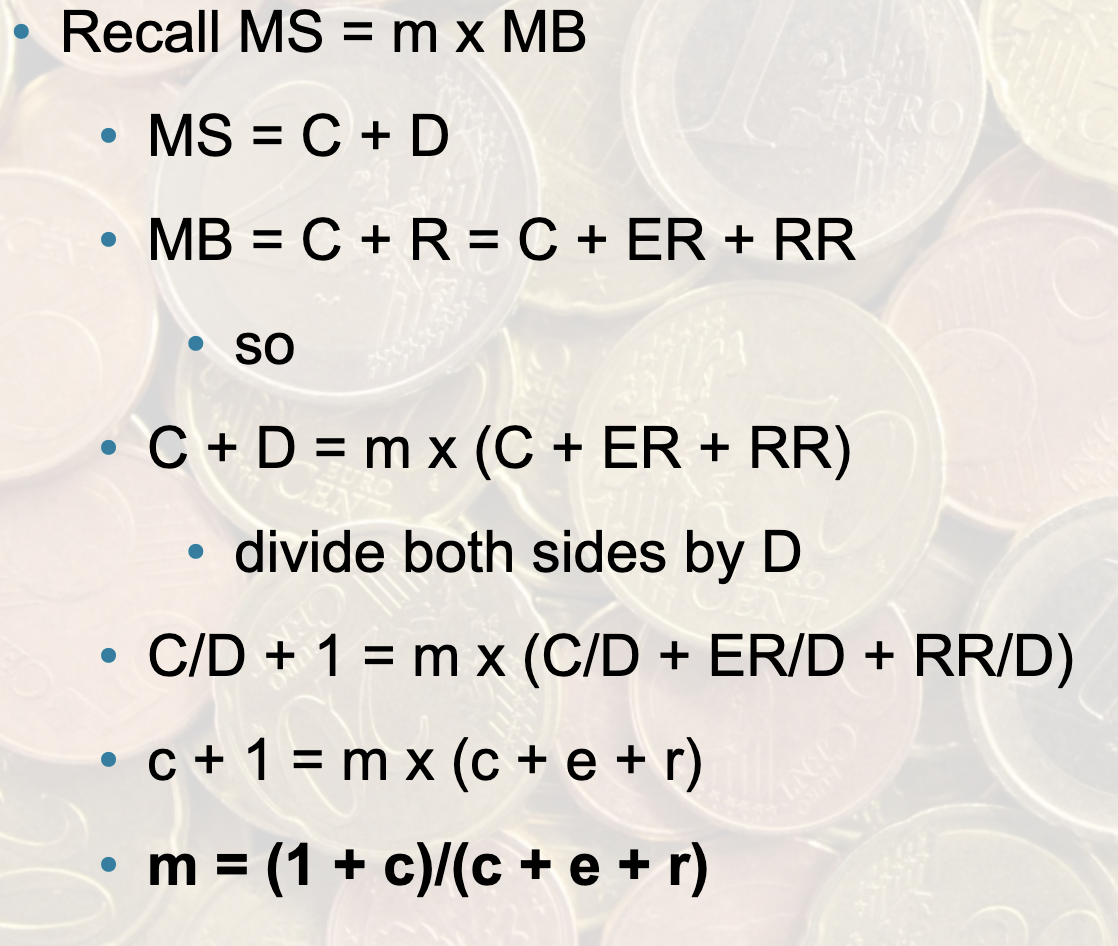
Money Supply Formula:
Where “m” is the money multiplier, dependent on actions of banks and depositors.
Deriving the Money Multiplier
Ratio Definitions:
c = Currency Ratio:
where C = currency held, D = checkable deposits
e = Excess Reserves Ratio:
r = Required Reserves Ratio:
where RR is the required reserves
Multiplier Calculation:
Examples and Calculations of Money Supply
Sample Values:
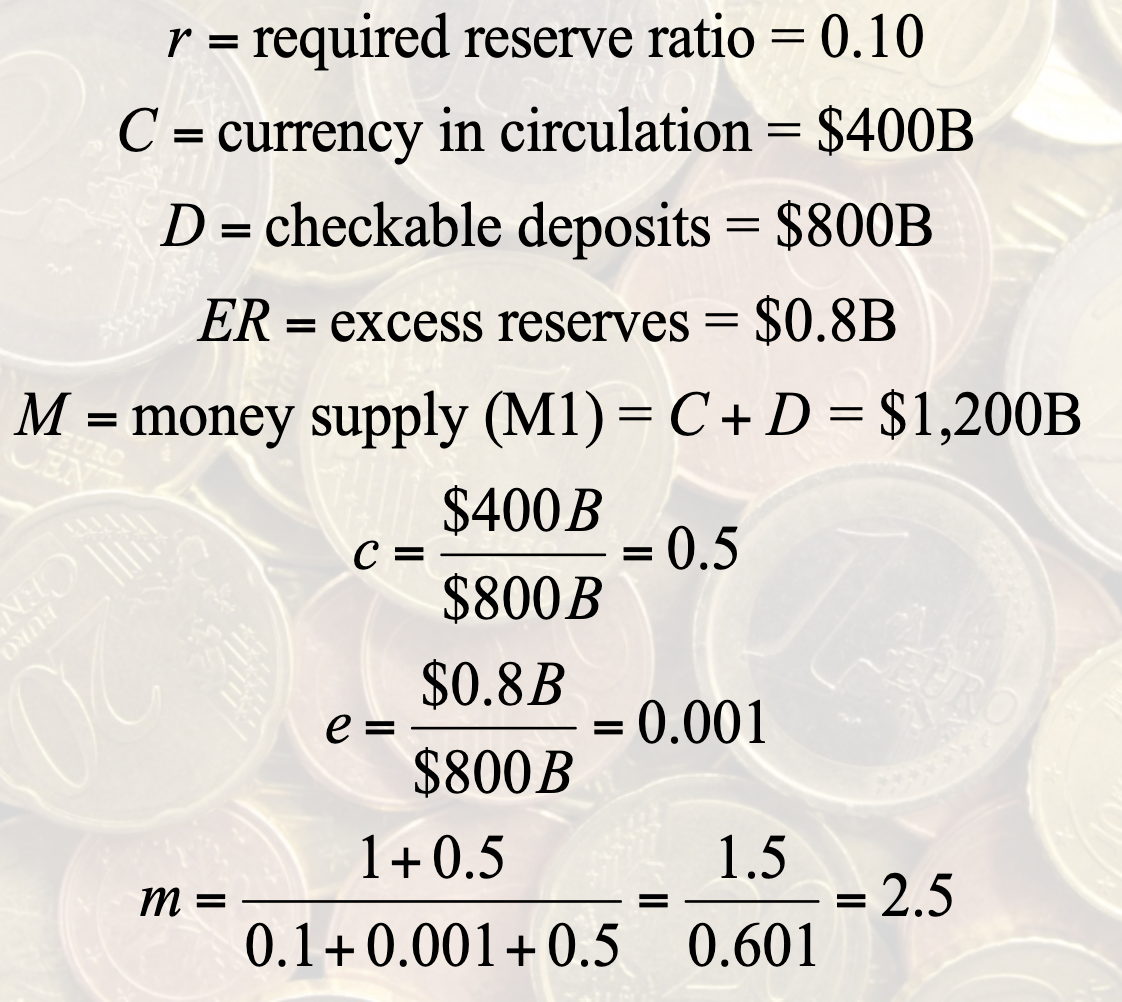
o } 2.5$$
Changes Affecting Money Multiplier
Factors Influencing Money Supply:
Required reserves ratio changes:
Money supply is negatively related to required reserve ratio
Currency holdings alterations:
Money supply is also negatively impact the money supply.
Excess reserves ratio fluctuations:
Excess reserves fluctuations negatively impact the money supply as well.
Central Bank Influence on Money Supply
Role of Central Bank:
Although the multiplier fluctuates, any shifts can be adjusted by altering the monetary base (MB).
The Central Bank can effectively control the money supply via the purchased and sold bonds; it operates differently than simply printing additional cash.
Methods to Decrease the Money Supply
Central Bank Actions:
The primary method for reducing money supply is through bond sales.
The selling of bonds decreases the money available hence leading to:
A lower monetary base
Diminished loan availability and deposit creation capacity.
2007 - 2009 Economic Crisis
Concerns and Reactions:
During the financial crisis, fears arose regarding the Fed's potential to create runaway inflation due to extensive bond purchases.
Inflation is ultimately linked to an excessive money supply rather than merely an increased monetary base.
Conclusion from Historical Context
Monetary Base vs. Money Supply Dynamics:
During this period, although the Monetary Base was notably raised, it was in response to a significant decline in the money multiplier.
The Central Banks' intervention through operations successfully avoided deflationary conditions, which could have been devastating.
Final Example - Calculating Money Supply Dynamics
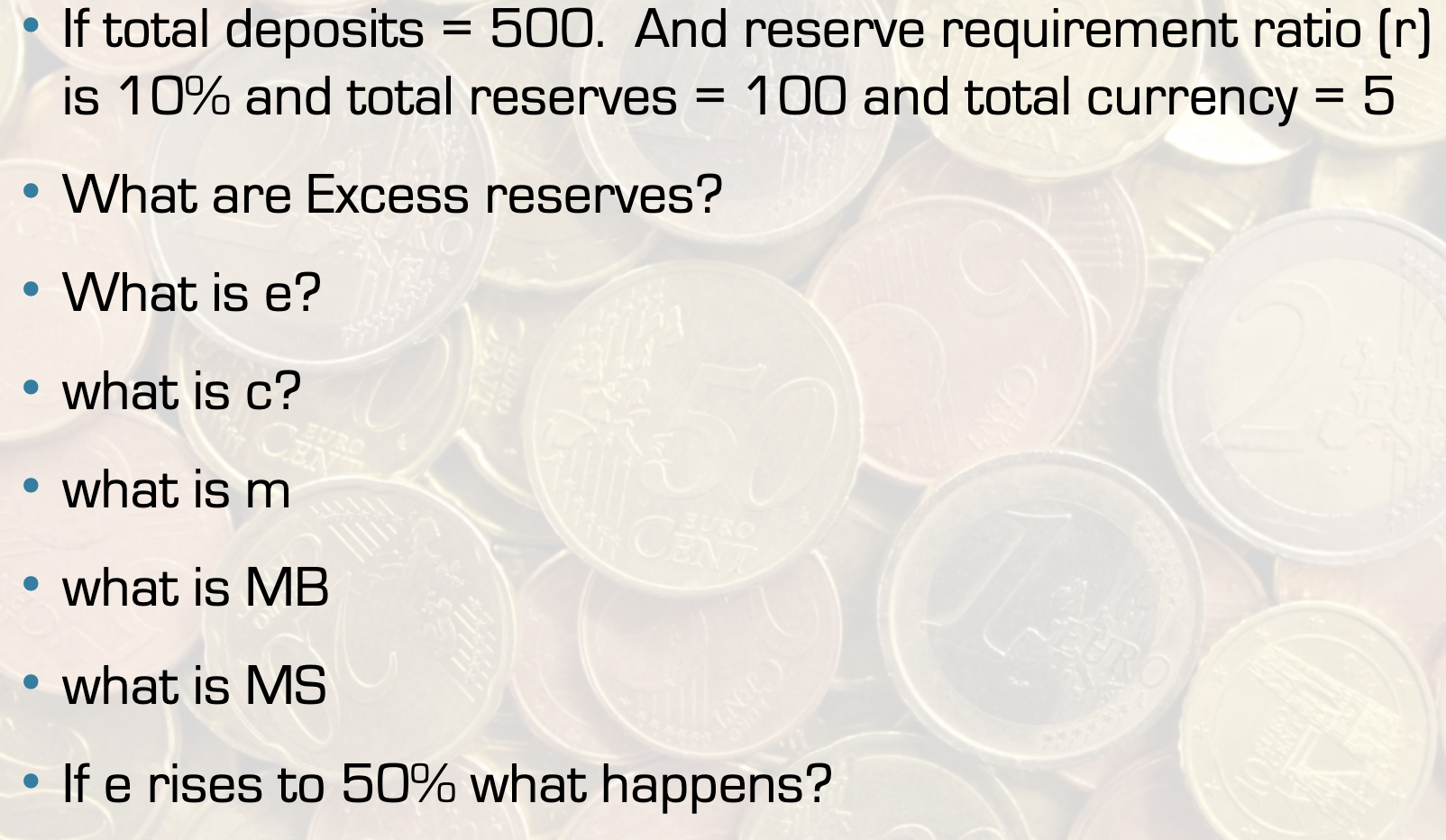
ER = TR - RR
RR = 0.1 × 500 = 50
100 - 50 = 50
ER = 50
e = ER/D
e = 50/500
e = 0.1
c = C/D
c = 5/500
c = 0.01
m = (1 + c) / (r + e + c)
m = (1 + 0.01) / 0.1 + 0.1 + 0.01)
m = 4.81
MB = C + R
MB = 5 + 100
MB = 105
MS = C + D
MS = 5 + 500
MS = 505