L1 - Intro to Nutrition
What is Nutrition?
- The science of food
- Nutrients and substances in food
- Their action and interaction in relation to health and disease
- The processes by which an organism ingests, digests, absorbs and excretes food substances
Future of Nutrition?
- Modern nutrition is now about understanding and tackling the effects of over nutrition
- Used to be about tackling malnutrition
- Also we are starting to focus on nutrigenomics, personalized nutrition and how diff ppl respond to the same thing
Essential Nutrients
- Chemical that is required for metabolism
- Cannot be synthesized or isn’t synthesized fast enough to meet the needs of the organism to perform physiological functions
Nutrients are essential to the human diet if…
- Removing the nutrient causes deficiency and decline in health
- Putting nutrient back in corrects the problem and health returns
Nutritional Deficiencies
- Occurs when a person’s nutrient intake CONSISTENTLY falls below the recommended requirement
- Iron, B1, Vit C or D
Deficiency vs Nutritional Requirement
- Deficiency is the amount you need to avoid in order to prevent disease or health decline
- Nutritional requirement is recommended amount to achieve optimal health
Why do we need to know Nutritional Requirements?
- This idea was prompted around WW1 for food rationing but they were limited with the 1st recs
- this is bc it was solely based on young, male, active soldiers
Daily Values
- Recs based on a 2000-calorie-a-day diet
- not very individualized (general population)
- not as factual as an estimate
- are made using DRIs
Dietary Reference (DRIs)
- Umbrella term that refers to a set of reference values (EAR, RDA)
- Established by the National Academy of Sciences using published data
- More factual and evidence based (not an approximation)
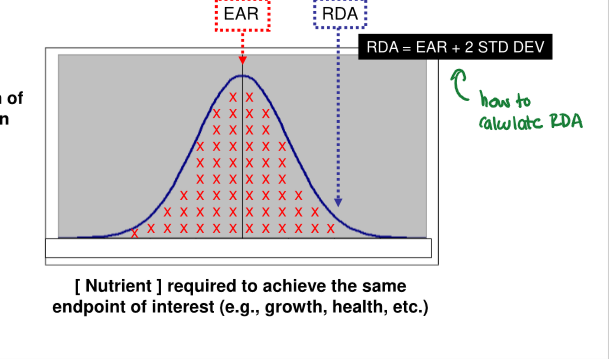
Estimated Average Requirement (EAR)
- Range of nutrient intakes required to meet the needs of 50% of the population (optimal health growth and storage)
Recommended Dietary Allowance (RDA)
- Nutrient intakes that meets the needs of 97% of the population
How to calculate RDA or EAR
- RDA = EAR + 2 STD DEV
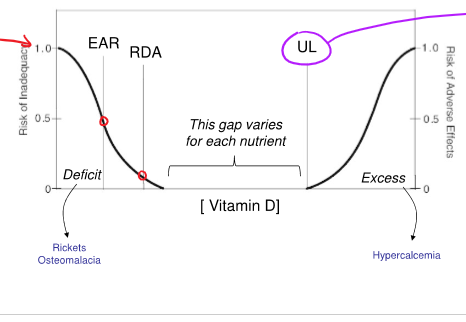
Tolerable Upper Limit
- Highest level of CONTINUOUS daily nutrient intake that causes no risk of bad effects (just before it gets bad)
Adequate Intake (AI)
- When you don’t have sufficient evidence to establish an EAR and RDA, then AI is created
- much less scientific data
- It is determined based on intake in healthy ppl who are assumed to have adequate nutritional status
- expected to meet the needs of most indiv
Minnesota Starvation Experiment
- Characterized the physical and mental effects of starvation
- Resulted in weight loss, irritability, dizziness, hair loss, reduced sex drive, depression
4 Characteristics of a Nutritious Diet
- Adequate - Diet that provides enough calories, essential nutrients and fiber to keep you healthy
- Moderate - making sure you don’t consume excessive calories or eat more of 1 food or food group
- Balanced - Eat nutrient dense food rather than nutrient poor
- Varied - Eating a wide selection of foods to get necessary nutrients
Methods used for Studying Nutrition
- Cell culture models
- Animal models
- Human studies (clinical studies)
Nutrient Classes
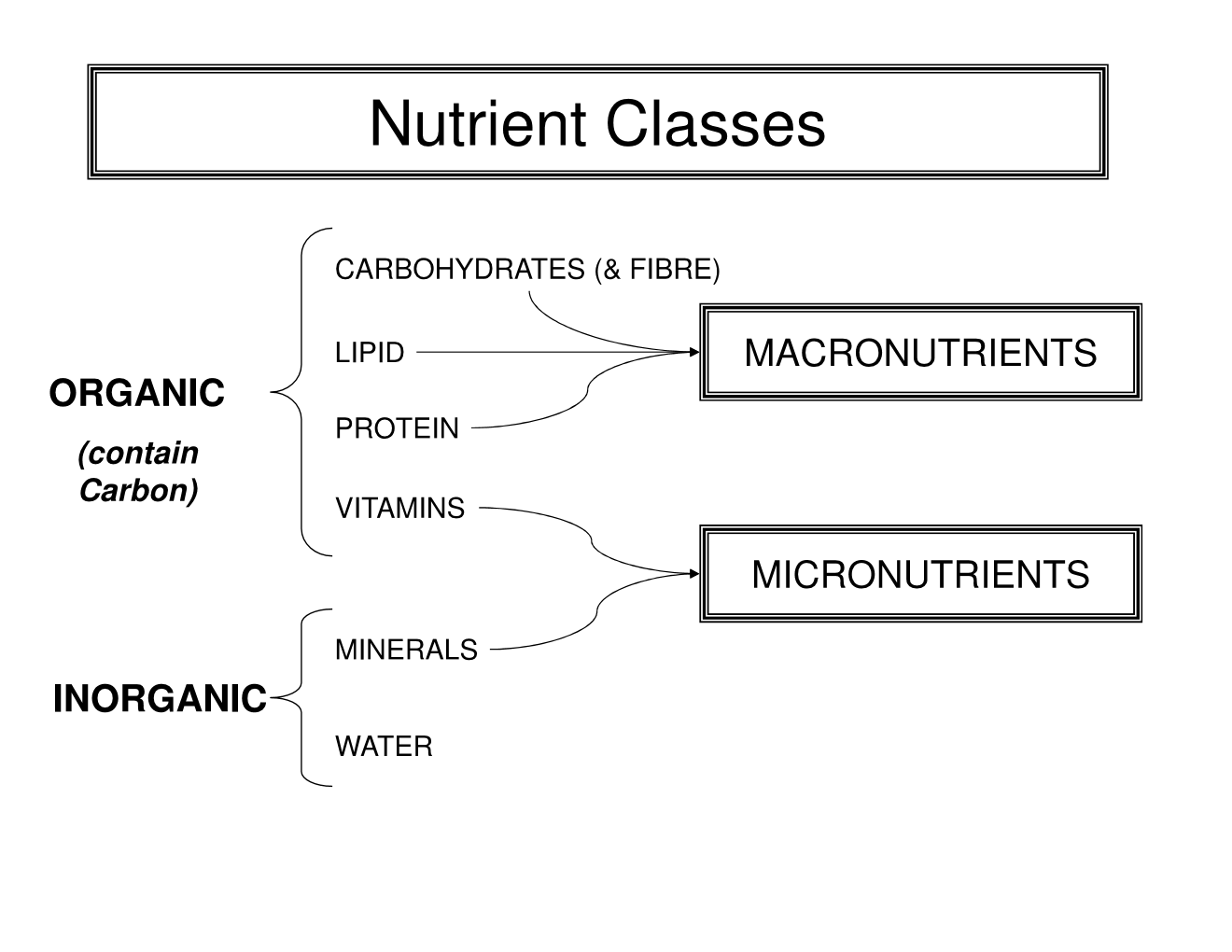
Organic - Contains C
Inorganic - No C
Macronutrient - We need a lot
Micronutrient - We don’t need a lot
Major Components in our body
- Fat (adipose)
- Protein (in muscles)
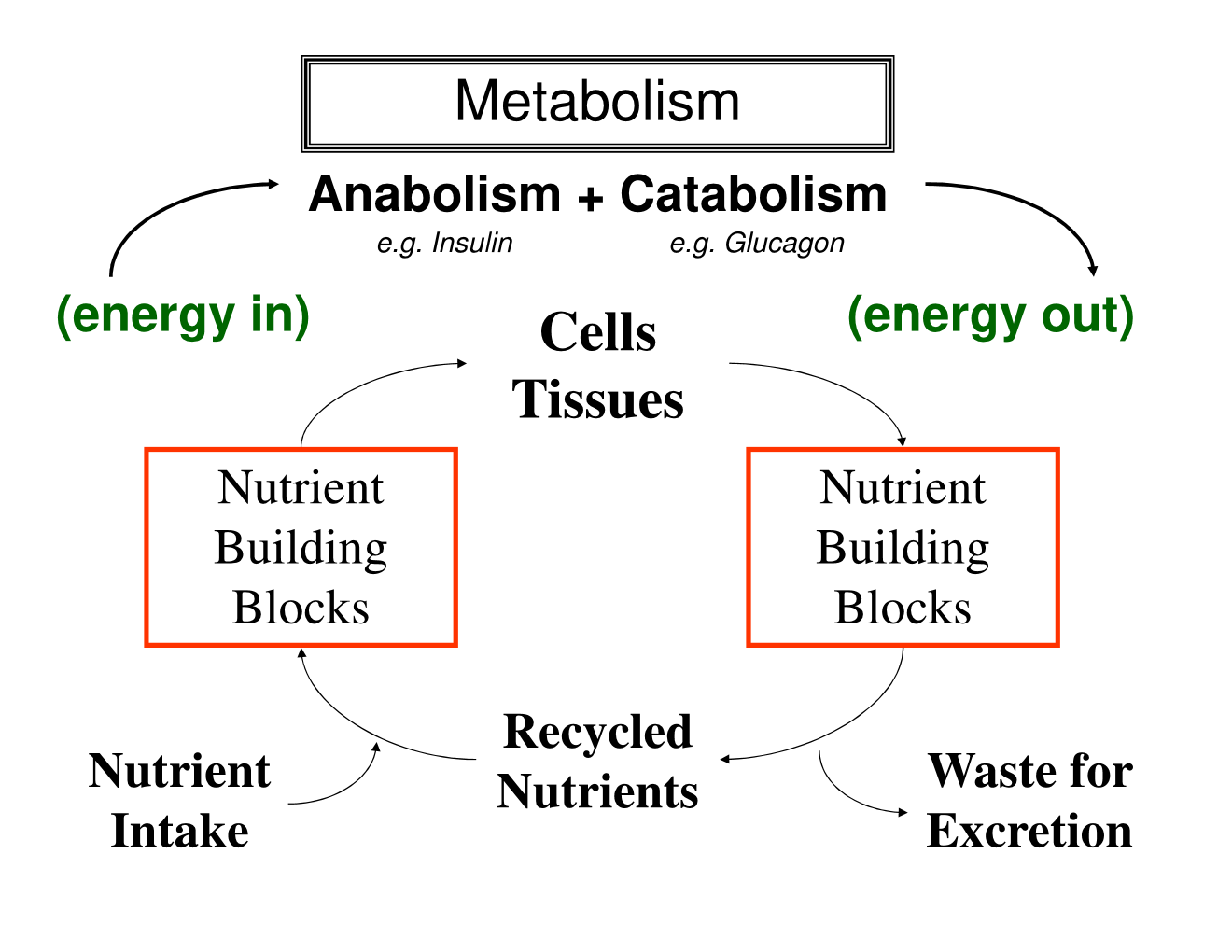
Metabolism
Anabolism - Forming things
- Insulin
- Oversees building things
- Uses it or stores it
- Energy storage (In)
Catabolism - Breaking things down
- Glucagon
- Utilizing the stored energy (out)
- Breaking down and releasing energy
Water is an essential nutrient
- It is imp in bio chem rxns
- Hydrolysis (catabolic)
- Nutrient transport
- Vascular volume
- Temp Regulation
When does water become toxic
- Hyponatremia - Water/Sodium Imbalance
- Can occur from excessive fluid intake, avoided with urination
- Cells become swollen, water goes in, Na+ comes out