1.5 Origins of Cells
==Study Links==
Non-living Synthesis
the theory that living cells arose from non-living matter is known as abiogenisis
this process is theorised to have occurred over four stages:
- there was non-living synthesis of simple organic molecules (from primordial inorganic molecules)
- simple organic molecules assembled into more complex polymers
- certain polymers formed the capacity to self-replicate (enabling inheritence)
- these molecules become packaged into membranes with an internal chemistry different from their surroundings (prontobionts)
Miller-Urey
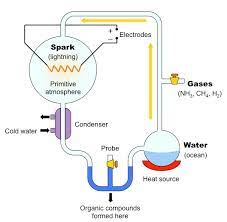
non-living synthesis of simple organic molecules has been demonstrated by the Miller-Urey experiment
Stanley Miller and Harold Urey recreated the postulated conditions of pre-biotic earth using a closed system of flasks and tubes:
-water was bioled to vapour to reflect the high temperature common to earths original conditions
-the vapour was mixed with a variety of gases (including H2, CH4, NH3) to create a reducing atmosphere (no oxygen)
-this mixture was then exposed to an electrical discharge (stimulating the effects of lightning as an energy source for reactions)
-mixture then was allowed to cool (concentrating components) and left for a period of around one week
-after this time the condensed mixture was analyzed and found to contain traces of simple organic molecules
Biogenesis
chemical process that contributed to the initial formation of biological life requiring specific conditions to proceed
included a reducing atmosphere and high temperatures (>100C) or electrical discharges to catalyse chemical reactions
these conditions don’t commonly exist on modern earth and hence living cells cant arise independently through abiogenesis: instead can only be formed by the cell-division of pre-existing cells
biogenesis describes the principle that living things can only arise from other living things by reproduction (not spontaneous generation): “omne virum ex vivo”- all life is from life
Pasteurs Experiment
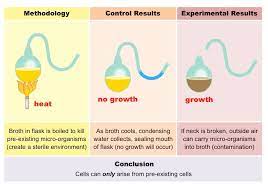
law of biogenesis attributed to Louis Pasteur who demonstrated that emergent bacterial growth in nutrient broths was due to contamination from pre-existing cells
-broths stored in vessels containing long tubings (swan neck ducts) that didnt allow external dust particles to pass
-broths boiled to kill any micro-organisms present in growth medium (sterilization)
-growth only occurred in flask if it was open, exposing contents to contamination from the outside
-from this was concluded that bacterial growth from external contaminants and didn’t spontaneously occur
 Endosymbiosis
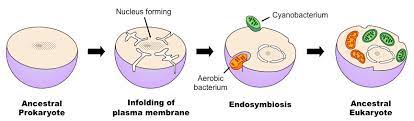
an endosymbiont is a cell that lives inside another cell with mutual benefit
eukaryotes were believed to have evolved from early prokaryotes that were engulfed by phagocytosis where it remained undigested as it contributed new functionality to the engulfing cell (e.g. photosynthesis)
over generations engulfed cell lost some of its independent utility and becomes a supplemental organelle
 Evidence for Endosymbiosis
mitochondria and chloroplasts are both organelle suggested to have arisen via endossymbiosis
evidence that supports the extracellular origins of these organelle can be seen by looking at certain key features (Mad Dr.):
Membranes (double bound): outer mebrane may mean that it was vesicular in origin
Antibiotics (susceptibility): indicates, e.g. chloramphenicol, organelles maay have bacterial origins
DNA (presences and structural composition): has own DNA and its naked and circular, like in prokaryotic DNA structure
Division (mode of replication): occurs via fission like process
Ribosomes (size): 70s sized ribosomes, identical to the ones in prokaryotes