5/15/26
-mini lesson-
Like analytsis, commentary…
>analyze what figurative lag. means/make infrences
>shows how the evidence supports the claim
Where commentary takes it further…
>discusses importance to text or deeper implications
-for fiction, this can include theme. for non fiction, this can include context/exigence
>connects to authors pupose or the effect on the reader(or both)
commentary is abt. being critical and insightful analysis!!
Mules: Stubborn, working animal, carry heavy loads
Nanny tells Janie how a black woman is “de mule of de world” in ch. 2
>What do you think the mule symbolises in TEWWG?
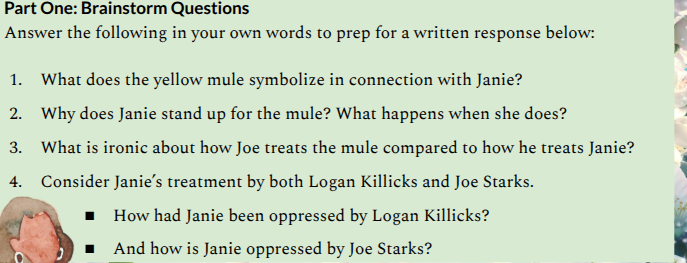
The yellow mule symbolizes Janie’s own lack of agency and oppressed status within her marriage to Joe Starks. Like the mule, which is overworked, abused, and publicly ridiculed by Joe and the townspeople, Janie is objectified and silenced. The mule acts as a mirror for Janie’s situation, representing the way Joe views living things as property to be controlled rather than individuals to be respected.
Janie stands up for the mule because she empathizes with its suffering; she recognizes the injustice of the men tormenting a creature that has been worked to exhaustion. When she speaks out, Joe Starks becomes furious and suppresses her voice, further enforcing her public silence.
The irony lies in the fact that while Joe publicly rescues the mule from abuse—giving it a "retirement" and treating it with a mock sense of importance—he simultaneously treats Janie as an object to be controlled, silenced, and utilized for his own social status, effectively committing the same kind of dehumanizing abuse he pretends to condemn.
Logan Killicks oppresses Janie through physical labor and the denial of emotional connection, while Joe Starks oppresses her through social control, the erasure of her voice, and the manipulation of her identity. Logan views Janie as a manual laborer. He forces her to perform menial farm work (like chopping wood) and treats her as a functional tool to help him maintain his land, rather than as a partner. He offers no romantic love or emotional support. Joe treats Janie as a trophy or an extension of his own ambition. He forces her to dress and behave in a way that reflects his status as mayor. He stifles her personality and prevents her from socializing or speaking her mind in public, systematically removing her independence. While Logan’s oppression is grounded in physical demand, Joe’s is more psychological and social; both, however, strip Janie of her agency and individuality.

In Zora Neale Hurston’s Their Eyes Were Watching God, the mule serves as a potent symbol for the marginalized and exploited status of Black women, specifically reflecting Janie’s experience of being silenced and objectified by the patriarchal figures in her life. When Logan Killicks attempts to force Janie to perform manual labor, he treats her not as a wife, but as a "beast of burden."(Hurston 31). This comparison to a mule metaphorically captures Janie’s lack of agency and the way her identity is stifled under the control of her husbands. By portraying Janie’s life through this lens, Hurston critiques the systemic dehumanization of Black women, who were often valued only for their domestic utility. Ultimately, the evolution of this symbol underscores Hurston’s broader purpose: to illustrate Janie’s struggle to transcend her role as a societal "mule," reclaim her voice, and achieve true self-actualization, thereby challenging the audience to recognize and dismantle the cycles of oppression that seek to limit women’s potential.