1b. Trading blocs
Trading blocs
A regional trading bloc is a group of countries within a geographical region that protect themselves from imports from non-members. Trading blocs are a form of economic integration, and increasingly shape the pattern of world trade.
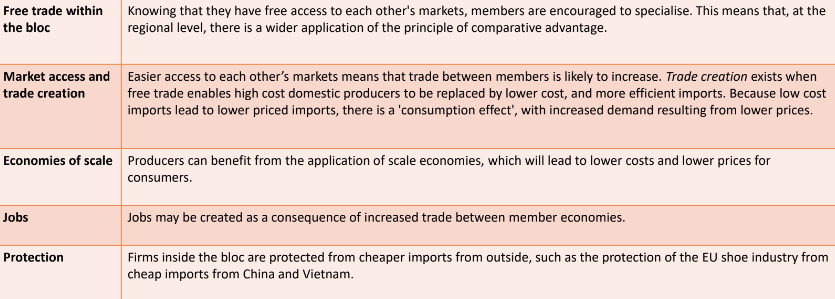
Advantages of joining a trading bloc
Disadvantages of joining a trading bloc
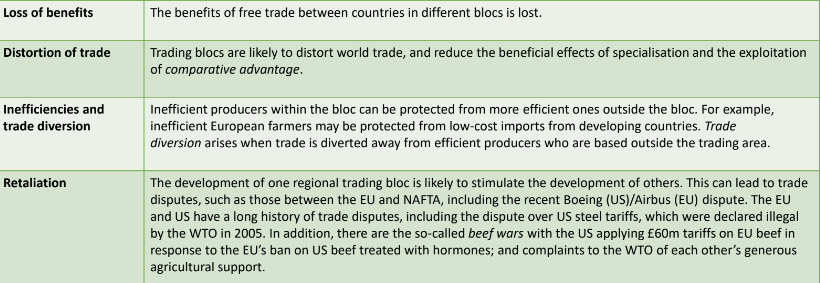
The UK faced trade diversions as they joined the trading bloc the imports from commonwealth countries would become expensive due to tariffs.
Similarly, Uganda would also face trade diversion, their main trade countries are in Asia so joining a local trading bloc would put them at a disadvantage as trade would become more expensive with the countries they usually trade with.
Trade creation
Trade creation is the movement from a higher cost source of output to a lower cost source of supply as a result of joining a trade agreement.
Trade creation occurs when a country enters a free trade area / agreement or becomes involved in a customs union in which there is free trade between members but also a common external tariff.
Trade diversion
Trade diversion is a switch from a lower-cost foreign source/supplier outside of a customs union towards a higher-cost supplier located inside the customs union.
Trade diversion is a feature of a country deciding to join a customs union i.e. an area where there is free trade within the customs union but also a common external tariff.
When a country joins a customs union it might initially be trading freely with a low-cost supplier in a 3rd party nation.
Once inside a customs union, the country must now adopt a common external tariff which will then increase the cost of importing from the 3rd party nation.
These higher prices might affect consumers directly e.g. higher prices for food.
Or they might affect consumers indirectly because producers now have to pay more for their imports from the 3rd party.
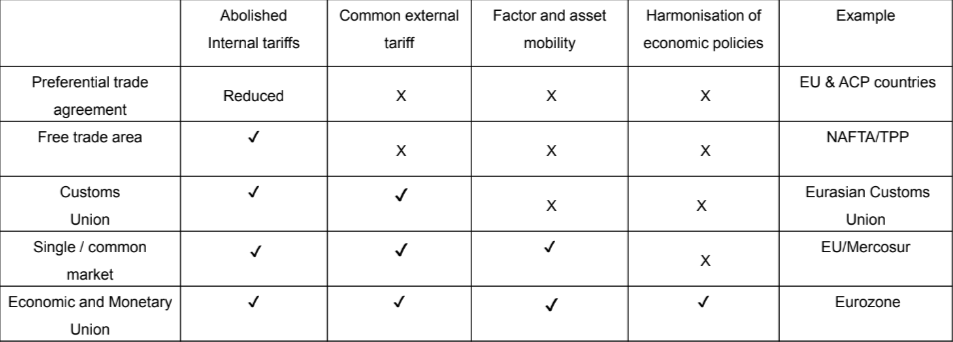
Deciding on levels of integration
Internal Tariffs
Are there taxes on trade within the trading bloc?
Common External Tariff
Do non-members have to pay the same amount to import goods and services into the trading bloc?
Factor and Asset Mobility
Is capital and/or labour free to move around the area?
Harmonisation of Economic Policy
Is there a common fiscal or monetary policy?
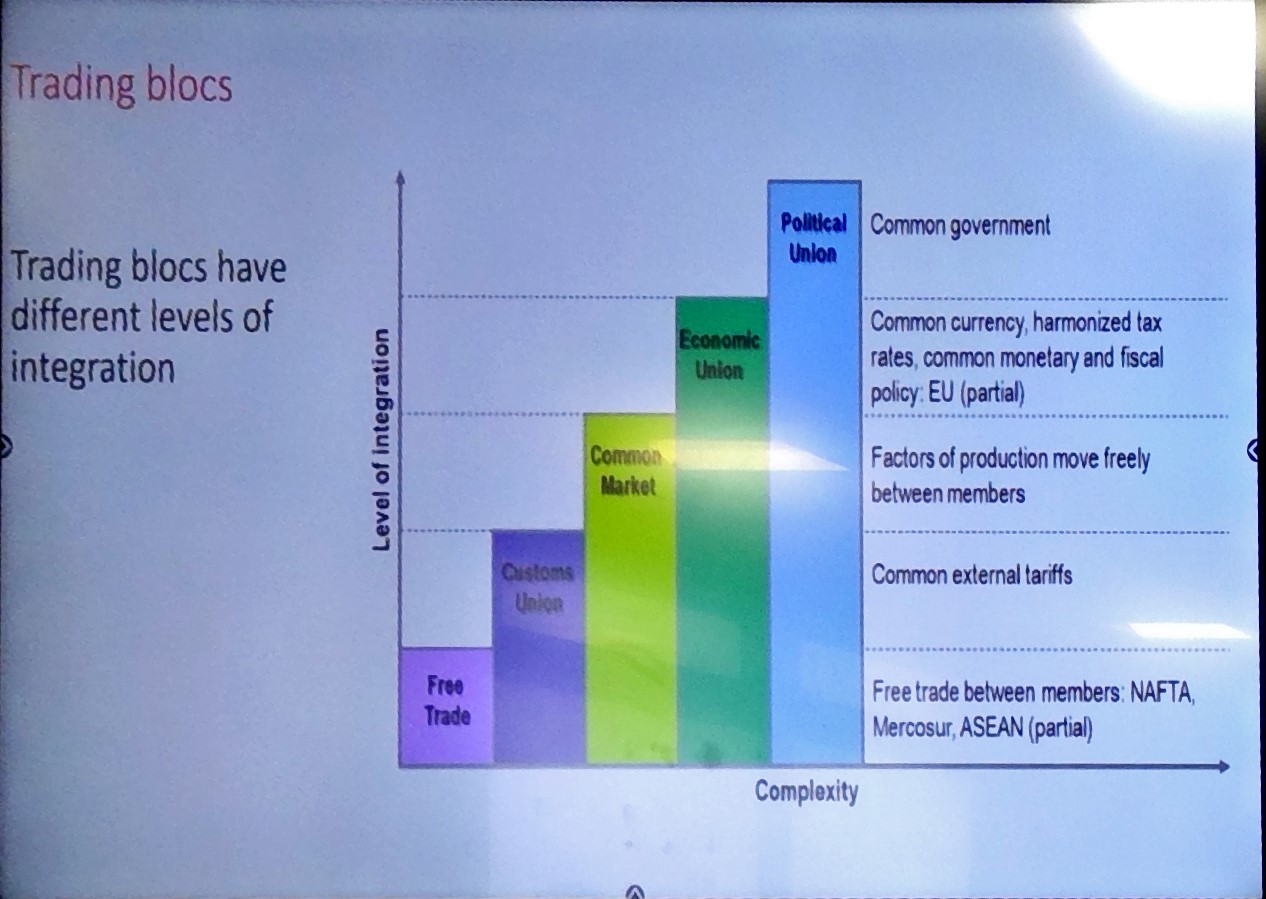
Levels of integration
Common market
Joining a common (or single) market is perhaps the most significant step a national economy can take towards integrating with its neighbours.
A single market may be defined as a formal arrangement between sovereign nations to allow members free access to each other's markets. Free access relates to the unrestricted movement of goods and services, as well as the free movement of labour and real and intellectual capital.
Advantages of common markets
Trade creation, where trade is stimulated as a result of free access to markets.
The exploitation of economies of scale by local firms as their markets expand.
Lower production costs as a result of scale economies.
Lower prices as a result of lower costs and increased competition.
Common production standards, which reduces information failure allowing consumers to make more rational choices.
Technology transfer as a result of increased investment flows between members.
Transfer of skills across the single market.
Increased labour mobility enabling wage costs to converge, and unemployment to be spread more evenly between members.
Increased capital mobility which increases its relative supply in each country, and enables businesses to grow and innovate.
Increased remittance flows between workers resident in one country and families remaining in another country.
Co-operation on common projects of mutual benefit, such as green energy research.
Enables jointly produced goods which members might not be able to fund on their own, such as Europe's Airbus consortium.
Disdvantages of common markets
Trade diversion may result from single market membership, as more efficient non-members are crowded out of local markets.
Lower wages as migrant labour may drive down local wages.
Rising negative externalities associated with the free movement of people, including pressure on infrastructure and the insufficient supply of merit goods such as healthcare and education.
Trade rules may favour some members over others, and some industries and sectors over others.
Excessive bureaucracy may inhibit the ability of members to innovate.
Members may become inward looking and their industries fail to respond to changes in the global economy.
Lost opportunities to exploit closer relationships with non-members through free trade deals between individual members and non-members (which, at least in the European single market, are not allowed.)
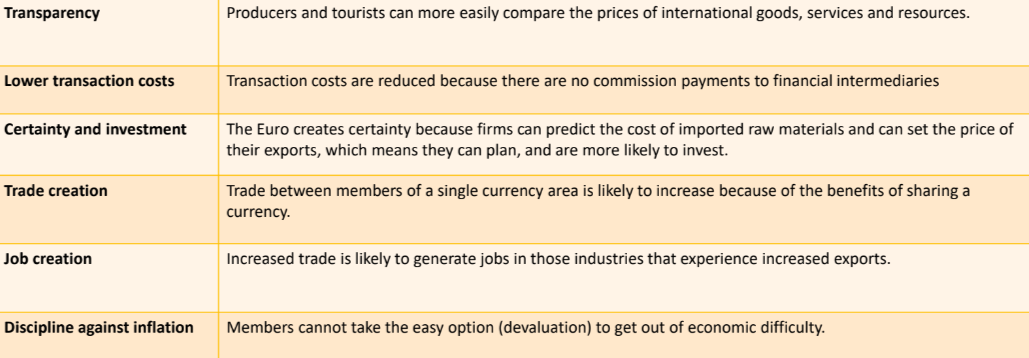
Advantages of monetary unions
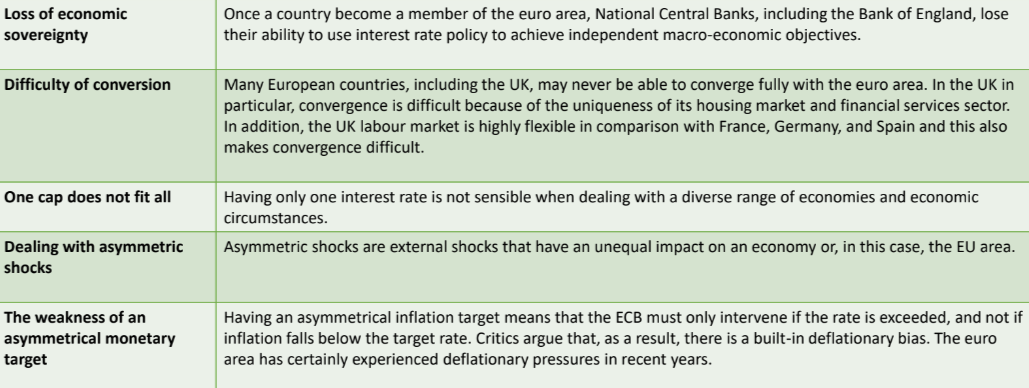
Disadvantages of monetary unions
Role of the European Central Bank (ECB)
Sets the interest rates at which it lends to commercial banks in the eurozone (also known as the euro area), thus controlling money supply and inflation
Manages the eurozone's foreign currency reserves and the buying or selling of currencies to balance exchange rates
Ensures that financial markets & institutions are well supervised by national authorities, and that payment systems work well
Ensures the safety and soundness of the European banking system
Authorises production of euro banknotes by eurozone countries
Monitors price trends and assesses risks to price stability.
Asymmetric shocks
Asymmetric shocks are external shocks that have an unequal impact on an economy or, in this case, the EU area. The following recent shocks did not have an equal effect across Europe: the handover of Hong Kong to China by the UK in 1997 led to an exodus from Hong Kong to the UK, and not to the rest of Europe, and helped fuel a mini-housing boom in parts of London; the September 11th 2001 attacks on New York did not affect all euro area countries evenly; and the collapse of the Argentinean peso in 2002 mainly affected Spain.
The growing imbalance between the more affluent northern euro members, including Germany, and the increasingly indebted southern ones, including Greece, Italy and Portugal, has also raised the issue of the inadequacies of having a single monetary policy. In these types of circumstance it is argued that a single interest rate will not be appropriate. A member experiencing a negative (perhaps domestically originating) shock would require lower interest rates and looser monetary policy in comparison with those members less affected.
Trade creation vs trade diversion
Outside of a customs union, each country will seek to trade freely with others. One country will specialise knowing that it is able to export finished goods cheaper than competitors. They will also import goods they need for the cheapest possible price from another country that is specialising.
In a situation where countries don’t trade freely by either imposing tariffs or favouring one country over another trade will be distorted and the pattern of trade will change. Inefficient producers may be protected and encouraged at the expense of more efficient ones.
The creation of common markets with common external tariffs distorts trade patterns because member countries are protected.
Trade creation vs trade diversion
Once a common market is created, members agree to eliminate tariffs between themselves. The effect of this is that, facing lower priced, zero-tariff, imports from members, consumers increase their demand for these goods, and new trade will be created – a process called trade creation
The major loser in this is the previous trading partner left outside the bloc - less trade now exists between new members and their old trading partners. The process of efficient producers losing out to inefficient ones is generally referred to as trade diversion.
It is important to remember that there is a loss in revenue to the government as they are no longer receiving money from tariffs