Business Year 12
Operation Management
An operations system is used to transform inputs (e.g. labor, materials, etc.) into outputs (e.g. car, chocolate, beer - any good or service you can think of), through a transformation process.
Operation management is the area of management responsibility that oversees all activities involved in managing an operations system to efficiently and effectively produce finished goods or services, and create improved profit margins for a business.
Business Objectives
Meeting shareholder expectations, financial objectives (i.e. increased profits, increased percentage of market share), and social objectives.
Effective management of operations can have a big impact on the achievement of these key business objectives.
Indications of Business Performance
| Financial Indicators of Performance | Non-financial indicators of performance |
|---|---|
| Rate of productivity growth – how well a business transforms inputs (e.g. materials) into outputs/finished products, compared to previous levels. | Rate of staff absenteeism – a percentage indicating the number of workdays lost to unscheduled staff absence from work, usually without a valid reason. |
| Percentage of market share – The proportion of total sales accounted for by the organization compared to competitors. | Rate of staff turnover – the rate at which employees join/leave the business, usually expressed as a percentage each year. |
| Number of sales – The total amount of sales generated by a business across a given period (usually monthly, quarterly, or yearly). | Number of customer complaints/returns – the number of customer written or verbal expressions of dissatisfaction or concern about the business’ products or services. |
| Net profit figures – revenue from sales minus costs/expenses incurred. | Level of wastage – a measure of efficiency which captureslevel of scrap/waste created during transformational processes to convert inputs in to outputs. |
| Return on investment – any interest or dividends returned to shareholders. | Number of workplace incidents – a measure of how safe the business is for employees, customers and other stakeholders measured by how many OH&S incidents have occurred. |
| Share price – value of the company’s shares on the stock exchange. |
Operations Management and Business Objectives
Operations are vital to the success of a business, due to this area producing the goods or services that are sold to consumers, which generates sales, revenue, and ultimately profit.
There are a number of strategies the operations manager will implement in order to optimize (make the most effective use of or get the most out of) the business operations system (IPO), to best achieve business objectives:
| Use of technology | Materials management | Quality management | Waste minimization |
|---|---|---|---|
Relationship Between Operations and Business Objectives
The operations management function has a considerable influence on the quality*,* cost, and availability of an organization’s goods or services. These have a direct bearing on whether the organization achieves its main objectives — to increase profitability, increase market share, provide a good return for investors or to contribute to the wellbeing of the community”.
(Jacaranda Textbook, pg. 100)
Relationship Between Operations and Business Objectives + MEETING SHAREHOLDER EXPECTATIONS
| Financial Indicators of performance | |
|---|---|
| Net profit figures – revenue from sales minus costs/expenses incurred. | Using strategies across all 4 areas to optimise operations can help reduce business operating costs (e.g. by sourcing cheaper inputs, improving productivity or reducing waste) or boost the quality of the end product. In both cases, improved net profit figures can result from increased sales, and/or reduced costs. |
| Return on investment – any interest or dividends returned to shareholders as a financial return on their initial investment in purchasing shares in the business. | Minimising waste in production , using technologies (e.g. robotics) and minimising costs in the management and handling/movement of materials can help to reduce business operating costs. Investing in quality management strategies (e.g. quality control and quality assurance) can enhance the quality of products, attracting higher sales. All strategies implemented to optimise operations can help improve profits and increase shareholder dividends/returns*.* |
| Share price – value of the company’s shares on the stock exchange. | As above, by reducing waste and inefficiency in operations, and improving productivity and quality throughout the operations system, businesses can enhance their competitiveness and potentially give the business a competitive advantage over rivals. This will help the business’ financial performance, which could attract increased shareholder investment, boosting the share price. |
Relationship Between Operations and Business Objectives \n \n FINANCIAL OBJECTIVES
| Financial Indicators of performance | |
|---|---|
| Rate of productivity growth– how well a business transforms inputs (e.g. materials) into outputs/finished products, compared to previous levels. \n | Managing the use of technology (e.g. introducing automated technologies such as robotics) can assist in increasing the rate of productivity. Enhancing quality and managing waste minimisation can reduce the number of defective units produced, which can also help improve productivity. |
| Percentage of market share – The proportion of total sales accounted for by the organisaton compared to competitors.Number of sales – The total amount of sales generated by a business across a given period (usually monthly, quarterly, or yearly). | Through the strategy of quality management (e.g. testing and inspecting goods/services as they are produced through quality control), businesses can improve the quality of the end product, giving them a competitive edge over rivals (helping achieve increased sales and percentage of market share). Managing materials effectively (e.g. inventory control) and using technology (e.g. robotics) can help reduce production costs and give the business a competitive edge based on price, assisting improved sales. |
| Net profit figures – revenue from sales minus costs/expenses incurred. | Using strategies across all 4 areas to optimise operations can help reduce business operating costs (e.g. by improving productivity or reducing waste) or boost the quality of the end product. In both cases, improved net profit figures can result from increased sales, and/or reduced costs. |
Relationship Between Operations and Business Objectives \n NON-FINANCIAL OBJECTIVES
| Non-financial indicators of performance | |
|---|---|
| Number of customer complaints/returns – the number of written or verbal expressions of dissatisfaction or concern about the business’ products or services. | Managing the quality of outputs through testing/ inspecting goods or services as they are produced and comparing to benchmark standards (quality control) can boost the quality of outputs, increasing customer satisfaction and reducing the number of complaints/ returns. |
| Level of wastage – a measure of efficiency which captures level of scrap/waste created during processes to convert inputs in to outputs. | Through the strategy of waste minimisation, businesses can reduce the amount of unwanted or unusable waste resources or outputs created through their production process. Recycling scrap/waste, or exchanging waste with others businesses as a by-product can help minimise wastage. This can also help reduce costs/improve profits*.* |
| Number of workplace incidents – a measure of how safe the business is for employees, customers and other stakeholders measured by how many OH&S incidents have occurred. | Establishing healthy and safe processes as part of operations can reduce the number of workplace incidents. Use of automated technology in production has helped to reduce the number of injuries associated with heavy lifting/labour. Effective control of stock/inventory can help minimise injuries related to movement and handling of stock. |
Inputs
- nputs refer to the resources that are used to produce the business’ goods or services.
- Inputs can include things such as:
- Raw materials - parts, components and supplies used up in the transformation process;
- Capital equipment – plant, equipment, machinery and property used to produce goods/services;
- Labour – people involved in producing goods/offering services;
- Information – knowledge relevant to business’ operations;
- Time – time needed to provide good/service;
- Finance/money – purchasing materials, paying labour, etc.
Processes
- Processes refer to any activity the business undertakes to transform inputs in to outputs (i.e. finished goods/services).
- For example, consider the following operational processes undertaken to produce Yakult.
Outputs
- Outputs refer to the end result of a business’ transformation process – the final good or service that is delivered to the consumer.
Characteristics of Operations Management with both Manufacturing and Service Businesses
Elements of an Operations System
- inputs – resources (i.e. labor, capital, knowledge, time, money, etc.) and raw materials used to produce a good or service output.
- Processes – transformational activities are undertaken to convert raw materials into a finished good or service output.
- Outputs – the end result of the operational processes, which is the finished good or service delivered to consumers.
Manufacturing vs Service Businesses
Key elements of an operations system will be for manufacturing and service businesses
A manufacturing business is any business that combines raw materials and other resources to produce a finished goof that is tangible (i.e. can be seen, touched, and stored for later use).
A service business is any business that uses resources (i,e equipment, labor, knowledge, expertise, etc.) to perform an activity that satisfies a specific need of customers that is intangible (i.e. cannot be seen, touched, or stored for later use).
Characteristics of Operations in Service and \n Manufacturing Businesses \n \n TANGIBLE vs INTANGIBLE
| Manufacturing Businesses | Service Businesses | Examples | |
|---|---|---|---|
| Tangible vs Intangible | Manufacturing businesses produce tangible outputs. These are goods which can be seen/touched, and stored away for later use. Quality/productivity much easier to measure. | Service businesses produce intangible outputs. This means the final service provided cannot be physically seen/touched, or stored away for later use. Quality/productivity more difficult to measure. | Haircut \n Hair straightener \n Lawn mower \n Mowing the lawn |
Characteristics of Operations in Service and Manufacturing Businesses
CAPITAL-INT ENSIVE vs LABOUR-INT ENSIVE
| Manufacturing Businesses | Service Businesses | Examples | |
|---|---|---|---|
| Labour vs Machines | Manufacturing businesses rely heavily on the use of capital equipment and machineryas key inputs in the operations system. \n This is because machines are more suited to the mass production of standardised goods and can complete simple and repetitive tasks with more efficiency and precision than humans. | Service businesses rely more on the use of labour(i.e. humans) as key inputs the operations system. \n This is because humans are more suited to carrying out services which need to be customised and tailored to the needs of the customer. Services may require more technical skills, expertise and knowledge of customer needs, which machines struggle to cope with. | Hairdressers \n Coca cola \n Financial advice \n Education \n iPhone \n Mobile service \n |
Characteristics of Operations in Service and Manufacturing Businesses \n CUSTOMER CONTACT
| Manufacturing Businesses | Service Businesses | Examples | |
|---|---|---|---|
| Customer contact | Manufacturing businesses typically produce goods which are consumed after the final good is produced as an output. Processes are usually highly automated, and there is no customer contact or involvement throughout production. | Service businesses typically provide services which are consumed simultaneously as they are produced. The customer must be present for the service to be carried out, and there is a high degree of customer contact or involvement throughout delivery of the service. | Surgery \n Car \n Dining out at a restaurant \n Ice cream \n |
Characteristics of Operations in Service and Manufacturing Businesses
STORAGE/ CONSUMPTION
| Manufacturing Businesses | Service Businesses | Examples | |
|---|---|---|---|
| Storage/Consumption | Manufacturing businesses typically produce goods which are consumed after the final good is produced as an output. These goods have a longer shelf-life and can be stored away for later use and consumption. | Service businesses typically provide services which are consumed simultaneously as they are produced. The customer must be present for the service to be carried out. The service has no shelf-life and cannot be stored away for later use. | Visit to doctor \n DVD \n Going to the cinemas \n Uber \n iPhone |
Characteristics of Operations in Service and Manufacturing Businesses
STANDARDISED vs CUSTOMISED
| Manufacturing Businesses | Service Businesses | Examples | |
|---|---|---|---|
| Standardized vs Customised | Manufacturing businesses typically produce standardized goods which are mass-produced on a large scale. Being standardized means the final output is identical or has minimal alteration (e.g.bottle of Coke). | Service businesses typically have to tailor and customize the final service to suit the needs of the end consumer. Being customized means the service (e.g. a haircut, financial advice) is altered in some way. | Mazda 3Servicing carCarlton DraughtYakultMedical treatment |
View examples on slides
Strategies to improve both the efficiency and effectiveness of operations related to technological development, including the use of automated production lines, robotics, computer-aided design, computer-aided manufacturing techniques, artificial intelligence, and online services.
Technology
- Refers to any tool used by businesses to assist in the designing, producing and selling of a good/service
- Technological development refers to advancements in the tools/equipment used to perform tasks and create products
- In today’s high-tech, internationally competitive world, the acquisition and effective use of up-to-date technology is a key strategy which operations managers use to optimise operations.
Types of Technology \n 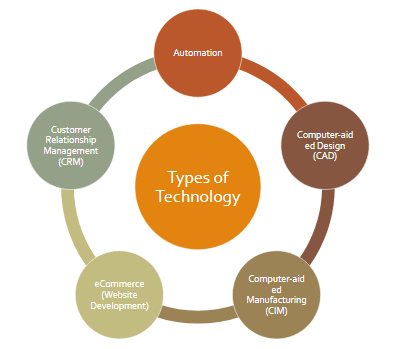
Automation
- A strategy that involves replacing human activity and effort with machinery and technology
- Automation is widely used in modern manufacturing operations systems to complete repetitive tasks involved in the production
Example of Automation: Automated Production Lines
- An automated production line involves a process where raw materials (inputs) enter an assembly line and finished products (outputs) leave with little or no human intervention.
- In an automated production line:
- Machinery at a series of workstations adds parts or components in a pre-determined production sequence until the product is finished.
- Workstations are linked by a transfer system.
- Computers act as a system to control the timing, movement, and sequencing, etc. of materials, parts, etc. along the assembly line to ensure production occurs efficiently.
Strengths and weaknesses:
| Strengths of using Automated Production Lines | Weaknesses of using Automated Production Lines |
|---|---|
| Increased speed of production | Higher initial setup costs |
| Reduction in human labour costs | May lead to redundancies/removal of employment opportunities |
| Greater precision and accuracy of processes (less prone to human error) which can minimise waste. | Machines and systems require ongoing maintenance and may need to train/upskill staff (costly). |
| Consistent and improved quality of final output produced | Systems can be exposed to threats from hackers, viruses, etc. |
| Business can remove dangerous or boring/repetitive tasks, improving workplace safety. | Rate of technological advancements can limit the life-span of systems or machines (continual upgrading). |
| Automation makes mass production possible – greater economies of scale. |
Computer-aided Design (CAD)
- CAD refers to the use of computer programs to prepare product designs, which can then be reviewed, evaluated, and modified without the need for a physical prototype to be built
- CAD enables:
- 3D diagram of product/prototype
- Accurate predictions of what final outcome will look like
- Accurate cost analysis
- Precise design and customization according to customer needs
- Production and sharing of technical documents 3-4 times fast than manual methods
Computer-aided Manufacturing (CAM)
- Computer-aided Manufacturing (CAM) refers to the use of computer software in the control of machinery, tools, and equipment during the manufacturing process.
Computer Integrated Manufacturing (CIM)
- CAD and CAM work effectively together, and when this occurs, the entire production process is controlled by a computer. This is known as Computer Integrated Manufacturing (CIM).
- When CIM is used, computerised designs stored in the CAD system are used by the CAM software to direct machinery and complete production of the CAD designs with no human involvement.
Strengths and weaknesses CAD, CAM, CIM
| STRENGTHS of using Computer-aided Design and Manufacturing | WEAKNESSES of using Computer-aided Design and Manufacturing |
|---|---|
| Increased speed of production/ production – greater productivity. | CAD/CAM software is very expensive to introduce. |
| Reduction in human labor costs (one of the biggest business expenses). | This may lead to redundancies/removal of employment opportunities (CSR). |
| Greater precision and accuracy of processes (removes human error) which can minimize waste. | Machines and systems require ongoing maintenance and may need to train/upskill staff (costly). |
| Consistent and improved quality of final output produced. | Systems can be exposed to threats from hackers, viruses, etc. |
| Efficiency is enhanced (can produce and share technical documents 3-4 times quicker than manual methods). | The rate of technological advancements can limit the lifespan of systems or software (continual upgrading). |
| Enhanced flexibility in the design process due to a ‘soft’ prototype. | Breakdowns in production lines can shut down the entire system. |
eCommerce and the Growth in Online Shopping
- eCommerce refers to the buying and selling of goods and services, or the transmitting of funds or data, over an electronic network (primarily the Internet)
- Online sales exceeded $20bn for the first time in Australia in 2016 (Australian Financial Review), with online spending growing five times faster than traditional retail spending in bricks and mortar department stores.
Website development
The development and maintenance of an accessible and visible business website has become very important to the competitiveness of a business.
| Website Development and Operations Management |
|---|
| Businesses can use websites to improve communication and information sharing between the company, customers, and suppliers. Websites can allow for automated or faster ordering of raw materials from suppliersSupplier Portals can be set up using websites to allow for effective communication and FAQsWebsites improve efficiency by minimizing costs of labor and the use of physical office space |
Strength and weaknesses Website development
| STRENGTHS of developing a website/leveraging eCommerce | WEAKNESSES of developing a website/leveraging eCommerce |
|---|---|
| Can reach customers around the world, at any time (24/7) expanding the markets the business can access. | May be expensive to pay for design and maintenance of website. |
| Can increase business sales through online avenues (i.e. bricks and clicks) and track customer behaviour. | Can expose customers to the risk of theft or online fraud (security of private information important). |
| Can reduce marketing costs through the use of email marketing, or direct advertisements on website. | Protecting private information can create extra costs (e.g. outsourcing data protection to expert provider). |
| Facilitates easier communication with employees, customers, suppliers and the community. | |
| Can avoid many of the business costs associated with running a ‘bricks and mortar’ business. |
\n Strategies to improve both the efficiency and effectiveness of operations related to materials, including forecasting, master production schedule, material requirement planning and just in time
Strategies to improve both the efficiency and effectiveness of operations related to materials, including forecasting, master production schedule, material requirement planning, and just in time
Materials management
- The strategy that manages the use, storage, handling, and delivery of materials to ensure the right amount of inputs are available when required by the operations system
- Effective management of materials is very important to the success of operations:
- Too much inventory = capital (money) tied up in stocks, when it could be used in other areas (e.g. expanding business). Excess stock increases waste (can go off), and increases costs (storage, movement and handling, etc.)
- Too little inventory = no access to materials, production delays, and an inability to meet customer demand. This can damage the business’ reputation
Materials management strategies
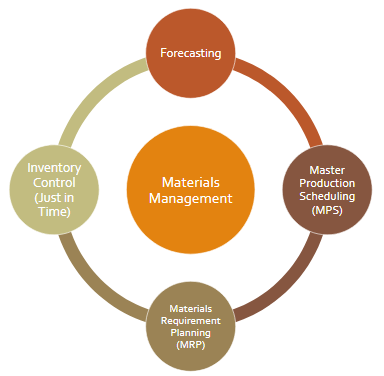
Forecasting
The job of a material manager is to achieve:
- The right MATERIALS, in the right QUANTITY, at the right PLACE, at the right TIME, at the right PRICE, and at the right SOURCE. Forecasting in very important for this.
- Forecasting is a materials planning tool that relies on data from the past and present, and analysis of the trends to attempt to determine future events.
- Effective forecasting enables a business to develop a production plan and minimize the uncertainty of future events by predicting materials and other resource needs.
What does Forecasting involve?
- Materials/Prices
- What materials are needed?
- What quantity of materials are needed
- How much will materials and transportation cost?
- Timing
- When are the materials needed?
- How much lead-in time do suppliers need?
- When does production need to commence?
- Demand
- What are the historical patterns for demand (previous 5 years)?
- How much do we need to produce to satisfy demand?
- Special demand times (e.g. Easter)?
Production and Materials Planning
- Once a materials manager has forecasted materials requirements, production, and material planning will be conducted.
- A production plan is an outline of the activities undertaken to combine resources (inputs) to create goods or services (outputs).
- The production plan includes:
- Master production schedule (MPS)
- Materials requirement planning (MRP)
Master Production Scheduling (MPS)
- A master production schedule (MPS) is a plan of what will be produced when it will be produced, where it will be produced, and the quantity in which it will be produced.
- The master production schedule specifies:
- Quantity and type of each good/service to be produced;
- How, when, and where production will occur;
- The labor force requirements.
- Delivery dates and contract agreements to meet.
- An effective master production schedule ensures that goods will be produced and delivered in time to meet the production schedule and satisfy orders/customer demand.
Materials Requirement Planning (MRP)
- Materials requirement planning (MRP) is a computer-based inventory management system that assists with scheduling and placing orders for materials by developing an itemized list of materials involved in production to meet customer orders.
- Materials requirement planning sets out:
- Lead times required by suppliers (Boeing issue);
- The exact number of raw material inputs required to meet satisfy the production schedule;
- The amount of stock (inventory) on hand;
- Purchasing procedures (batch vs bulk purchasing).
Pros and cons:
| ADVANTAGES of MPS/MRP | DISADVANTAGES of MPS/MRP |
|---|---|
| Helps to accurately determine ordering quantities and timing needs – can avoid unnecessary wastage and costs. | Can be time-consuming to develop schedules and plans for production. |
| Can assist new staff in knowing and understanding production routines. | Plans may not be realized in practice for reasons beyond the manager’s control (e.g. natural disaster). |
| Can minimize disruption to production by ensuring materials are on hand and available, reducing situations where machines are ‘idle’ (i.e. not being used). | Reduces flexibility in production, which may lead to businesses missing out on an opportunity. |
| Can help maintain a good reputation for business among its customers (i.e. deadlines met more consistently). | Can be expensive to track, record and continually analyze production schedules. |
Inventory Control (Just in Time)
- Inventory control is a system used to ensure that costs associated with maintaining an inventory of materials are minimized and that the operations system has access to the right amounts of inputs when required.
- Most businesses today have computerized inventory control systems that use barcoding to monitor stock levels/availability and stock loss (i.e. from theft), and automatically signal management when re-ordering is needed.
- A common strategy used by many businesses is the just in time (JIT) system of inventory control.
- The just-in-time approach ensures that the exact amount of materials inputs arrive only as they are required in the operations system.
| ADVANTAGES of usingJIT approach | DISADVANTAGES of usingJIT approach |
|---|---|
| Inventory (stock on hand) minimised, reducing materials handling and storage costs for the business. Also, minimal cash ‘tied up’ in stock. | Business is highly dependent on its suppliers – delays can completely shut down production. |
| Reduced space requirements, lowering rent or other premises costs. | Less time is available for checking and inspecting the quality of materials |
| Inventory is replaced as it is used, therefore waste is reduced as no over- or under-stocking of materials. | Ordering/administration costs may be higher (more frequent ordering). |
| May lose bulk order discounts. |
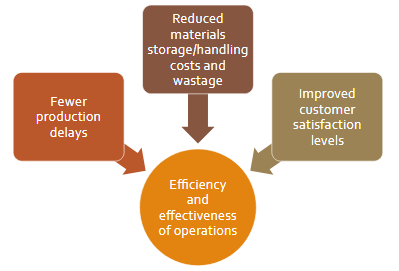
How can effective management of materials optimize operations?
Effective management of materials can improve the efficiency and effectiveness of the operations system.
 \n
\n
Strategies to improve both the efficiency and effectiveness of operations related to quality, including Quality control, Quality assurance, and Total Quality Management
Quality Management
- Quality refers to the degree of excellence of a good or service and its fitness for a stated purpose
- Quality management refers to the management of all production processes to ensure output are consistently reliable, durable, and free from defect.
Quality Management Strategies
Quality control
- Refers to a process where products and services are regularly inspected and evaluated during production/delivery to ensure they meet benchmark standards.
- The purpose of QC is to ensure problems and defects are identified before product completion/service delivery (i.e preventative measure)
- QC involves four key responsibilities
- Establish quality standards/benchmarks
- Test/inspect samples of goods/service
- Compare actual quality and benchmark
- Take Corrective action where necessary
- Strength and weaknesses
- \
| Advantages of Quality Control | Disadvantages of Quality Control |
|---|---|
| Prevents poor quality goods or services from reaching the end customer, which can give the business a positive image in the market | |
| Can increase consistency and quality of the finished output by continually testing and inspecting during production | |
| Specially trained staff can preform quality tests and inspections and are more skilled in identifying quality issues |
Quality Assurance
- Refers to a process in which a business receives certification that its systems and processes meet accepted quality standards of and external organization.
- QA is a proactive measure (as opposed to qc which is reactive) the business submits itself to rigorous testing to determine if it meets quality standards set by a certification body (e.g Standards, Australia, International Organization for Standardization (ISO))
- Undertaking QA guarantees ‘quality approval’ (i.e ‘real’ quality, as opposed to ‘official’ quality)
- Strengths and Weaknesses
Total Quality Management
- Refers to a holistic, business-wide approach to the management of quality where all members of the business commit to achieving excellence in every aspect of the business operations.
- The aim of TQM is to create a defect-free production process - all waste and inefficiency in operations are eliminated, and ‘perfection’ is achieved in every single part of the operation system.
Strategies to Improve Efficiency and Effectiveness of Operations through waste minimization in the production process, including reduce, reuse, recycle
Waste Minimisation
- Waste is any resource (raw material, labor, time, etc.) that is discarded after use, or outputs which are defective/of no use.
- Waste minimization refers to a process involving the reduction of the amount of unwanted or unusable resources produced by a business in an attempt to improve the efficiency and effectiveness of operations and maximize value for the end customer.
Lean Management
Lean management is a waste minimisation strategy that uses a range of measures (traditionally used by Japanese businesses) in an attempt to improve the efficiency and effectiveness of operations by eliminating waste, reducing costs and improving quality.
Principles of Lean Management
- Pull System
- A lean technique for reducing waste of any production process. Applying a pull system allows you to start new work only when there is a customer demand for it. This gives you the opportunity to reduce overhead and optimize storage costs.
- Kaizen (continuous improvement)
- All areas the business responsible for working together to proactively achieve regular incremental improvements in operations
- One Piece Flow
- Achieving a steady flow in production without constant starts or stops
- Zero Defects
- Zero defects is a way of thinking and doing that reinforces the notion that defects are not acceptable, and that everyone should “do things right the first time.” The idea is that with philosophy of zero defects, you can increase profits both by eliminating the cost of failure and increasing revenues through increased customer satisfaction. This strategy can be implemented with a focus on preventative quality control (eg extensive cleaning), and proactively addressing the flaws in systems and processes
Strengths and Weaknesses of Wast Minimisation
| Advantages of Waste Minimisation | Disadvantages of Waste Minimisation |
|---|---|
| Creates cost savings for the business - costs of energy, materials, waste treatment and disposal, etc, reduced | Can be time-consuming to implement waste minimization strategies ( can involve a complete overhaul of operations) and this can be disruptive to the operation |
| Emphasis on employee involvement/empowerment can increase levels of job satisfaction and staff morale | Invesstment in lean production can create large returns initially but these tend to diminish as new efficiencies become more difficult to find |
| Exchanging waste with another business | |
| can enable the business to **generate | |
| revenue from something that would | |
| otherwise be disposed of and create | |
| additional costs**. | Can increase stress and strain on employees - constant pressure to improve waste minimization |
| Businesses can minimize negative impacts on the environment, demonstrating corporate social responsibility. | Reliance on JIT - Businesses can become very dependent on suppliers. Can lead delays or disruptions in production |
| Can help a business establish a | |
| competitive advantage based on cost. |
Corporate social responsibility considerations for an operations system, including the environmental sustainability of inputs and the amount of waste generated from processes, and the production of outputs
Corporate social responsibility (Social, Economic, Environmental, Ethical, Legal Stakeholder)
(SEEELS)
The commitment by organizations to go above and beyond legal obligations to conduct their business in an ethical manner, to take responsibility for the economic, social, and environmental consequences of their activities, and to be accountable to a wide range of stakeholders, including employees, customers, and suppliers.
CSR in the operations system
Manage Inputs
- Sustainable Procurement - source inputs that do not harm the environment
- Source ‘Fair Trade’ input, or use socially responsible suppliers* only
- Use renewable energy sources (e.g. solar) to power production process.
- Source inputs locally to lower carbon emissions involved in supply chain.
Manage processes
- Ensure operational processes promote a healthy/safe working environment for employees, and ensure all employees have access to training.
- Introduce waste minimisation processes/green technologies to reduce waste.
- Retain all processes in Australia to ensure local employment opportunities.
Manage Outputs
- Ensure outputs are high quality - fit for purpose, safe, durable and reliable.
- Ensure goods produced benefit society in some way, without causing harm for society or the environment (e.g. Toyota Prius).
- Be proactive with product recalls if potential to cause harm (e.g. Toyota, VW).