Using Materials
Treating Water
potable water is water that is safe to drink - not necessarily chemically pure. 3 ways that it’s acquired in the UK:
1. fresh water sources (rivers and lakes)
water is filtered through a wire mesh to remove large solids
water is passed through a bed of sand and gravel to filter out small solids, mimicking how groundwater gets purified by layers of soil
sterilise water to kill harmful microbes. done in 3 days:
bubbling chlorine gas through it, which leads to a reaction that produces hypochlorus acid; a weak acid with disinfectant properties
expose it to ozone (O3) which causes a reaction that creates disinfecting chemicals
expose it to UV, which affects the DNA of any microbes, killing them
2. salt water sources (oceans)
distillation
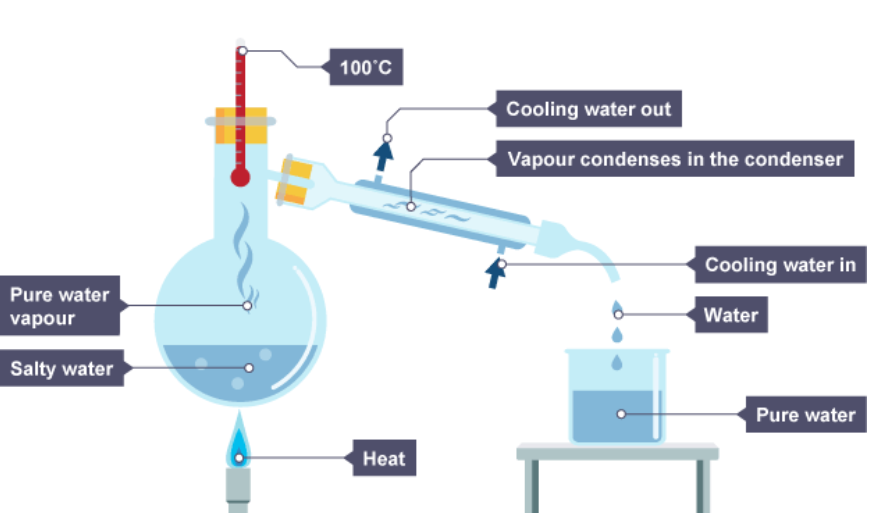
the solvent (water) has a lower boiling point than the solute (the salt dissolved in it). so when the temperature in the flask exceeds 100 degrees C it’ll evaporate, enter the condenser as a gas where it condenses back into a liquid and is collected.
+ hypothetically, you don’t need to sterilise distilled water, as the 100 degree C temps you need for the water to evaporate is high enough to kill most microbes
- uses a lot of energy in heating the water
reverse osmosis
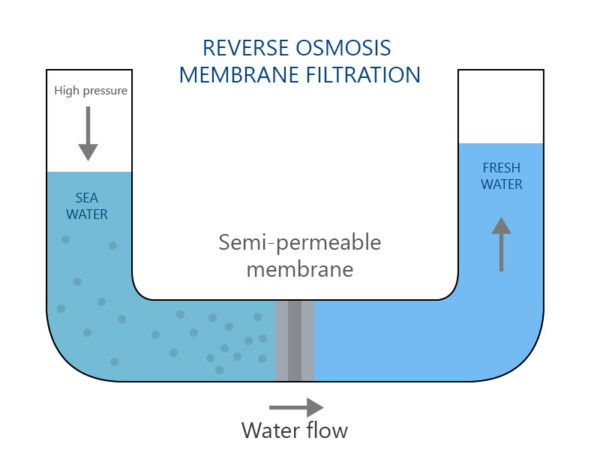
the partially permeable membrane only lets small water particles through and stops the larger salt particles dissolved into the mixture (remember that salt water is a mixture; only physically combined). water is then sterilised to remove any remaining microorganisms that may have crossed the membrane.
+ uses less energy than distillation (but still requires energy to apply pressure to the water)
- salty water can corrode the pumps of the setup, incurring a replacement cost
3. waste water sources (sewage, agricultural/industrial waste)
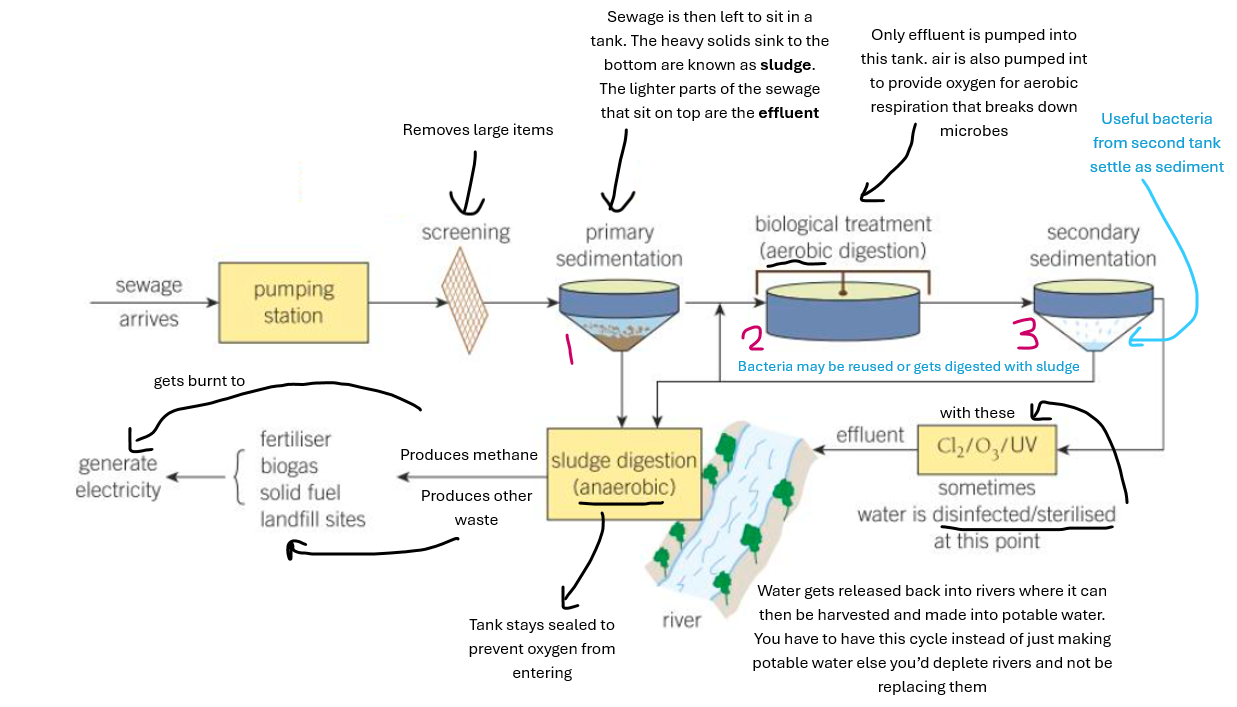
Required Practical: analysing and purifying water
part 1
put 3ml of the water sample onto a watch glass using a pipette and add a drop of universal indicator to determine its pH. note this down
rinse and dry the watchglass then weigh it
add another 3ml of the sample to the watchglass
place on top of a steam bath with tongs. alternatively, use an evaporation setup (the watchglass in that case would be the evaporation basin)
wait 5-10 minutes for the water to evaporate
once the water has evaporated, remove the watchglass from the steam bath. place it on a tissue to remove any steam that may add to its weight and allow it to cool
weigh the watchglass + dissolved solids and subtract the mass of the watchglass alone to get the weight of dissolved solids
part 2 - distillation
produce a distillation setup like the one above or like this:
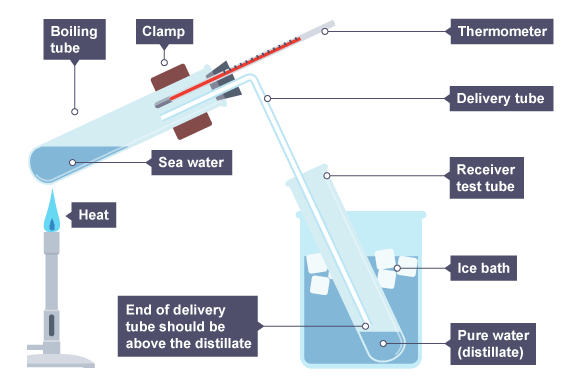
- it’s important to keep the delivery tube above the distillate for the whole experiment because otherwise, as the gas inside it and the boiling tube cools and contracts, it’ll pull the ice-cold distillate up with it. if this reaches the warm glass of the boiling tube, the glass may crack.
- the water is also not necessarily safe to drink, as there may still be microbes in it. in real life, this is treated with chlorine, ozone or UV.
heat the sea water gently. distilled water should start forming
wait until no more distilled water is produced to dismantle and cleanse the setup.
Extracting Metals
an ore is a rock that contains enough of a metal to make it economically worthwhile to extract it - the money you’d spend on the extracting process would be less than what the metal will be worth, once extracted.
copper used as the example because it’s often what these methods are used for due to high global demand. however, they can be used on other metals.
1. phytomining
plants are grown on low grade copper ore (ore with less copper than in high grade ore, which low grade ore usually surrounds), and will absorb Cu2+ ions in the ore via its root system
plants are harvested, dried and burnt to produce ash, which contains the Cu2+ ions the plant absorbed
ash is reacted with sulfuric acid, then with ion to displace the copper from CuSO4
pros of phytomining | cons of phytomining |
doesn’t deplete high-grade ore supplies, conserving them for future use | energy intensive |
reduces need for open cast mining, where a huge hole is dug to extract metal, which destroys the environment around it + releases harmful by-products | time consuming, as you have to wait for the plant to grow and accumulate copper, so can’t meet demand if the sole mining method used |
carbon neutral - photosynthesis of plants removes CO2 which is then re-emitted when they’re burnt |
2. Bioleaching
bacteria is placed into soil/ore containing low grade copper, where they feed on the ore/soil to provide energy for their metabollic reactions
as the bacteria feed, they produce a solution of Cu2+ ions around them, known as a leachate
scrap iron is added to the leachate to displace the copper from the leachate and form pure copper
pros of bioleaching | cons of bioleaching |
high efficient extraction | VERY slow - can take years |
no toxic chemicals required |
Life Cycle Assessments66
LCAs are ways of analysing the life of a product to see how much water and energy is used and the effects this has on the environment at each stage of its manufacturing and lifetime.
the crux of this is that energy and water cost the environment; to produce clean water, it needs to be treated, which requires masses of energy, which requires fossil fuels to be burnt, which releases greenhouse gases that cause global warming.
6 mark questions on this topic will often ask for an evaluation. in this case, ensure you have a concluding sentence that picks a side.
Stage 1 - Raw Materials
is it made of a renewable material?
where are the raw materials found and how do they need to be extracted?
- wood → cutting down trees, which reduces the amount of natural carbon sinks
- metal → quarrying, which produces a lot of dust, destroys habitats and releases harmful chemicals
how far do the raw materials need to be transported? how much energy will this require? links impacts of fuel combustion (carbon monoxide, nitrous oxides, sulphur dioxide, carbon dioxide and water vapour)
Stage 2 - Manufacturing
what processes are needed to manufacture the product from its raw materials, and how much energy/clean water do they consume?
Stage 3 - Distribution
how far does the manufactured product have to be transported? again links to fuel combustion
Stage 4 - Product Use
does using the product have an impact? e.g. a vehicle burns fossil fuels
how long will it last? if it doesn’t last long people are likely to repurchase it, contributing more greenhouse gases in sum from stages 1-3 than a long lasting product
what is needed to maintain it? e.g. you’ll likely clean your car, requiring a lot of water. car washes may also use harmful chemicals
can it be reused once its fulfilled its initial purpose?
Stage 5 - Product Disposal
can it be recycled?
- glass gets crushed and melted into new glass products
- plastic can be recycled
- metals can be melted and recast
is it biodegradable?
what are the impacts of sending it to landfill or incinerating it? in addition, the waste needs to be transported to landfill/an incinerator, meaning fuel is burnt.
landfill | incineration |
chemicals seep out to environment, polluting soil and any crops that local communities may be reliant on | releases pollutants into the atmosphere |
takes up a lot of room, potentially destroying a habitat | requires energy to carry out, which means burning fossil fuels |
Metals and alloys
metals have a lot of useful properties that humans want to take advantage of, such as it being a good conductor of heat and electricity, ductile and having a high melting point. however, pure metals aren’t very strong and easily malleable due to their identical atoms in a regular arrangement creating layers that slide over each other, making them largely impractical for most use cases

alloys are mixtures of two or more elements, where at least one is a metal. they retain the property of the metal (because they’re mixtures) but are stronger, as the other element(s) disrupt the layers, meaning metal atoms can no longer slide over each other as easily.
Gold Alloys
gold is often alloyed with copper for use in jewellery in order to:
make jewellery last longer - pure gold wears away quicker than its copper alloy
create different shades of gold, depending on the proportion of gold and copper
gold purity is expressed in carats; 24k gold is almost 100% pure. 18k gold is about 75% pure, as 18/24 = 3/4 = 75%
Copper Alloys
bronze is an alloy of copper and tin. it‘s tough and resistant to corrosion (courtesy of the tin) but still workable, so can be hammered into sheets and pressed into certain shapes. because of this, it’s used in things like statues and ship propellers
brass is an alloy of copper and zinc. it’s harder than pure copper but still workable, so is used in instruments (e.g. trumpets) and taps.
Aluminium Alloys
there’s over 300 aluminium alloys available. it’s commonly chosen for alloys due to its high strength to weight ratio (its very strong but fairly light) and high resistance to corrosion. for these reasons, it’s often used as armour plating on tanks or to build aeroplanes.
Steel
steel is an alloy of iron and carbon made in a blast furnace. differing the amount of carbon in steel, you can vary its properties:
low carbon steel is softer and more malleable than high carbon steel, but is still strong. it’s used in the bodies of cars, ships, etc.
high carbon steel is incredibly strong, but very brittle; it’s likely to shatter on impact with a hard objects. it’s used in knives.
steel is also commonly alloyed with other metals:
alloyed with nickel to be used in bridges and bike chains because it’s resistant to stretching forces
alloyed with tungsten to be used in drillbits because it operates well in hot conditions
alloyed with chromium AND nickel (stainless steel) to be used in reaction vessels and kitchen utensils as it’s hard, strong and corrosion resistant
Glass
soda-lime glass is used in windows and bottles. it’s made of sand, sodium carbonate (Na2CO3) and limestone, heated together in a furnace until it melts and is then formed into shape.
borosilicate glass is used for glass that requires heating (e.g. labware) due to its higher belting point. it’s made of boron trioxide (B2O3) and sand.
Ceramics
ceramics (e.g. bricks, tiles and pottery) are made by shaping wet clay and then heating it in a furnace/kiln. (the water between the layers helps when shaping the clay but evaporates in the heat of the kiln. when this happens, strong bonds are formed between adjacent layers of clay, making the ceramic stronger.)
hard but brittle due to their orderly ionic structure consisting of metal and non-metal ions in the clay, which is quickly distorted by a strong impact. this distortion causes ions of like charges to be adjacent, repelling each other and causing cracks to form in the object
Composites
a composite is a material made from 2 or more other materials to form one with improved properties. they consist of a matrix/binder that surrounds and binds together fibres or fragments of another material, the reinforcement. e.g. carbon fibres (reinforcement) are combined with plastic resin (binder) to produce carbon fibre, which is very strong but also very light.
Recycling
why recycle?
conserves resources - the resources being extracted to make a product but also the fossil fuels burnt in extracting, transporting and manufacturing it. Recycling means extracting less, and thus conserving resources.
protects the environment
less waste goes to landfill, where microbes decompose it into methane. also less space is used for landfill, preserving existing habitats and protecting soil from pollution.
fewer mines are created to extract materials. quarries eradicate the environment they dig through and require masses of energy, which involves burning fossil fuels
economic benefits - in most cases, it takes more energy and burns more fossil fuels to extract and manufacture a whole new version of a product. also creates more jobs than landfill sites do, as recycling is a chain
recycling certain materials
glass can be crushed and melted into new products
metals can be melted and recast. e.g. scrap steel and iron can be used in the production of steel to reduce the amount of iron taken from iron ore that needs to be used.
Corrosion and Rusting
corrosion is the process by which metals are slowly broken down as they react with substances in their environment. more reactive metals corrode faster.
rusting specifically refers to corrosion of iron; iron + water + oxygen → hydrated iron II oxide (which is a redox reaction)
preventing corrosion
oiling/painting/greasing the object, which formed a barrier between the metal and moisture in the air (water) and oxygen
sacrificial protection, which is when a more reactive metal is placed on top of the object so it reacts with water and oxygen instead, protecting the metal
for iron specifically this is called galvanising, and uses zinc as the sacrifice
electroplating a metal with a more corrosion resistant (so less reactive) metal via electrolysis
when you’re carrying out experiments involving corrosion and need to measure the amount of rust formed, take a measurement of the object before it becomes susceptible to rust and afterwards. it should gain mass, because the mass of the resulting oxide includes both the metal and oxygen. a larger ending mass means more rusting, and the difference is the amount formed
Acid-based fertilizers
solid fertilizers can be made by reacting ammonia with 3 different acids:
nitric acid (HNO3) to produce ammonium nitrate: HNO3 + NH3 → NH4NO3
sulfuric acid (H2SO4) to produce ammonium sulfate: H2SO4 + 2NH3 → (NH4)2SO4
phosphuric acid (H3PO4) to produce ammonium phosphate: H3PO4 + 3NH3 → (NH4)3PO4
in the lab this is done by carrying out a titration of an ammonia solution against certain acids, then evaporating it to produce crystals. this uses very small amounts and thus produces very little fertilizer compared to industrial methods.
industrial manufacturing
retrieve large amounts of the reactants - ammonia + nitric, sulfuric or phosphuric acid
react them together. this is done by continuously piping ammonia and acid into large reaction towers and then spraying the acid at the ammonia as an anhydrous gas
the ammonia needs to be anhydrous to prevent the ionic compound from crystalizing, as crystals are too small and likely to clump together, preventing them from exiting the nozzle of the fertilizer spraying equipment
pipe the slurry of the ammonia + acid ionic compound into another tower
using the heat generated by the exothermic reaction in step 2, heat the slurry and blow air up from the base of the tower to produce granules/pellets of the fertilizer
NPK fertilizers
NPK - Nitrogen, Phosphorus, Potassium, which are plant macro-nutrients crucial to growth
Nitrogen is taken from ammonia.
Phosphorus is taken from mined phosphate rock, which is actually mainly insoluble calcium phosphate. It thus needs to be treated to make it soluble so it can react with the ammonia solution used to make fertilizers. This can be done in a few ways:
phosphate rock + nitric acid → calcium nitrate + phosphuric acid
phosphate rock + sulfuric acid → calcium sulphate + calcium phosphate (single superphosphate)
phosphate rock + phosphuric acid → calcium phosphate (triple superphosphate)
Potassium is taken from soluble mined potassium chloride or potassium sulfate
ammonia and phosphuric acid (or any of the other forms of treated phosphorus) are reacted together to form ammonium phosphate, which is then reacted with potassium chloride or sulfate to produce NPK fertilizers.