Biological Classification and Taxonomy
Fundamentals of Biological Classification
- Classification: The grouping of living organisms according to shared physical, morphological, behavioural, and biochemical characteristics.
- GRIMNER: Acronym representing the essential life processes common to all living organisms.
- Taxonomy: The formal science of classification; the fundamental unit of taxonomic rank is the species.
- Species: A group of closely resembling organisms of common ancestry and genetic profile, naturally capable of interbreeding to yield fertile offspring (encompassing over 2 million documented species).
- Purpose of Classification:
- Prevents nomenclature confusion and enables the identification of newly discovered organisms.
- Simplifies the study of extensive biological diversity.
- Elucidates evolutionary histories (ancestral descent) and ecological dynamics (competition, predator-prey relationships).
Classification Methods
- Artificial Classification:
- Categorises organisms based on easily observable physical traits (e.g., colour, size, shape, number of legs).
- Convenient and practical, but fails to account for evolutionary origin (e.g., the analogous wings of birds and butterflies).
- Natural Classification:
- Organises organisms by shared ancestral characteristics that directly reflect evolutionary descent.
- Arranged in a descending taxonomic hierarchy from broad groups to specific subsets.
Taxonomic Hierarchy and Nomenclature
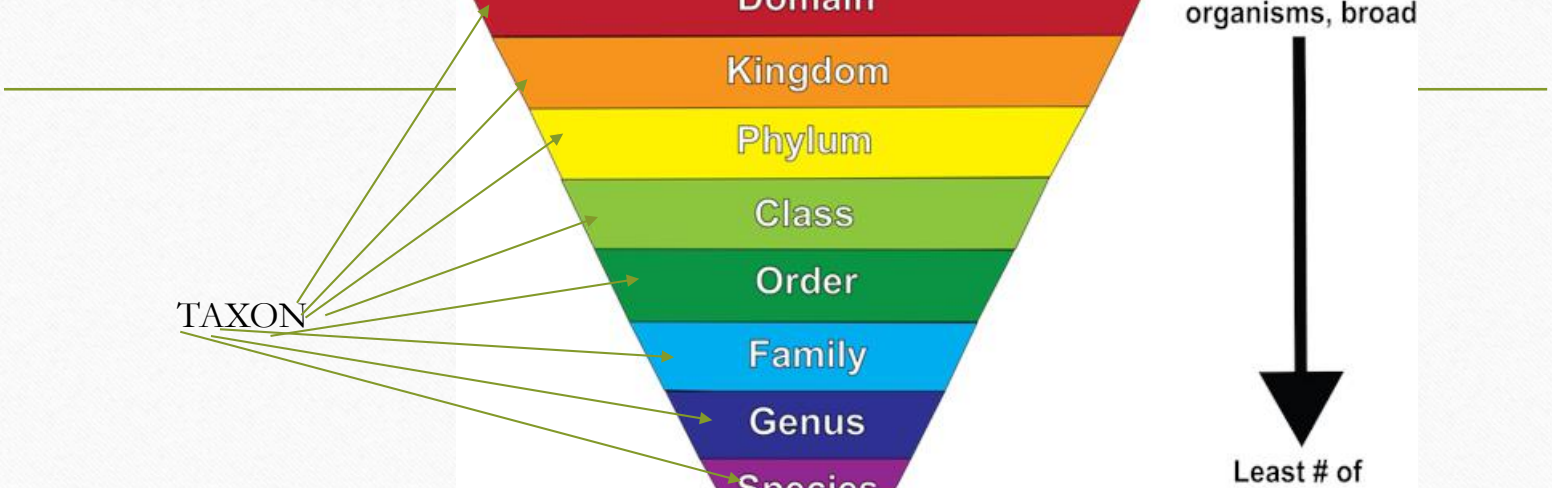
- Hierarchical Ranks (Broadest to Most Specific):
- Domain: Broadest rank containing the largest number of organisms.
- Kingdom: Major division of domains (e.g., Animalia).
- Phylum: Organisms sharing a foundational body plan (e.g., Arthropoda).
- Class: Subgroup sharing additional specific structures (e.g., Insects).
- Order: Subgroup of a class with refined morphological traits (e.g., Hymenoptera).
- Family: Grouping of closely related genera; animal families typically end in -idae (e.g., Formicidae).
- Genus: Group of closely allied species (e.g., Atta).
- Species: The most specific classification unit (e.g., Atta texana).
- Binomial Nomenclature:
- Formal system established by Carl Linnaeus (1707–1778).
- Every organism receives a two-part Latin name: a capitalized generic name and a lowercase specific name, styled in italics (e.g., Homo sapiens, abbreviated as H. sapiens).
The Three Domains
- Bacteria: True bacteria; ancient, simple prokaryotes lacking a membrane-bound nucleus.
- Archaea: Tough, ancient prokaryotic unicellular organisms lacking a true nucleus; frequently adapted as extremophiles.
- Eukarya: Structurally complex organisms whose cells possess membrane-bound nuclei and distinct organelles (comprises protists, fungi, plants, and animals).
The Five Kingdoms
- Prokaryotae: Unicellular organisms with a cell wall, free DNA lacking a nuclear envelope, and no membrane-bound organelles; primarily absorb nutrients (e.g., tuberculosis bacterium, blue-green algae).
- Protoctista: Mostly unicellular (or simple multicellular without complex tissues) eukaryotes; includes animal-like protozoans (Amoeba, Paramecium) that ingest food and plant-like algae (Euglena, Sargassum) containing chlorophyll.
- Fungi: Mostly multicellular bodies composed of hyphal threads (except unicellular yeasts), chitinous cell walls, heterotrophic via absorption, non-photosynthetic, reproducing via spores (e.g., pin mould).
- Plantae: Multicellular, autotrophic organisms with cellulose cell walls and chlorophyll; stationary and photosynthetic.
- Animalia: Multicellular heterotrophs with cells lacking walls and chlorophyll; ingest food and exhibit whole-body motility.
Kingdom Divisions: Plantae and Animalia
- Major Plant Groups:
- Bryophytes: Non-vascular; simple stems, leaves, rhizoids, and spore reproduction; limited to damp habitats (e.g., moss, liverwort).
- Ferns: Vascular plants with true roots, stems, and fronds; reproduce by spores on frond undersides (e.g., maidenhair fern).
- Conifers: Possess true roots, stems, and needle-like leaves; reproduce via naked seeds in cones (e.g., pine, fir).
- Flowering Plants: Form seeds within ovary-derived fruits; split into:
- Monocotyledons: Narrow leaves with parallel veins, single cotyledon, flower parts in multiples of 3 (e.g., sugar cane).
- Dicotyledons: Broad leaves with reticulate veins, two cotyledons, flower parts in multiples of 4 or 5 (e.g., flamboyant).
- Major Animal Groups:
- Invertebrates:
- Porifera: Pore-bearing, stationary filter-feeders lacking tissues (e.g., sponges).
- Cnidaria: Umbrella- or bag-shaped bodies with a single opening encircled by tentacles (e.g., jellyfish, coral).
- Platyhelminthes: Dorsoventrally flattened, unsegmented worms (e.g., tapeworm, fluke).
- Nematodes: Cylindrical, unsegmented roundworms with tapered ends (e.g., hookworm).
- Annelids: Segmented cylindrical worms (e.g., earthworm).
- Arthropods: Chitinous waterproof exoskeleton, segmented bodies, and jointed appendages (Crustaceans, Arachnids, Insects, Myriapods).
- Molluscs: Soft, unsegmented bodies with a muscular foot; frequently shelled (e.g., snail, octopus).
- Echinoderms: Radial five-part body plan, calcareous spiny plates, and tube feet (e.g., starfish).
- Chordates (Vertebrates): Possess a notochord replaced by a vertebral column, a dorsal nerve cord with a brain, and an internal skeleton (Pisces, Amphibians, Reptiles, Aves, Mammals).