Module 2
Chapter 3 notes
PPT/Lecture Notes
Wiley Ch 3 slides
Neuroscience and the Human Brain
Neuroscience: “The scientific study of the nervous system— and of the brain in particular.”
The human brain has 3 lbs of grey matter and white matter
grey matter: neurons and synapses
white matter: connecting fibers and axons
The human brain has 80 billion neurons and 80 trillion connections
Why is the brain important?
Thinking Brain: Cognitive and Intellectual Functions
Thinking, Learning, Remembering, Decision-Making, Problem-Solving
Clinical Diagnosis:
Understand Clinical Conditions
Autism, Dyslexia
Motivated Brain:
Needs, Desires, Liking and Wanting, Cravings, Pleasure and Pain, Addiction
Emotional Brain:
Emotions, Feelings, Affect, Mood
The Motivated and Emotional Brain has two principles
Day-to-day events activate specific brain structures.
Threat activates the amygdala
Reward activates the striatum
Brain structures generate specific states when activated
Insula → feelings (ex: risk, intrinsic motivation)
Dorsolateral prefrontal cortex activation → self-control
Anatomy of the brain (basic)
Cortical region and Subcortical region talk to each other
Subcortical activations send excitatory and inhibitory information to the cortical brain
Cortical activations send excitatory and inhibitory information to the subcortical brain
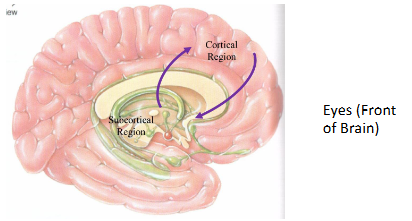
Cortical Brain
Bulging, grooved, wrinkled surface.
It functions at a conscious, intentional, and purposive level.
Associated with cognitively-rich motivations such as goals, plans, strategies, values, and beliefs about the self.
Engages in self-control, resisting temptation, decision-making, assessing risk, self-regulation.
Subcortical Brain
Small nuclei that make up the anatomic core of the brain.
Associated with basic urges (e.g., “Ice cream—I want it!”) and emotion-rich motivations such as hunger, thirst, anger, fear, anxiety, pleasure, desire, reward, and wanting.
Bi-Directional Communication
Almost all individual brain structures project out nerve fibers that act as information superhighways to communicate reciprocally with other brain structures.
The affective subcortical brain and the cognitive cortical brain are two interacting systems that are often in competition and conflict with one another (e.g., decision-making, delay of gratification, short-term vs. long-term goals).

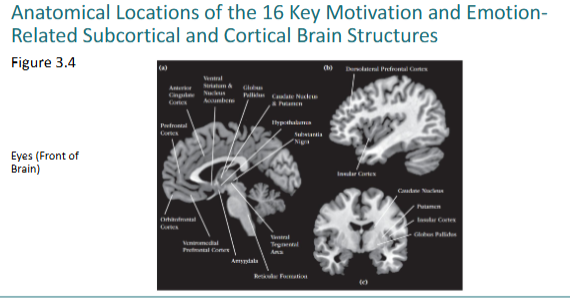
Areas of the subcortical brain involved in motivation and emotion:
Reticular Formation: Arousal, alertness, wakefulness.
Amygdala: Detects, learns about, and responds to the stimulus properties of environmental objects, including threat-eliciting and reward-eliciting associations.
Basal Ganglia: Motivational modulation of movement and action.
Ventral Tegmental Area: Starting point in the brain's dopamine-based reward center. Manufactures and releases dopamine.
Striatum and Nucleus Accumbens: The brain’s reward center. Responds to signals of reward (dopamine release) to produce pleasure, wanting, liking, and approach.
Hypothalamus: Responsive to natural rewards in the regulation of eating, drinking, and mating. Regulates both the endocrine system and the autonomic nervous system.
Areas of the cortical brain involved in motivation and emotion:
Insula (Insular Cortex): Monitors bodily states to produce gut-felt feelings.Processes feelings associated with empathy, intrinsic motivation, risk, uncertainty, pain, and personal agency.
Prefrontal Cortex: Makes plans, sets goals, formulates intentions. Right hemispheric activity is associated with negative affect and “no go” avoidance motivation; left hemispheric activity is associated with positive affect and “go” approach motivation.
Orbitofrontal Cortex: Evaluates and stores reward-related value of environmental objects and events to formulate preferences and make choices between options.
Ventromedial Prefrontal Cortex: Evaluates and stores the unlearned emotional value of environmental events and internal body states. Responsible for emotional control.
Dorsolateral Prefrontal Cortex: Evaluates and stores the learned emotional value of environmental events and possible courses of action. Responsible for control over urges and evaluates risk during the pursuit of long-term goals.
Anterior Cingulate Cortex: Monitors motivational conflicts. Resolves conflicts by recruiting other cortical brain structures for executive (cognitive) control over basic urges and emotions.
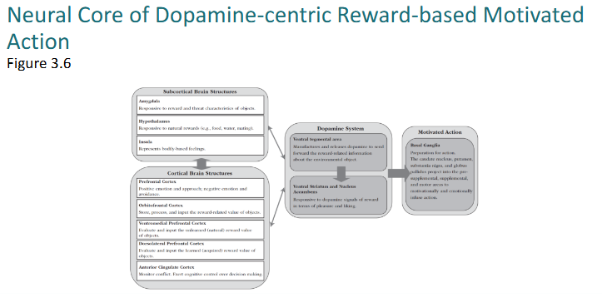
Dopamine-based Reward Circuit
reward system
dopamine-based reward circuit begins in the ventral tegmental area (VTA) where dopamine is manufactured and then released to the nucleus accumbens (NA).
From the NA. the reward center extends into the prefrontal cortex, which is involved in the subjective experience of pleasure, and into the orbitofrontal cortex, which stores the object's teamed reward value.


Amygdala detects, responds to, and learns about rewarding and beneficial properties of environmental objects and events.
also detects environmental threat and generates threat-elicited defensive responses
What the amygdala detects:
Presence vs. absence of reward
Value or quality of the available reward
Predictability of the reward
Costs associated with trying to obtain the potential reward.
If there is an attractive, emotionally-charged stimulus in the environment, the amygdala will detect it, evaluate it, and respond to it (e.g., I see a cup of orange juice. It is sweet; it is a cool and refreshing temperature.)
From a neuroscience perspective, reward is dopamine release.
The VTA is the manufacturing site for brain dopamine. It is the starting point in the brain’s reward center, and it projects fibers into the NA that receives dopamine-release information.
Activation of the Ventral Striatum and NA is synonymous with the experience of reward (e.g., “I like it.”). Through their activation, people learn what to like, what to prefer, and what to want.
Once activated, the ventral striatum and NA translate the experience of reward into motivational force, approach behavior, and the exertion of physical effort (via basal ganglia). The more dopamine that is released (by VTA), the greater will be the learning, positive emotion, and approach behavior.
Dopamine release is greatest when rewarding events occur in ways that are unpredicted (“Wow, I’m surprised how nice that flower smells.”) or under-predicted (“Wow, that flower smells much nicer that I thought it would.”).
A very attractive—but highly expected—stimulus does not produce much dopamine release.
Some level of dopamine is always in the brain. In day-to-day behavior, when events unfold in ways that are better than expected, increased dopamine release occurs.
When events unfold in ways that are worse that expected, decrease dopamine release occurs.
Dopamine release occurs more with the anticipation of reward (thinking about eating chocolate chip cookies, anticipating making money) than it does for the actual receipt of reward (eating chocolate chip cookies, receiving money)
dopamine release facilitates learning, approaching, not necessarily consuming.

Dopamine
Dopamine Release and Incentives
Incentives (stimuli that foreshadow the imminent delivery of rewards) triggers dopamine release.
Dopamine Release and Reward
Dopamine release teaches us which events in the environments are rewarding.
Dopamine and Motivated Action
Dopamine release activates voluntary goal-directed approach responses.
Addictions
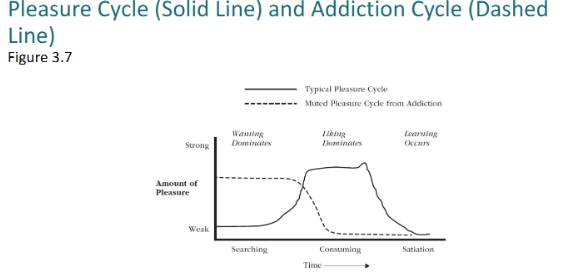
Addictive drugs are potent reinforcers because their repeated usage produces hypersensitivity to dopamine stimulation (i.e., cravings).
Liking and Wanting
For the full experience of reward, wanting and liking need to occur together



Professor Slides/Video lecture
Motivation, emotion, and neuroscience
Day-to-day events activate specific brain structures
Amygdala processes and interprets environmental threats
Other brain structures actively interpret environmental rewards
Activated brain structures generate specific motivations and emotions
Understanding of which specific brain structures and pathways are the neural basis of specific motivations and emotions
How brain activity in turn creates the motivational and emotional states that energize, direct, and sustain behavior
Neural basis of motivation and emotion
Cortical brain
Deliberate and intentional mental states
Associated with cognitively rich motivations such as goals, plans, strategies, values, and beliefs about the self
Subcortical brain
Reactive events
Associated with basic urges and impulses and with emotion-rich motivations such as anger and thirst
Bidirectional communication
Dual-process theories: Cortical and subcortical viewed as interacting systems that are often in competition / conflict
Neurotransmitters: Chemical messengers
Serotonin: Mood and emotion
Norepinephrine (or adrenaline): Arousal and alertness
Dopamine: Reward and pleasure
Endorphin: Inhibition of pain, anxiety, fear; Generation of good feelings
Individual brain structures involved in motivation and emotion
Reticular formation
Cluster of neurons within the brain stem
Ascending reticular system projects nerves upward to alert and arouse brain
Descending reticular system projects nerves downward to regulate the body
Wakes, alerts, and arouses brain to ready it to process incoming information
Amygdala
Collection of interconnected nuclei associated with emotion and motivation
Primary functions: Threat and reward detection
Detect, learn about, respond to emotionally significant and aversive events
Detects aversive characteristics of environmental objects
Relays emotion-laden information to nearby cortical and subcortical regions
Detect, respond to, learn about rewarding and beneficial properties of various environmental objects and events
Sends (not receives) projections to almost every part of the brain
Basal Ganglia
Cluster of many different small nuclei in subcortical brain that work collectively to provide movement and action
Closely connected to and receive information from cortical brain
Energize or inhibit (cortical) action plans
Ventral Striatum, Nucleus Accumbens, and Ventral Tegmental Area
Activation of ventral striatum (and nucleus accumbens)
Associated with reward, pleasure, or “liking”
Translate the experience of reward into motivational force
Ventral tegmental area
Manufacturing site for dopamine
Starting point for dopamine-based reward center
Releases dopamine when events are better than expected or when good news is merely anticipated
Hypothalamus
Small subcortical brain structure; “motivational giant”
Regulates arousal and recovery
Endocrine system / Pituitary gland
Autonomic nervous system
Regulates key biological functions
Thirst, hunger, and sex
Insula
Fold that lies between the posterior part of the frontal lobe and the anterior part of the temporal lobe and also above subcortical brain
Posterior part: Monitors and becomes aware of bodily states
Anterior part: Monitors and becomes aware of “gut” feelings
Processes and learns about risk and uncertainty
Responsible for feeling of “self” and social differentiation
Prefrontal cortex
Prefrontal lobes of cerebral cortex lie immediately behind forehead
Underlie many important motivations: Affect, goals, personal strivings
Houses a person’s conscious goals
Left and right makes a difference (Carver & White, 1994)
Left prefrontal cortex associated with BAS (Behavioral Activation System)
Right prefrontal cortex associated with BIS (Behavioral Inhibition System
Orbitofrontal cortex
Lies anatomically beneath the prefrontal cortex, just above the eyes
Stores and process reward-related information; Associated with preference and choice
Central to ability to delay gratification
Bidirectional communication with subcortical brain
Ventromedial prefrontal cortex
Groups together a set of interconnected cortical brain areas that integrate affective-based information from sensory and social cues
Evaluates emotional value of basic sensory rewards, such as tastes
Bidirectional communication with subcortical brain
Conscious thoughts control emotions
Emotions inform beliefs and decisions
Dorsolateral prefrontal cortex
Evaluates learned emotional value of environmental events and possible courses of action
Contributes inhibitory forces during decision-making, allowing one to resist temptation during pursuit of long-term goal
Inhibits urge for self-interest
Anterior Cingulate Cortex
Mid-frontal cortical brain area above subcortical brain
“Top-down” processing: Monitors conflicts in information processing and manages conflict through resource allocation processes
Involved in prioritizing attention, monitoring conflict, making choices, making decisions, predicting the consequences of action, alerting other brain areas to the need for increased cognitive control to resolve conflict, and regulating the self
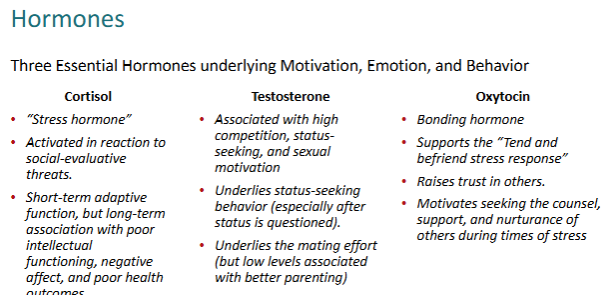
Hormones
Endocrine system uses hormones in bloodstream to communicate between bodily organs, such as the heart, kidney, and pancreas
• Key hormones
Cortisol: Stress
Testosterone: Competition, status-seeking, and sexual motivation
Oxytocin: Bonding; Tend-and-befriend
Other notes from the module
Steps
9/18 : Attended class lecture
9/18 : Reviewed Wiley PPT on Canvas
9/18 : Reviewed Professor PPT / Video
9/20 and 9/21: Review TB
9/21: took quiz
9/22 : establish chosen CLG and draft inquiry focus
CLG 3.4 — Distinguish between liking and wanting as separable motivational processes.
what i will do: explore the differences between liking and wanting by looking at their influences on behavior.
desired output: ven diagram???
what the output represents: compare the two motivational forces and in terms of (cause and effect??)(biology??)
9/22 : review lecture video to determine which extra sources may fit my CLG
dixon and dweck
9/22: with the sources, asked gemini to help me understand concepts
generated an audio “podcast“ that went in depth. exploratory studio output, but not a DLA
connect 2 CLGs?
CLG 3.3 — Describe the role of dopamine and reward systems in motivated behavior.
CLG 3.4 — Distinguish between liking and wanting as separable motivational processes.
9/23: met with TA … forgot to ask about 2 CLGs
Guided by CLG 3.4 (…) I will explore the differences between liking and wanting by looking at their influences on behavior. This will be done using a (studio output) created to compare the two distinct motivational forces in terms of both biological and behavioral cause and effect.
Need to elaborate more and in the right places