22.4 Entropy
Entropy can be used to explain things that occur naturally
a gas spreading through a room
heat from a fire spreading through a room
ice melting in a hot room
In these, energy is being dispersed and becoming more spread out, there is always a natural tendency for energy to spread out rather than be concentrated in one place.
The greater the entropy, the greater the dispersal of energy and the greater the disorder.
UNITS ARE JK-1mol-1
The greater the entropy value, the greater than energy is spread out per kelvin per mole.
In general
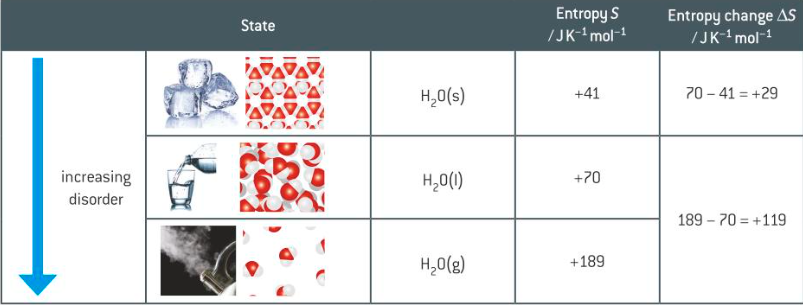
Solids have the smallest entropies
Liquids have greater entropies
Gases have the greatest entropies
Predicting entropy changes
At 0K, there would be no energy and all substances would have an entropy value of 0. Above 0K, energy becomes dispersed amongst the particles and all substances have positive entropy.
Systems that are more chaotic have a higher entropy value
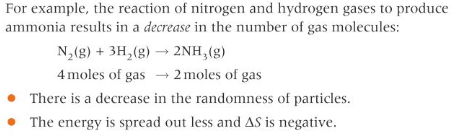
If a system changes to become more random, energy can be spread out more - there will an entropy change which will be positive.
If a system changes to becomes less random, energy becomes more concentrated - the entropy change will be negative.
In an equation for a physical change or chemical change, you can predict whether entropy increases or decreases by comparing the physical states and amount of gas molecules on either side of an equation.
Changes of state
Entropy increases during changes in state that give a more random arrangement of particles.
solid → liquid → gas
When any substance changes state from solid to liquid to gas, its entropy increases
melting and boiling point increases the randomness of particles
energy is spread out and is more positive
Change in the number of gaseous molecules
Reactions that produce gases result in an increase in entropy, like calcium carbonate reacting with HCL.

production of a gas increases the disorder of particles
energy is spread out more and is more positive
You can predict the sign of the entropy change for reactions where the reactant and products have different numbers of gas molecules.
Standard entropies
Every substance has a standard entropy, which can be found in data books
The standard entropy of a substance is the entropy of one mole of a substance, under standard conditions (100 kPa and 298K)
standard entropies have units JK-1mol-1
standard entropies are always positive
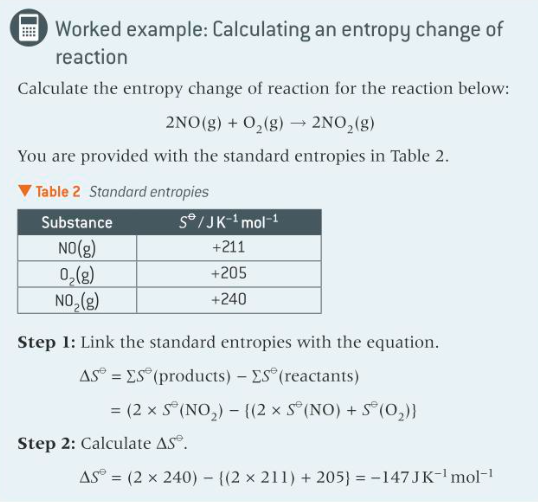
Calculating entropy changes
Standard entropies can be used to calculate the entropy change of a reaction