Sept 24th - Cells, genomes, and model organisms
cell: the fundamental unit of life
- morphically & structurally diverse and share common features
1) adaptation
2) complexity & organization
3) growth, development, and death
4) interactions - cell environment
5) energy acquisition
6) transmission of genetic information between generations
7) homeostasis
common ancestry contributes to cellular unity
- LUCA (origin of life)
- vertical transmission of genomes sends information from parent to progeny to multicellular organism
- 4 bases: optimal number of bases to construct nucleotides; two would be too few for what genetic information could code for & eight would be too costly (energetically)
- 2 strands: two strands will code for different genetic information
DNA genomes are replicated semi-conservatively
central dogma
- genetic information is transferred in multiple forms
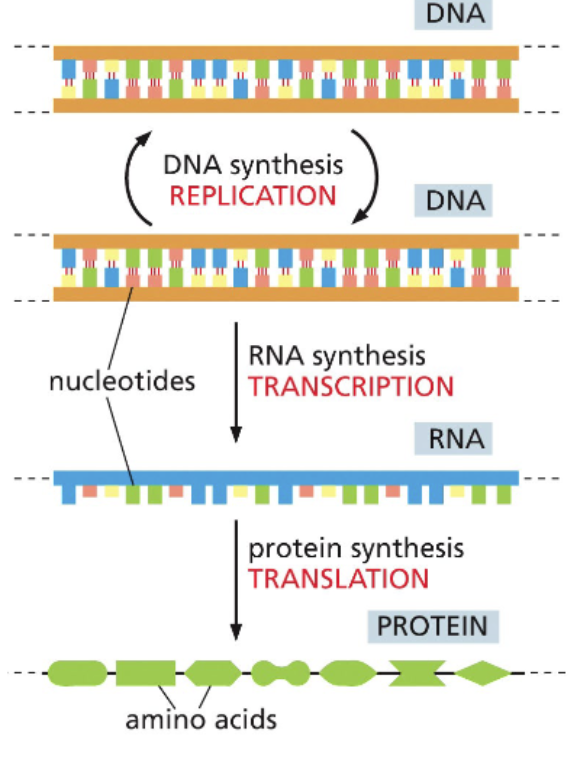
- proteins do the work both structurally & functionally
a genome contains all an organism’s genetic information, but genes aren’t uniformly active
- differences in cell morphology and behavior emerge depending on which genes are active
- for cells to get energy, hydrophobic and nonpolar / uncharged molecules pass through the lipid bilayer
information transfer is not perfect — alterations are the basis of evolution
- genomic differences
- radiation, oxidants, and radicals in DNA replication alter genetic sequences
- mutations (some parts of the genome are more likely to mutate than others)
- new genes are generated from existing genes: 1) mutation 2) gene duplication 3) DNA segment shuffling 4) horizontal DNA transfer