Biodiversity
the shortened form of 2 words “biological” and “diversity
it refers to all the variety of life than can be found on earth (plants, animals, fungi and microorganisms) as well as to the communities that thyy form and the habitats in which they live
TYPES OF DIVERSITY
Genetic Diversity- diversity of genes within a species
Species Diversity- diversity among species in an ecosystem
Ecosystem Diversity- diversity of a habitat in a given unit area
3 DOMAIN SYSTEM
Eukaryota- chromists, plants, alveolates, animals, fungi, rhodophytes, flagellates, basal protists
Bacteria- cyanobacteria, heterotopic bacteria
archaea- halophiles, thermophiles
6 KINGDOM SYSTEM
Eukaryotes
Plantae- multicellular
Animalia- multicellular
Fungi- multicellular
Protista- multicellular
Prokaryotes
Eubacteria- unicellular
Archaebacteria- unicellular
BIOLOGICAL SYSREM OF CLASIFICATION
Kingdom
Phylum or Division- each phylum consists of organisms that are basically similar, although their similarities may not be obvious
Class- a phylum is made out of several classes
Order- classes are made out of orders
family- within each order there are families within each family, as the name suggests, the resemblance between organisms are fairly close
Genus- each family consists of a varying number of genera (singular: genus)
Species- a genus usually has several species Organisms within a species can breed or produce offspring that can grow, develop and reproduce normally
CARL LINNAEUS
developed a system of classifying living things which became the basis of classification and naming systems today
his system has 7 levels, these levels are constantly being refined by scientists today
started the binomial (2 part) naming system
each living thing has a name consisting of 2 latin words the genus and the species name
BINOMIAL NOMENCLATURE
Linnaeus developed a system for naming organisms
the naming system is call binomial Nomenclature
Why do we classify?
To make the study of organisms easier
to clearly communicate about living things with people despite language differences
to explore how various living things are related to each other
DICHOTOMOUS KEY
Has a series of paired statements called couplets, each couplets consists of 2 contrasting statements
CLASSIFICATION
The grouping of organisms is based on their shared observable characteristics
Scientists also have been using genetic data to know whether a living thing is related to another
CLASSIFICATION USING THE DICHOTOMOUS KEY
a classification key is a set of questions and answers used to identify and classify a living being
resembles a branching flow-chart, making it helpful in identifying closely related organisims
KINGDOM ARCHAEA
microscopic
prokaryotic cell
without peptidoglycan
capable of surviving in extreme environments
EX. thermophiles, acidophiles, halophiles
KINGDOM BACTERIA
Microscopic
prokaryotic cell
cell walls with peptidoglycan
most are pathogenic
can form clusters/colonies
Reproduces through binary fission
spheres, rods, spirals
KINGDOM PROTISTA
Unicellular/multicellular organisms
eukaryotic cell
cell wall with cellulose
some form clusters/colonies
produces sexually/asexually
CONSISTS OF
protozoans- euglena, paramecium, amoeba
Algae- Volvox, algae, dinoflagellates
Slime molds
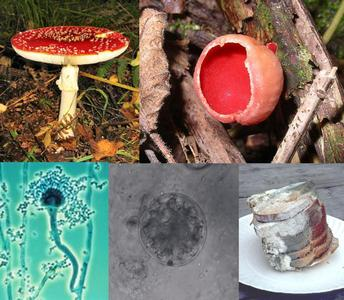
KINGDOM FUNGI
Unicellular/multicellular
eukaryotic cell
bodies consist of mycelium (hyphae
heterotopic
either saprophytic or parasitic
reproduces sexually/asexually
KINGDOM PLANTAE
multicellular organisms
autotropic
cell walls composed of cellulose
contains chloroplast and chlorophyll
Vascular- plants that have vascular tubes to transport water and food
Non-Vascular- plants that don’t have vascular tubes
Xylem
water and minerals goes ones way
no ends walls between cells
outer cells are not living
Phloem
organic molecule
enwalls (sieve plates)
2 way movement
cells are living but need support
Vascular
seedless
seedbearing plants- gymnosperms and angiosperms
ANGIOSPERMS
flowering plants
reproductive system in flowers
seed enclosed in library
flat leaves
seasonal life cycle
has triploid tissue
hardwood
pollinated by animals, wind and water
ex: apple, dandelion, wheat, maple, rose, walnut
GYMNOSPERMS
non-flowering plans
reproductive system in cones
unclosed or naked seeds
needle like seeds
evergreen
has haploid tissue
softwood
mainly pollinated by wind
ex: pine, spruce, gingko, yew, cypress
KINGDOM AMALIA
multicellular organisms
heterotopic
eukaryotic cell
ingests food and digest it in their internal cavity
most reproduce sexually
can be grouped in vertebrates and non-vertebrates
consists of 9 phyla: Mollusca, porifera, cnidaria. platyhelminths, Nematoda, Annelida , Arthropoda, Echinodermata and Chordata
CONSISTS OF
Phylum Porifera- sponges
Phylum Mollusca- snail, clams, squid
Phylum Cnidaria- jellyfishes
Phylum Platyhelminthes- tapeworm, planaria, fuchsia flatworms
Phylum Annelida- earthworms, leeches
Phylum Nematoda- hookworm, pinworm, ascaria
Phylum Arthropoda- insects arachnids crustatians
Phylum Echinodermata- sea urchin, starfish
Phylum Chordata- reptiles, amphibians, mammals, birds