Lecture 1: Introduction to Computer Programming
Computer
A device capable of performing computations at speeds millions (even billions) of times faster than human beings
Computer programs are sets of instructions that computers follow to process data
Computer programmers are the people that specify the programs
Logical Units of a Computer
Input Unit - “receiving” section of the computer
Output Unit - “shipping” section of the computer
Memory Unit - rapid-access, relatively low-capacity “warehouse section of the computer”
Arithmetic and Logic Unit - “manufacturing” section of the computer
Central Processing Unit (CPU) - “administrative” section of the computer
Secondary Storage Unit - long-term, high-capacity “warehousing” section of the computer
Computer Programming
The process of designing, writing, testing, debugging, and maintaining the source code of computer programs
This source code is written in one or more programming languages (such as JavaScipt, C++, C#, Java, Python, etc.)
DEVELOP > TEST > DELIVER > FEEDBACK > DEVELOP…
Why Study Programming?
The discipline of learning any programming language tends to help in the understanding of computer-based environments, such as GIS or RS
This way of thinking involves taking often ambiguously defined problems and breaking them down into computable steps
Programming can help us perform complex tasks at a faster rate
Applications of Geomatics and Programming
Image matching
Map Projections
Programming Language
A programming language allows communication between ourselves and the computers that share the common language
Like any other languages, it contains syntax and semantics
Types of Computer Languages
Machine Languages
“natural language” of a computer and as such is defined by its hardware design
Assembly Languages
uses English-like abbreviations to represent elementary operations. Translator programs called assemblers were developed to convert early assembly-language programs to machine language at computer speeds
High-Level Languages
To speed the programming process, high-level languages were developed in which single statements could be written to accomplish substantial tasks. Translator programs called compilers convert high-level language programs into machine language
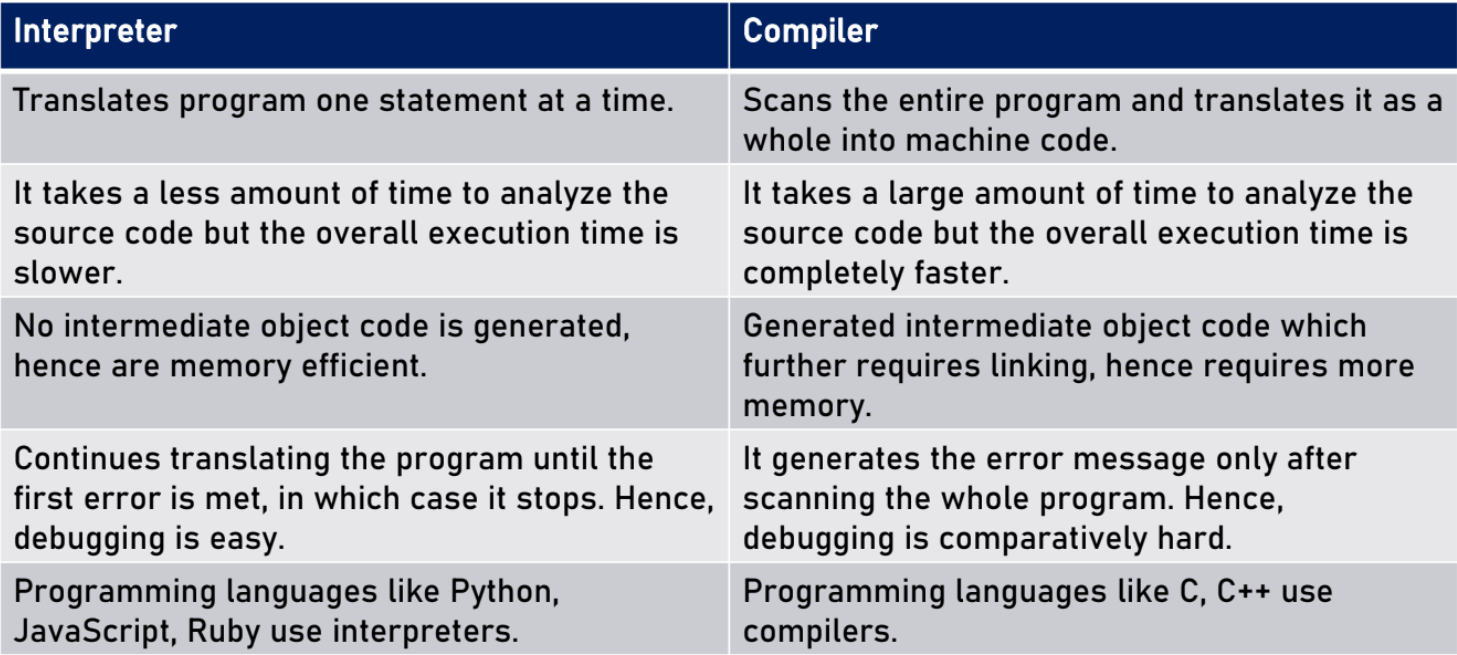
Interpreters vs Compilers
Python
a high-level multi-paradigm, programming language, with applications in numerous areas
Allows users to express concepts in fewer lines of codes
Since its public release in early 1991, a growing community of Python developers and users have improved it to create a mature and well-supported programming language
Python’s elegant syntax and dynamic typing, together with its interpreted nature, make it an ideal language for scripting and rapid application development in many areas on most platforms
Guido Van Rossum
a Dutch researcher at the National Research Institute for Mathematics and Computer Science Amsterdam (CWI), needed a high-level scripting language to accomplish administrative tasks for his research group’s Amoeba distributed operating system
Created Python in late 1989, appeared 1991
When he began implementing Python, Guido van Rossum was also reading the published scripts from “Monty Python’s Flying Circus”, a BBC comedy series from the 1970s. Van Rossum thought he needed a name that was short, unique, and slightly mysterious, so he decided to call the language Python.
Who Uses Python?
Google
Facebook
Spotify
Netflix
NASA
Reddit
Why Use Python?
Simple and easy to learn
Similar to pseudocode (dynamic typing)
Code looks like English language
Has bindings for most advanced programming modules
Used on different platforms (Windows, MacOS, Linux)
Most GIS platforms/software uses python for scripting
JavaScript
a high-level multi-paradigm, programming language
one of the core technologies of the World Wide Web (along with HTML and CSS)
Has extended into server development (NodeJS) and even mobile app development (React Native)
Designed by Brendan Eich of Netscape, first appeared in 1995
Other Productivity Tools
Used to create computer programs faster and more efficiently
Help in debugging code and linting (error warnings)
Support collaborative development
VS Code
a streamlined code editor with support for development operations like debugging, task running, and version control
runs on macOS, Linux, and Windows
Free for private and commercial use
Git
A free and open source distributed version control system designed to handle everything from small to very large projects with speed and efficiency
Git allows and encourages you to have multiple local branches that can be entirely independent of each other. The creation, merging, and deletion of those lines of development takes seconds.