Core Principles
Anatomy= the study of how bodies are structured.
Physiology= the study of how bodies work.
Level of organization
Largest to smallest
Organ System- Largest
Collection of organs that work together to perform a function
Organ
Composed of tissues that come together to perform a specific task, such as facilitating digestion or respiration.
Tissue
Composed of cells that work together to perform a specific function within the body.
Cell
Fundamental building blocks of all life.
Composed of molecules
Molecules
Formed from atoms
Atoms- Smallest
Fundamental building blocks of EVERYTHING (living or non living)
Structure and function
One of the most basic principles in anatomy and physiology is the concept that structure follows function
This principle is crucial in understanding how different types of cells and tissues in the body are uniquely adapted to perform specific roles.
EX: The wall of the lung is extremely thin. It is thin because its function is to allow gases to cross the tissue into the blood vessel. If the lung wall were too thick, gases would take too long to diffuse across the tissue and our cells would suffocate from lack of oxygen
Gradients
A gradient is present any time more of something exists in one area than another connected area.
They are important in physiology because they drive many physiological processes.
Pressure gradient- exists when there is a difference in pressure between two adjacent compartments.
EX: the pressure inside blood vessels is higher than the pressure outside them. This is why blood flows out of a wound – blood flows down the pressure gradient from an area of high pressure inside blood vessels to an area of lower pressure outside.
Concentration gradients- exist when there are differences in the concentration of chemicals between two compartments.
EX: the concentration of sodium is higher outside cells than inside, so a concentration gradient exists across the cell membrane. If the cell membrane were freely permeable, sodium would flow unopposed down its concentration gradient into the cell.
Temperature gradient- exists when there is a difference in temperature between two compartments.
EX: newborn lambs born in cold conditions quickly lose heat as the heat moves down a gradient from warm skin to the cold atmosphere.
Homeostasis
The body's collective communication and control systems maintain internal conditions within a narrow, stable physiologic range
Negative Feedback Loops
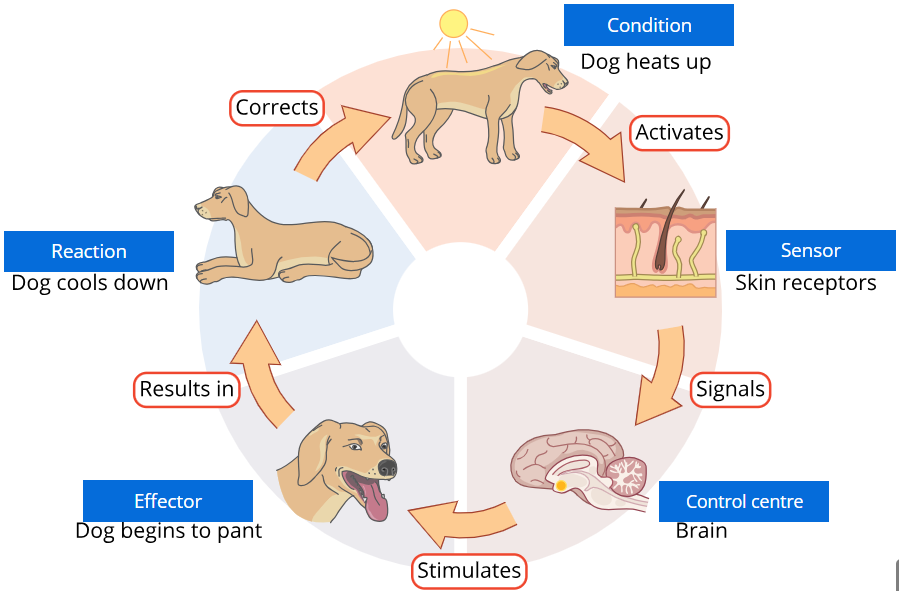
The set point is a value at which the condition must be maintained for optimal health
EX: the set point for the body temperature of dogs is in the range of 38.0–39.2 °C.
Every physiological condition is associated with a sensor that detects upward or downward deviations from the set point and signals the need for an opposing change.
This entire sequence of events, from the sensor to the response, is called a negative feedback loop
Negative feedback is a process that reflexively keeps systems tightly regulated near their set points.
An integrating or control centre to compare the value to the set point.
An effector to make an appropriate change that will move the condition back to the set point.
Negative feedback is central to the moment-by-moment maintenance of many vital body processes.
Positive Feedback loops
positive feedback enhances the detected change in the same direction until the process is completed.
positive feedback plays a role in only a few normal physiologic events
EX: Birth
the cervix keeps stretching until the baby is born.
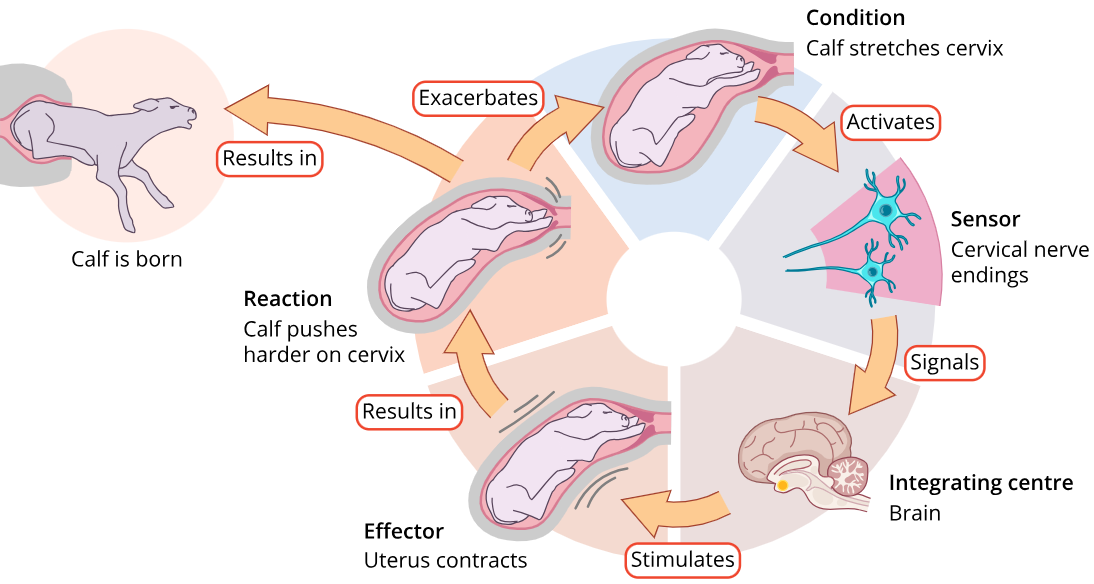
Positive feedback loops share the same elements as negative feedback loops: a condition is detected by a sensor, which signals an integrating center, which in turn signals an effector to induce an action.
The difference is that this action boosts rather than diminishes the condition
Cell-Cell Communication
when one cell triggers a response from another cell, generally exists in the form of electrical signals or chemical messengers.
Electrical signals are typically transmitted directly between neighboring cells.
Chemical messengers may be released from one cell directly onto another cell, into the fluid surrounding another cell, or they may travel through the blood to another cell.