Photosynthesis essay step-by-step
Question 1:
Chlorophyll and carotenoids are essential pigments in photosynthesis, each playing a role in capturing and converting light into chemical energy. Chlorophyll absorbs light, mainly in the red and blue wavelengths, and excites electrons that drive the light-dependent reactions. This energy creates a proton gradient for ATP synthesis in Photosystem II, while Photosystem I generates NADPH. Carotenoids extend the absorption spectrum, capturing additional light in the blue-green range and protecting against oxidative damage by dissipating excess energy. Chlorophyll and carotenoids convert light energy into ATP and NADPH, used in the Calvin cycle to synthesize glucose.
More details:
Chlorophyll and carotenoids are essential pigments in photosynthesis, playing critical roles in capturing and converting light into chemical energy. Chlorophyll is the primary pigment in plants, absorbing light most efficiently in the red and blue parts of the spectrum. When light is absorbed, it excites electrons, initiating light-dependent reactions. In Photosystem II, chlorophyll molecules absorb light, excite electrons, and pass them through the electron transport chain. This drives proton pumping across the thylakoid membrane, creating a proton gradient used by ATP synthase to produce ATP. Additionally, the excited electrons from Photosystem I reduce NADP+ to NADPH, providing energy for the Calvin cycle.
Carotenoids, the secondary pigments, absorb light in the blue-green region and help extend the range of light that can be used for photosynthesis. They also protect plants by dissipating excess light energy as heat and preventing damage from reactive oxygen species. Though they don’t directly participate in energy conversion, carotenoids ensure chlorophyll remains protected and functioning efficiently. Chlorophyll and carotenoids capture light and convert it to ATP and NADPH, fueling carbon fixation in the Calvin cycle and ultimately producing glucose and other organic molecules.
Question 2: If plants are provided with radioactively labeled CO2, the radioactive carbon will be incorporated into organic compounds through photosynthesis, specifically during the Calvin cycle. The CO2 is first fixed by the enzyme RuBisCO, forming 3-phosphoglycerate (3-PGA). This 3-PGA is then converted into glyceraldehyde-3-phosphate (G3P), a three-carbon sugar. G3P can be used to produce a variety of organic molecules. These include glucose and fructose (simple sugars), which may be stored as starch or used for energy, and cellulose, which is used for building cell walls. These molecules will contain the radioactive carbon because they are derived from the G3P initially formed from the fixed CO2. Therefore, the radioactive tracer would be detectable in sugars (like glucose and fructose), starch, and cellulose.
Question 3:
The wavelengths of light determine the color of a flower, and its pigments reflect and absorb. Red petunias reflect light in the red part of the spectrum (around 620-750 nm) due to pigments like anthocyanins. These pigments absorb wavelengths in the blue and green parts of the spectrum, which is why the flowers appear red. White petunias reflect nearly all wavelengths of visible light equally. This is because they lack the specific pigments that absorb light, so they appear white due to all colors being reflected. Blue petunias reflect light in the blue spectrum (around 450-495 nm) because of pigments like anthocyanins that specifically absorb light in the red and green regions of the spectrum. As a result, the flowers appear blue. Each flower's color directly results from the particular pigments in its petals that absorb specific wavelengths of light and reflect others.
More details: Their petals' pigments determine the floral colors of the red, white, and blue petunias and how they interact with light. Here’s an explanation for each color:
1. Red Petunias: Absorbed light: The red color in petunias typically comes from anthocyanin pigments, which absorb light in the blue and green regions of the spectrum (roughly 430–490 nm). Reflected light: The red wavelengths (around 620–750 nm) are reflected or transmitted, so we see the flower as red. The pigments absorb most colors except for red, reflected in our eyes.
2. White Petunias: Absorbed light: White flowers have very few pigments that absorb visible light. Instead, they may reflect most wavelengths of light. Reflected light: Since white combines all visible wavelengths, white petunias reflect light across the spectrum (approximately 400–700 nm). As a result, no specific color is emphasized, and the flower appears white.
3. Blue Petunias: Absorbed light: The blue in petunias is often due to pigments like anthocyanins or flavonoids, which absorb light in the red and green regions (around 500–600 nm). Reflected light: The pigments in blue petunias reflect light primarily in the blue wavelength range (about 450–495 nm), which gives the flower its blue appearance.
Red petunias absorb blue and green light, reflecting red.
White petunias reflect all visible light, appearing white.
Blue petunias absorb red and green light, reflecting blue.
Question 4: Photosynthesis and cellular respiration involve different cellular locations. Photosynthesis occurs in the chloroplasts, with the light-dependent reactions occurring in the thylakoid membranes. Here, light energy is absorbed by chlorophyll, producing ATP, NADPH, and oxygen as a byproduct. The light-independent reactions (Calvin cycle) occur in the stroma of the chloroplasts, where ATP and NADPH are used to convert carbon dioxide into glucose.
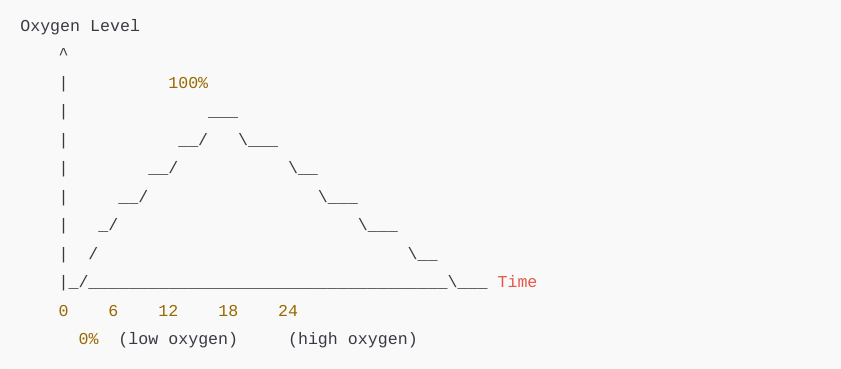
Grapah:
Label this axis as "Time" in hours, ranging from 0 to 24 (representing the 24 hours, starting at midnight).
Label this axis as "Oxygen Level" (or "Oxygen Concentration"). This axis will show how much oxygen is in the jar, with higher values representing more oxygen.
More detail: Photosynthetic Reactions That Require Sunlight:
The light-dependent reactions of photosynthesis, which require sunlight, occur in the thylakoid membranes of the chloroplasts. These reactions capture light energy, which is then used to produce energy-rich molecules (ATP and NADPH) and release oxygen as a byproduct.
Location: Thylakoid membranes of the chloroplasts.
Process: Sunlight excites electrons in chlorophyll, which are then passed through an electron transport chain, producing ATP and NADPH. Water molecules are split in the process, releasing oxygen (O₂).
Photosynthetic Reactions That Do Not Require Sunlight, aka Calvin cycle:
The light-independent reactions, also known as the Calvin cycle, do not require sunlight directly but instead use the energy (ATP and NADPH) generated during the light-dependent reactions to synthesize glucose and other organic molecules. These reactions occur in the stroma of the chloroplasts.
Location: Stroma of the chloroplasts.
Process: The Calvin cycle involves the fixation of carbon dioxide (CO₂) into a 3-carbon sugar using ATP and NADPH produced during the light-dependent reactions
By the way, You don’t have to explain why on the graph. It’s just here to show you why I put the points there.
1. 0-6 hours (Midnight to 6 AM): Oxygen levels are low—reason: During the night, photosynthesis does not occur because there's no sunlight. However, respiration (the process by which plants consume oxygen to break down glucose) continues throughout the night. This means oxygen is consumed but not replaced by photosynthesis, causing oxygen levels to drop. Therefore, I placed the bar near the 0% level to indicate low oxygen levels in this period.
2. 6-12 hours (6 AM to Noon): Oxygen levels increase. Reason: As the sun rises, photosynthesis begins. Plants absorb sunlight and convert it into energy, producing oxygen as a byproduct. The oxygen level increases as more oxygen is made during the morning hours. Since photosynthesis has just started, the oxygen levels will increase but are not yet at their peak, so I placed the bar around 50-75%, reflecting moderate oxygen production.
3. 12-18 hours (Noon to 6 PM): Oxygen levels are at their highest. Reason: Midday to afternoon photosynthesis peaks because sunlight is most potent. During this period, the plants produce the maximum amount of oxygen, so oxygen levels in the jar should be at their highest. I placed the bar at 100% to represent the peak oxygen level when photosynthesis is most efficient.
4. 18-24 hours (6 PM to Midnight): Oxygen levels decrease again—reason: After sunset, photosynthesis stops because there is no longer sunlight. However, plants continue to perform cellular respiration, consuming oxygen and releasing carbon dioxide. Since no new oxygen is produced and oxygen is still consumed, oxygen levels will drop again. I placed the bar between 25-50% because respiration continues, but the oxygen level won't fall as much as it did during the night from 0-6 hours (because it’s not a whole 12-hour period without sunlight). The oxygen level should be lower but still above 0% by midnight.