Ch. 10
Erikson’s Theory: Industry versus Inferiority
Industry: sense of competence at skills and tasks
• Positive but realistic self-concept
• Pride in accomplishment
• Developing sense of competence at useful skills; tasks
• Formal schooling; Activities
Inferiority:
• Pessimism, lack of confidence in own ability to do well
• Others’ negative responses can contribute
School-Age Fears and Anxieties
Common fears:
Academic failure
Peer rejection
Personal harm
Threats to parents’ health
Frightening media events
School refusal:
Maternal separation: ages 5–7
Particular aspects of school: ages 11–13
Harsh living conditions promote severe anxieties
Self-Concept
• Shift to trait-like psychological constructs
• Recognition of both positive and negative traits
• Social comparisons
• Frequent reference to social groups
Self-Esteem
• Increasing self-awareness
• Self-beliefs related to behavior
• Positive parental interactions
• Attributions:
o Mastery-oriented
o Learned-helpless
• Process praise vs. person praise
Achievement Motivation
• Willingness to persist at challenges
• Growth mindset vs fixed mindset
o Mastery orientation
o Learned helplessness orientation
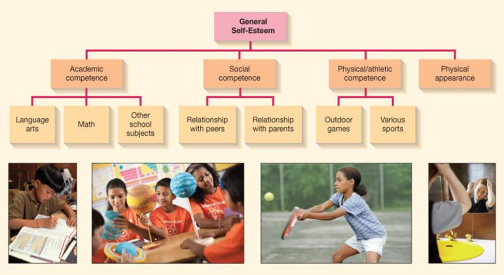
Hierarchical structure of self-esteem in mid-elementary years
Body Image
Influence of peer interactions
Influence of contextual factors
School-based body image education
Culture, Gender, and Ethnicity and Self-Esteem
Media influence
Gender stereotypes:
Girls less confident appearance, athletic abilities
Girls ↑ in language arts and friendships
Boys ↑ in math and science self-esteem
African-American children: slightly higher self-esteem than other groups
Self-esteem supported by neighborhoods, schools where child’s SES and ethnicity are well-represented
Gender Differences and Gender Typing
• Boys and Girls:
• High degree of overall similarity
• Minor differences in cognitive aspects
• Persisting socioemotional differences
Gender Identity
Gender identity (third to sixth grade):
Boys’ “masculine” identification strengthens
Girls become more androgynous; explore more options
Awareness of society’s greater regard for “masculine” traits
Gender Differences and Typing
Self-evaluations affect adjustment:
• Gender typicality
• Gender contentedness
• Felt pressure to conform to gender roles
Gender-atypical children’s self-worth declines
Peer Relationships in Middle Childhood
Friendship
Influences of contextual characteristics
Effects of friendship dissolution and chronic friendlessness
Friendships in Middle Childhood
➢ Personal qualities, trust become important
➢ More selective in choosing friends:
➢ Tends to select friends similar to self
➢ Fairly stable, can last several years
➢ Type of friends affects development and behavior
Children Who Bully
Relational aggression
Motivations
Causes
Influence of sociocultural context
Family Influences
▪ Parent–child relationships:
o Easier with established authoritative style
o Coregulation: gradually shift control to child
▪ Sibling relationships:
o Rivalry: parental comparisons
o Companionship and support
Changes in Moral Understanding
Flexible moral rules:
▪ Lying not always bad, and truthfulness not always good
▪ Considers intentions and context
Better understanding of varied reasons for deception:
▪ Gains in recursive perspective taking
Linking moral imperatives and social conventions:
▪ Violations of purposeful social conventions are regarded as closer to moral transgressions
Changes in Moral Understanding
• Challenges adult authority within personal domain
• Notions of personal choice
o Views denials of personal choice as wrong
o Approves of limits on personal choice, typically favoring kindness and fairness