CHAPTER 1: WHY PUBLIC SPEAKING MATTERS TODAY
1.1 Public Speaking in the Twenty-First Century
Public speaking is the process of designing and delivering a message to an audience.
effective public speaking involves understanding audience and speaking goals, choosing elements of speech to engage your audience and delivering it skillfully
good public speakers understand that they must plan, organize and revise their material
1.2 Why Is Public Speaking Important?
Most speeches can be grouped into three types
Informative: primary goal is to share one’s knowledge of a subject with an audience
any career field
Persuasive: to persuade others to take actions or reinforce/change beliefs
studied by the ancient greeks or whatever
elected officials, motivational speakers (Les Brown & Brian Tracy)
To entertain: happen at special occasional focused on creating ceremony
epideictic speaking
wedding toasts, presenting and accepting awards, eulogies, after dinner speeches and motivational speeches
religious leaders and comedians
Benefits of speech courses are:
developing critical thinking skills
fine-tuning verbal and nonverbal skills
overcoming fear of public speaking.
Speech is power: speech is to persuade, to convert, to compel – Ralph Waldo Emerson
Professional Benefits of Public Speaking
influencing the world around you (fracking)
developing leadership skills
becoming a thought leader (individuals who contribute new ideas to the world of business)
1.3 The Process of Public Speaking
getting your message heard depends on three fundamental components: message, skill, and passion.
There are different models of public speaking
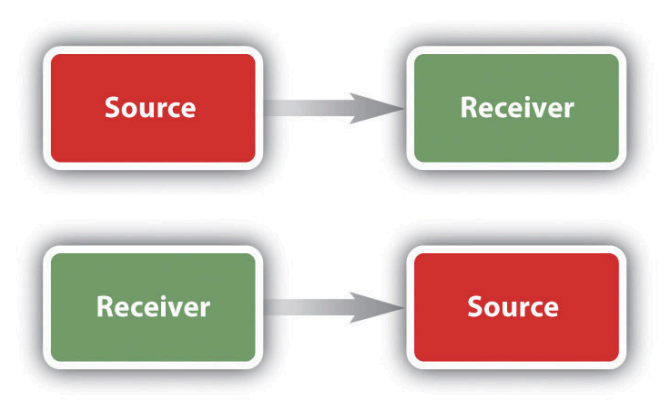
Linear model
Claude Shannon and Warren Weaver
mirrored how radio and phone communication worked
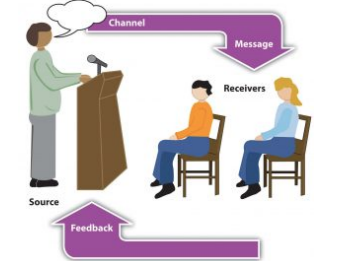
had three main parts, the source (telephone mic), the channel (the actual telephone) and the receiver (the phone’s speaker)
some problems with it exist but it has some useful parellels ig
“the source is the person who is giving the speech, the channel is the speaker’s use of verbal and nonverbal communication, and the receivers are the audience members listening to the speech. As with a telephone call, a wide range of distractions (noise) can inhibit an audience member from accurately attending to a speaker’s speech. Avoiding or adapting to these types of noise is an important challenge for public speakers”

Interactional model
Wilbur Schramm
encoding (creating a message, adapting it to its receiver, and transmitting it across some source-selected channel) and decoding (“sensing (for example, hearing or seeing) a source’s message, interpreting the source’s message, evaluating the source’s message, and responding to the source’s message (FEEDBACK))
presentation aids can make it easier or harder for a listener to understand (unfamiliar vocab, speaking fast or soft, small print)
Feedback has three types: direct (Q & A), moderately direct (audience’s nonverbal feedback), and indirect (votes)
Transactional model
Dean Barnlund
meanings are co-created between people is based on a concept called the “field of experience.”
impacted by Our education, race, gender, ethnicity, religion, personality, beliefs, actions, attitudes, languages, social status, past experiences, and customs
Dialogic Theory of Public Speaking
most people thing that giving a speech is just a monologue
Ronald Arnett and Pat Arneson
three overarching principles
dialogue is more natural than monologue
even nonverbal counts
if you approach public speaking as a dialogue, the listeners will be the
meanings are in people not words
you and your audience may differ in how you see your speech.
dog being cute unless u’ve been attacked
using teenage slang when speaking to the audience at a senior center would most likely hurt our ability to convey our meaning clearly.
contexts and social situations impact perceived meanings
has four dimensions: physical (how the space (size or decor) you’re speaking in impacts how much you can interact with the audience), temporal (how time or order in speech impacts), social-psychological (relationship among participants), and cultural (shared understandings)