Week 8: Blood Lactate Kinetics and the Lactate Threshold
Revision Questions
Lactate as a Metabolite
Why is lactate not considered a waste product in the body?
Lactate vs Lactic Acid: Lactic acid is the end product of anaerobic glycolysis. It dissociates rapidly in the body and is buffered by sodium bicarbonate, forming lactate (La⁻). Therefore, lactic acid and lactate are not the same compound. Lactate is often misunderstood as merely a waste product. However, it plays several crucial roles within the body. Notably, lactic acid production is reversible, which means lactate can be converted back into pyruvate under sufficient oxygen availability. This metabolic pathway is particularly active during recovery exercises or at submaximal exercise intensity.
Reversible Nature of Lactate Production
The reaction producing lactate is reversible, mediated by lactate dehydrogenase (LDH).
When oxygen availability is sufficient (submaximal exercise or recovery):
Lactate can be converted back into pyruvate
Pyruvate enters aerobic metabolism (e.g. Cori cycle).
Because lactate is reused, it is not a metabolic dead end or waste product
How does Blood Lactate Concentration ([BLa]) change during exercise?
Prolonged Exercise: The concentration of blood lactate tends to rise as exercise continues, but remains stable when lactate production equals clearance. At intensities below LT, oxidative metabolism dominates. As energy demands increase and the anaerobic systems begin to contribute more significantly to energy production.
Incremental Exercise: During progressive increases in exercise intensity, blood lactate levels initially remain stable but will eventually increase exponentially once clearance can no longer match production. This forms the basis of identifying lactate threshold (LT) and OBLA
What is the physiological meaning of the lactate threshold?
DefinitionsLactate Threshold (LT): Lactate threshold (LT) is the exercise intensity at which lactate begins to accumulate in the blood. It reflects the transition from predominantly aerobic metabolism to a point at which anaerobic metabolism contributes significantly to energy production. Represents the balance point between lactate appearance and disappearance.
Reflecting:
Mitochondrial density
Oxidative enzyme activity
Capillary density
Lactate transport capacity (MCTs)
OBLA (Onset of Blood Lactate Accumulation): Often defined as 4 mmol·L⁻¹, though this is an arbitrary marker.
What are the causes of lactate threshold (LT)?
LT can be influenced by several factors, including:
Muscle fiber composition
Training status (trained individuals demonstrate higher thresholds)
Exercise intensity and duration
Sex Differences (not significant)
What mechanisms exist for lactate clearance from muscles and the blood?
Lactate clearance occurs through various mechanisms, including:
Conversion back to pyruvate for entering aerobic glycolysis (Cori Cycle)
Transport to other muscles or the liver for recycling
Oxidation in the mitochondria for energy production
Oxidation in Type I muscle fibers
Uptake by heart, liver, and inactive muscles
Transport via monocarboxylate transporters (MCTs)
What factors influence an individual's lactate response?
Factors that influence lactate responses include:
Training history
Exercise modality
Continuous or discontinuous exercise
Muscle fiber type distribution
Current fitness level
Recovery methods (ice baths/compression socks)
Nutritional status and diet (particularly carbohydrate intake)
What factors affect post-exercise lactate clearance rates?
Factors that may influence lactate clearance include:
Type of recovery (active vs. passive)
Intensity of recovery exercise
Time elapsed since exercise
Why is it important to study lactate responses to exercise?
Studying lactate responses helps in understanding:
The effectiveness of training programs
Identifying an athlete's performance capacity
Tailoring recovery strategies during training and competition
Why Lactate Still Matters (Despite Not Causing Soreness)
Lactate, H⁺, and Fatigue
Conversion of lactic acid → lactate releases H⁺, lowering pH.
Metabolic acidosis leads to:
Inhibition of PFK
Reduced lipolysis
Impaired membrane transport
Reduced ATP production
Muscle Fatigue Effects
↓ Force and contraction velocity due to:
Inhibition of myosin ATPase
↓ Ca²⁺ release and uptake by SR
↓ Ca²⁺ binding to troponin C
Important: Lactate is linked to muscle fatigue, not delayed onset muscle soreness (DOMS).
What insights can be gleaned from athletes’ lactate profiles?
Athletes' lactate profiles can inform coaches about:
Current aerobic and anaerobic conditioning levels
Potential adaptations in response to training strategies
Optimal exercise intensities for performance improvements
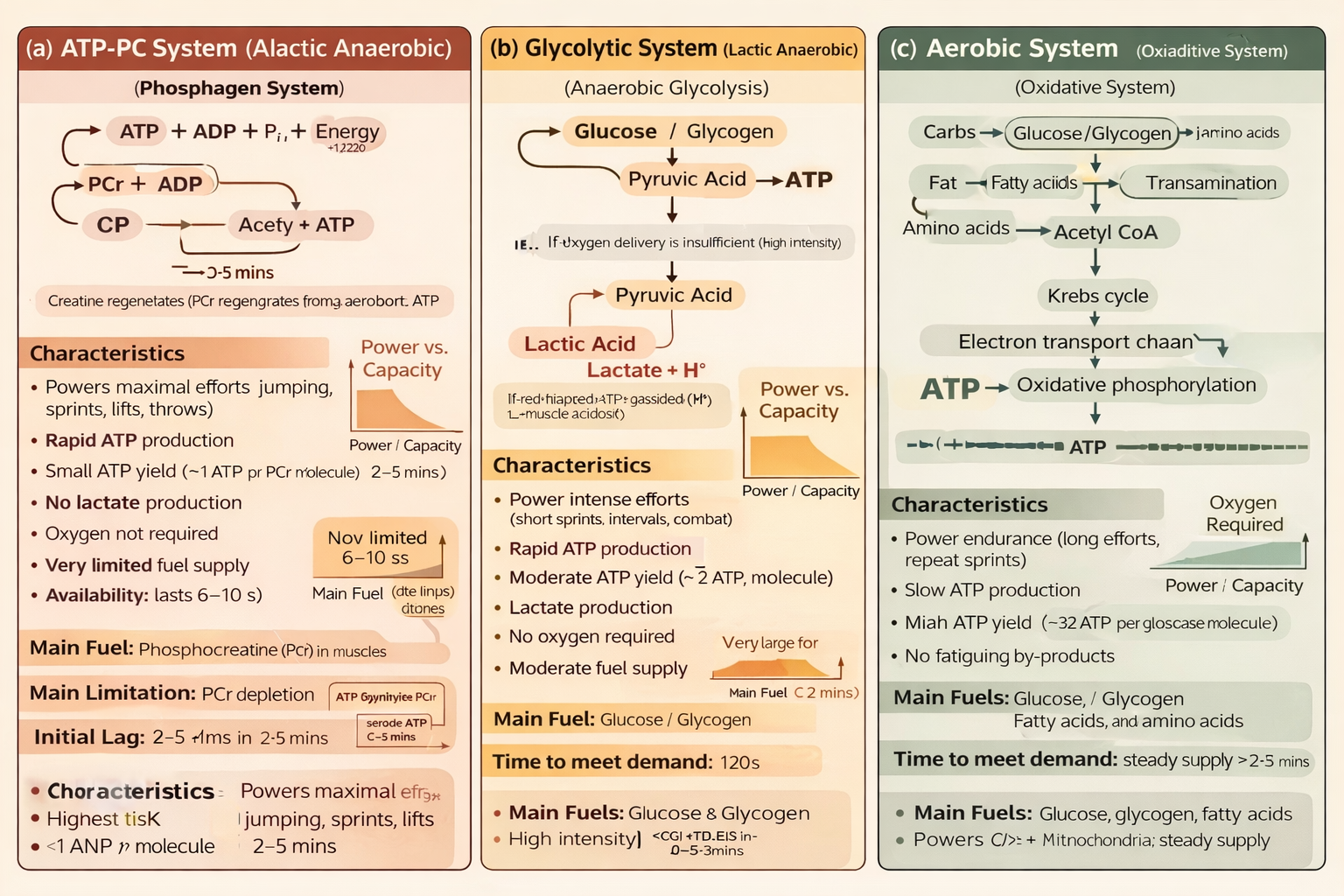
Energy Systems and Lactate Production
Types of Anaerobic Energy Systems
Alactic Anaerobic Metabolism
Reactions:
Availability: Provides instantaneous energy using stored phosphocreatine (PC) and ATP, utilized during short-duration, high-intensity efforts.
Reaction:
Energy System Duration: Effective for very short activities (up to 10 seconds).
Lactic Anaerobic Metabolism
This system predominates for efforts lasting 30 seconds to 2 minutes. Produces lactate as a byproduct during high-intensity exercise when the oxygen supply is insufficient for aerobic metabolism.
Reactions include glycolysis from glucose and glycogen.
Equation Example:
Aerobic Metabolism
Utilizes carbohydrates (glucose and glycogen), fats, and proteins for longer-duration activities, providing a sustainable energy source that does not produce lactate as a waste product.
Dominates beyond 2 minutes of sustained exercise.
Key Process Steps:
Glycolysis ● Krebs Cycle ● Electron Transport Chain
The aerobic system is the most efficient in producing ATP but is slower in response compared to anaerobic systems.
Lactate Dynamics During Exercise
Measurement of Blood Lactate
Unit: Lactate is quantified in mmol/L. A healthy resting level is typically around 1 mmol/L.
Implications of Elevated Levels: Levels above 2 mmol/L before exercise might signify incomplete recovery or previous exercise activity prior to measurement.
Lactate Profiles in Athletes: Different performance profiles can be identified between sprinters and distance runners; sprinters commonly present with a 20-30% higher blood lactate compared to untrained controls during maximal efforts.
Lactate Response During Steady-State Exercise
Response Dynamics: As intensity rises during steady-state cycling or treadmill tests, blood lactate concentrations reflect metabolic states and shifts in energy systems. These responses can be depicted graphically, showing changes in lactate levels over time.
Lactate Response to Incremental Exercise
The lactate response varies with exercise intensity, and specific thresholds (LT and OBLA - Onset of Blood Lactate Accumulation) can be charted, indicating points in escalating workload where lactate begins to accumulate significantly.
Lactate Threshold Reference Values
General Populations: 60% of VO2max
Recreational Athletes: 65-80% of VO2max
Elite Endurance Athletes: 85-95% of VO2max
Lactate Clearance Mechanisms
Factors Influencing Clearance Rates
Type of Recovery: Decisions surrounding activity (active vs. passive) critically shape lactate clearance efficiency.
Intensity of Recovery Exercise: Moderate intensity during active recovery (around 55-70% of VO2max for running) is optimal for lactate clearance.
Training Status: Regular physical training effects overall lactate handling capabilities, with trained individuals displaying better clearance rates.
Exercise Modality: Different sports or activities may influence how efficiently lactate is cleared.
Physical Interventions: Use of compression clothing or ice baths has been assessed for their effects on recovery and lactate clearance.
Active vs Passive Recovery
Active Recovery: Typically involves continued low-intensity activity and has shown efficiency in reducing blood lactate compared to no exercise post-activity.
Passive Recovery: Complete rest, which may be less effective in lowering blood lactate concentrations fast compared to engaging in light activity.
Lactate and Performance Implications
Impact on Muscle Function
Metabolic Fatigue: Increased lactate levels correlate with decreased ATP production, leading to performance decrements through disrupted enzyme activity, altered membrane transport, and hindered substrate availability due to acidosis.
Muscle Fatigue: Results in a diminished capacity for force production and contraction velocity, primarily via inhibition of myosin ATPase activity and Ca²⁺ handling within the muscle cells.
Neurological Effects
Elevated lactate levels and associated acidosis can have detrimental effects on central nervous system function, potentially altering cognitive performance and inducing symptoms such as nausea and confusion.
Importance of Lactate in Training
Monitoring and Testing
Practical Application: Frequent lactate testing during training allows for adaptation analysis, training zone determination, and adjustments to optimize performance improvements.
Adaptation Tracking: Changes in lactate profiling can indicate training effectiveness and physiological adaptations, serving as a feedback system for conditioning programs.
Lactate as an Indicator of Fatigue
Correlation with Fatigue: High lactate levels reflect not only physical fatigue but also metabolic workload, serving as a quantifiable marker for assessing endurance and recovery performance.
Training Responses: Understanding lactate responses assists in crafting individualized training strategies that take into account physiological readiness and adaptation timelines.
Specificity and Adaptation in Training
Variations Across Athletic Profiles
Athletes show differing lactate recovery patterns based on their training modalities (short-distance sprinters vs. long-distance runners), reflecting distinctive physiological adaptations to their respective sports.
Supercompensation and Recovery Strategies
Tapering periods after extensive training allow for physiological supercompensation, where performance may augment due to better lactate clearance and increased aerobic capacity after rest.