Thematic Analysis - Week 3
Braun & Clarke
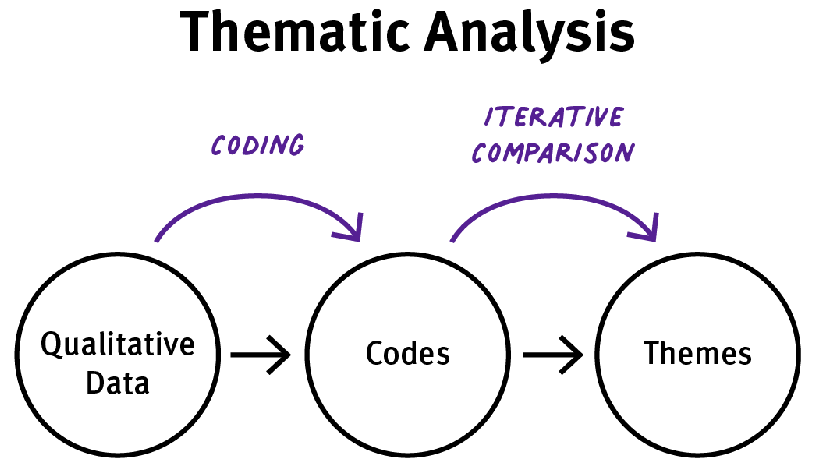
‘It is a method of qualitative analysis, widely used across the social and health sciences and beyond, for exploring, interpreting, and reporting relevant patterns and meaning across a dataset. It utilizes codes and coding to develop themes’ (2022)
‘Thematic analysis is a method for identifying, analysing, and reporting patterns (themes) within data. It minimally organises and described your data set in (rich) detail.' (2006)
Thematic analysis is a qualitative data analysis method used to identify, analyze, and interpret patterns of meaning (themes) within qualitative data.
It is a flexible approach that can be applied across various tyoes of qualitative research and is particularly useful for examining participants’ perspectives, experiences, and ideas.
Inductive (Data-Driven):
Themes emerge directly from the data without perconceived frameworks.
Example: Analyzing interview transcripts to explore participants’ experiences with therapy.
Deducive (Theory-Driven):
Themes are identified based on existing theories or research questions.
Example: Coding for stress coping strategies using Lazarus and Folkman’s stress model.
Semantic vs. Latent Themes:
Semantic: Focus on explicit, surface-level meanings, more overt
Latent: Explore underlying ideas, assumptions, and conceptual frameworks.
Advantages of Thematic Analysis
Flexibility
Can be used across a range of data collection approaches (interviews, focus groups, diary studies, ethnography, etc)
Easy and quick to learn and conduct
Accessible to new qualitative researchers
Highlights similarities and differences in the data set
Disadvantages of Thematic Analysis
‘thin’, ‘light’, ‘soft’ approach to qualitative data analysis, not really understanding what is happening to the participant.
Too flexible?
Tends to be descriptive
Analyses across cases not within, not talking about individual experiences
Summary:
Thematic analysis seeks to describe patterns across qualitative data but it is atheoretical (unlike Interpretative Phenomenological Analysis)
Thematic Analysis is useful for many types of datasets
Reflexivity in Qualitative Research
Acknowledge your role in the research
Reflexive questions for researcher (as per Patton, 2014)
What do I know?
How do I know what I know?
What shapes and has shaped my perspective?
With What vouce do I share my perepectivr?
What do I do with what I have found?
Data collection
Methods
Focus groups
Focus group discussions are group discussions intended to identify the beliefs and opinions of a selected group of people on a specific topic.
Pros:
May be a better method to use for sensitive topics
No need to book a venue or schedule an entire group to attend one event
Can occur in a place that is easy to get to for the person being interviewed, which puts them at ease
Can be more private
Allows more time to explore topics per person
Can yield more detailed answers from people
Cons
More expensive per person than conducting FGDs
Take more overall time
In-depth interviews
In-depth interviews are one-onone discussions designed to provide a detailed picture of an individual particiapnt’s views about the area of interest.
Pros:
Allows for group interaction and for people to build off of other’s answers
New idead or insights are more likely to emerge as a result of group exchange
Less time than it would take to interview the same number of people one by one
Good way to assess social norms
Cons:
Requires more logistics to schedule and plan things like finding a venue and a time that works for more people
Moderator must have training or skills at managing group interaction
Sensitive topics may be hard for people to talk about in the presence of others and so may be better explored in priavte, one by one
Hard to hear voices and transcribe when in a group setting
Strengths of semi-structured interviews (Livesey, Sociological Central, 1995-2010)
Positive rapport between interviewer and interviewee. A simple, efficient and practical way of obtaining information.
Meanings behind actions may be revealed through this dialogue, which is non directive.
High Validity as respondent