Teleconnections and ENSO Notes
Teleconnections
Definition: Causal connection or correlation between meteorological or environmental phenomena occurring a long distance apart.
First noted by Sir Gilbert Walker in the 19th Century.
Examples: ENSO, PDO, AMO, PNA, AO, etc.
Major area of current research.
Critical to understanding global processes in the weather/climate system.
Sir Gilbert Walker
Physicist and statistician.
Instructor at Cambridge University.
In 1904, he became the Director General of Observatories in India.
Worked on precipitation and the Monsoon, with a specific interest in drought periods.
Discovered alternating (and opposite) sea-level pressure patterns between the Indian and Pacific Oceans, now known as the Southern Oscillation.
Southern Oscillation Index (SOI)
Definition: Sea-level pressure difference between Tahiti (middle of Pacific) and Darwin (northern point of Australia.
Formula:
SOI utilizes standardized anomalies.
Jacob Bjerknes
Son of Vilhelm Bjerknes, founder of the Bergen School and developer of the Norwegian Cyclone Model and Polar Front Theory.
Founded the UCLA Department of Meteorology.
In 1969, he linked sea surface temperatures in the Pacific to the Southern Oscillation.
Reference: Bjerknes, J. (1969). Atmospheric teleconnections from the equatorial pacific. Journal of Physical Oceanography, 97(3), 163-172.
Walker Circulation
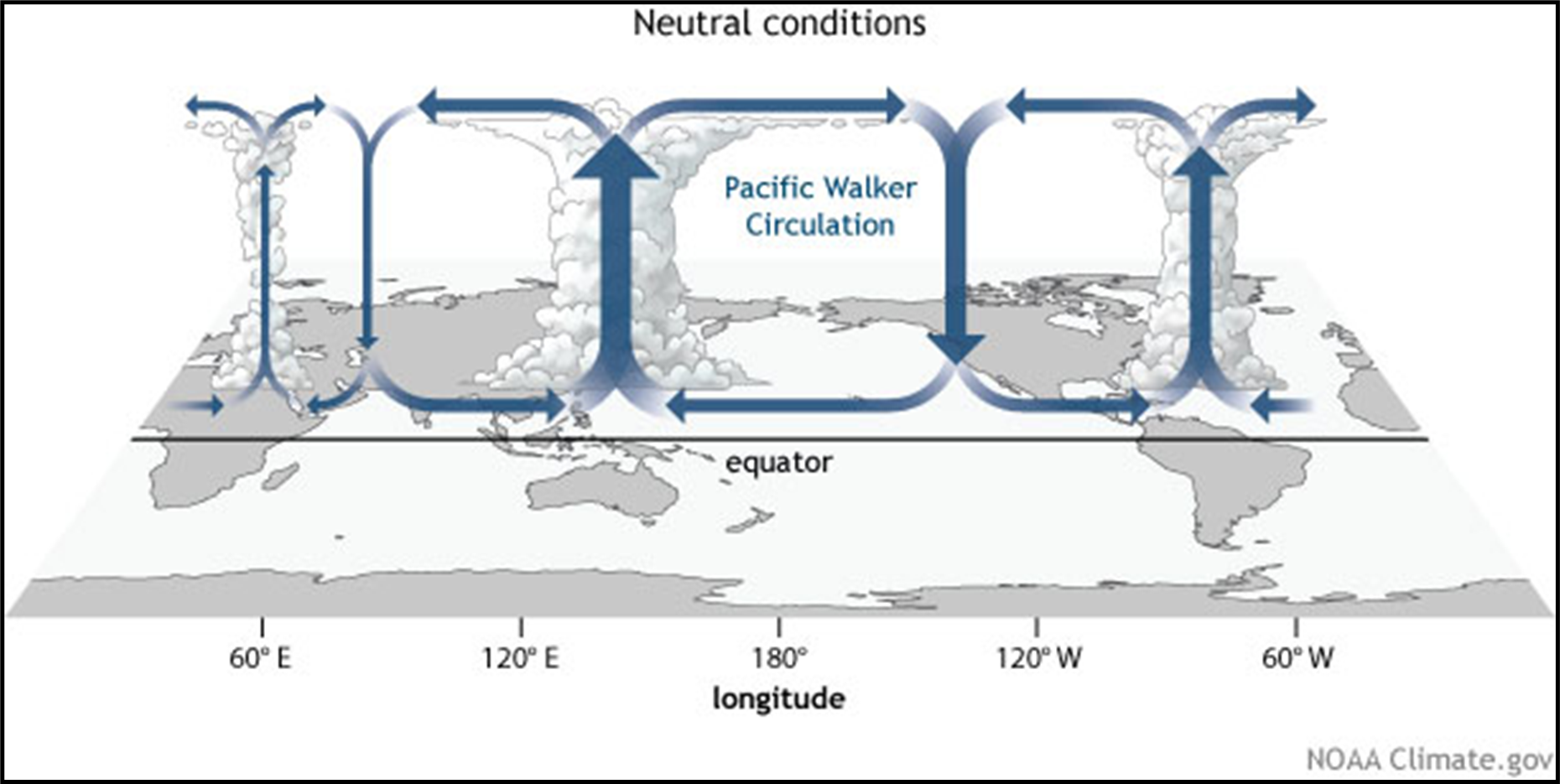
Pacific Walker (Sir Gilbert) Circulation under neutral conditions.
High rising air over SEA, eastward transport to western US where air sinks
El Niño
Sailors in the equatorial regions of the eastern Pacific noted poor fishing conditions off South America near Christmas.
It was termed El Niño (the Christ child).
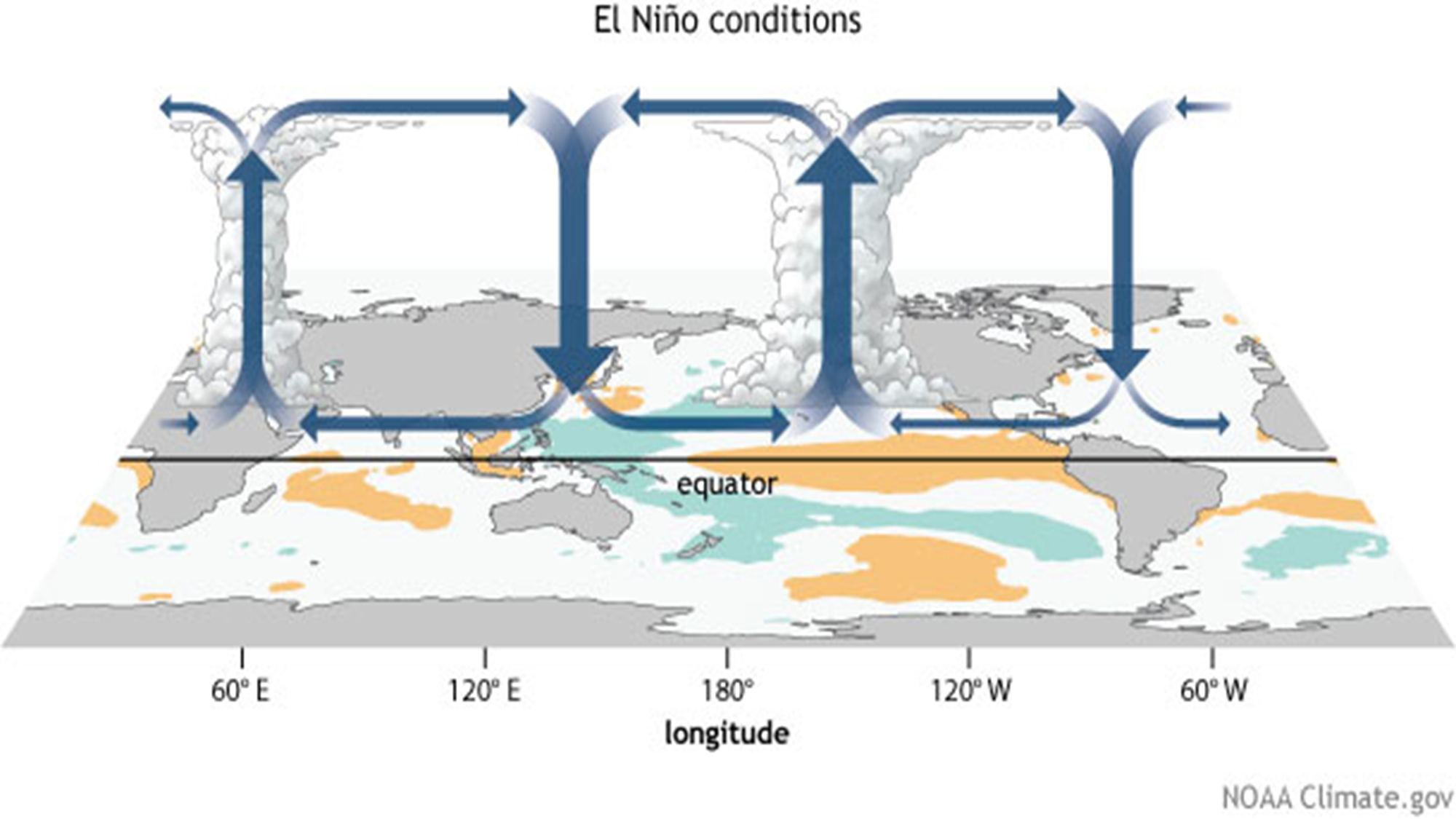
During El Niño conditions, the average air pressure is higher in Darwin than in Tahiti.
Air pressure differences in the South Pacific and water temperature approximately 8000 miles in the East Pacific ocean are “teleconnected”.
Typically referred to as ENSO - El Niño Southern Oscillation.
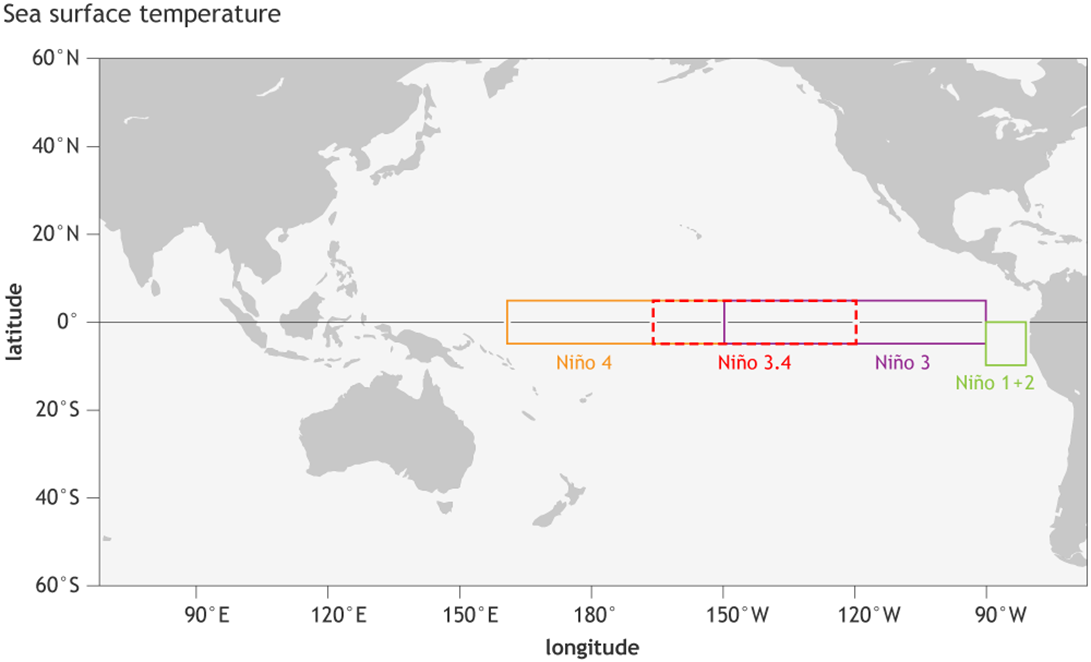
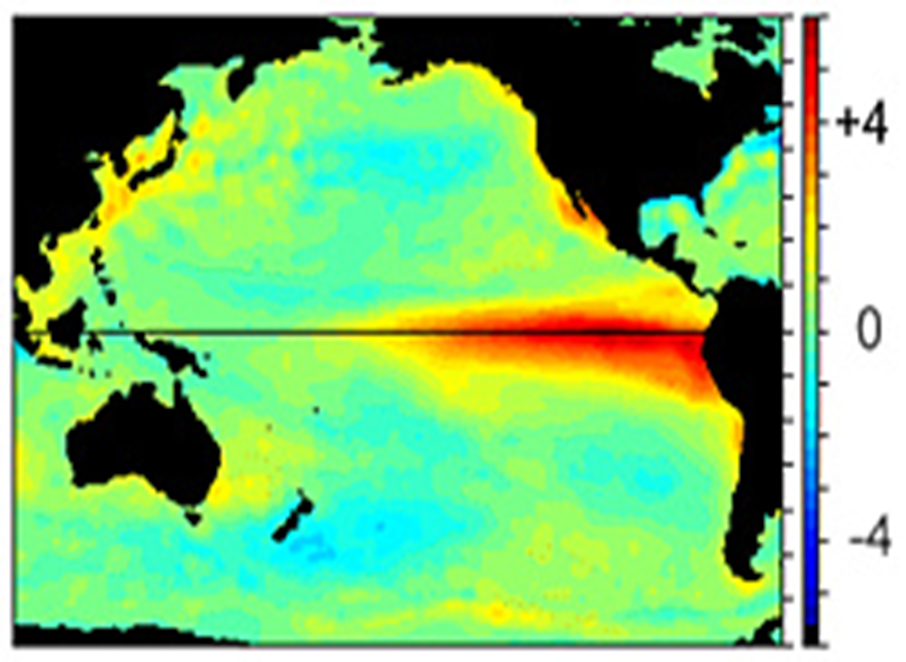
Warmer than usual temps in eastern Pacific, off west coast of South America.
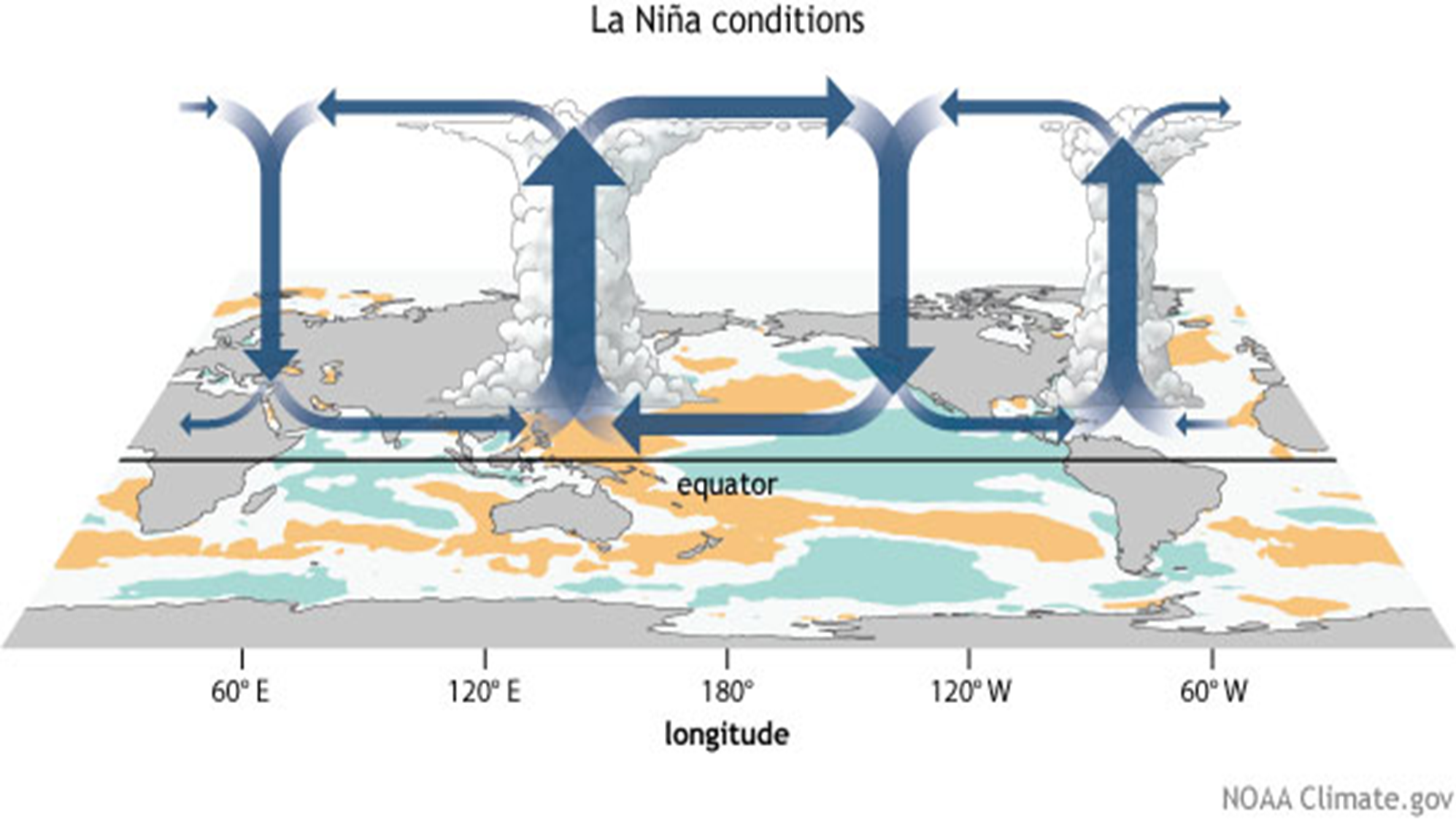
La Niña
Periods when the water temperatures are cooler than normal in the Eastern Pacific, also developing near Christmas.
Opposite of El Niño, termed La Niña.
During La Niña conditions, the average air pressure is lower in Darwin than in Tahiti.
Colder SST anomalies during La Nina
ENSO
During El Niño and La Niña episodes, the smoothed time series of the SOI corresponds very well with changes in ocean temperatures across the eastern tropical Pacific.
Negative SOI: Below-normal air pressure at Tahiti and above-normal air pressure at Darwin. (El Nino)
Positive SOI: Above-normal air pressure at Tahiti and below-normal air pressure at Darwin. (La Nina)
Prolonged periods of negative (positive) SOI values coincide with abnormally warm (cold) ocean waters across the eastern tropical Pacific, typical of El Niño (La Niña) episodes.
El Niño Impacts - North America (Dec-Feb)
Extended Pacific Jet Stream, amplified storm track.
Warmer conditions over northern US + such of Canada.
Drier conditions in Ohio river valley+more.
Wetter conditions along jet stream, along southern border of US.
Low pressure.
El Niño Climate Impacts - Globally and Seasonally
December-February: Impacts on North America, South America, Europe, Asia, Australia, and Africa.
June-August: Impacts on North America, South America, Europe, Asia, Australia, and Africa.
La Niña Impacts - North America
Colder conditions.
Drier conditions in some areas.
Wetter conditions in other areas.
High pressure and blocking patterns.
Variable conditions.
La Niña Climate Impacts - Globally and Seasonally
December-February: Impacts on North America, South America, Europe, Asia, Australia, and Africa.
June-August: Impacts on North America, South America, Europe, Asia, Australia, and Africa.
La Niña Impacts - Tropical Cyclones in the Western Hemisphere
More hurricanes in the Caribbean due to weaker vertical wind shear and trade winds, and less atmospheric stability.
Fewer hurricanes in the Pacific coasts of SE US due to stronger vertical wind shear
Cool, dry conditions in equatorial Pacific.
El Niño Impacts - Tropical Cyclones in the Western Hemisphere
More hurricanes in the pacific coast of SE US due to less vertical wind shear
Fewer hurricanes in the Caribbean due to stronger vertical wind shear and trade winds, and greater atmospheric stability.
Warm, wet conditions in equatorial Pacific.