Management Accounting 1
INTRODUCTION TO MANAGEMENT ACCOUNTING
Learning Objectives:
Differentiate between management accounting and financial accounting.
Describe elements in decision-making, planning, and control processes.
Emphasize profit maximization as a major objective of commercial organizations.
Discuss changes in the business environment impact on management accounting practices.
Identify key success factors affecting customer satisfaction.
Describe the functions of a cost and management accounting system.
Definition of Accounting:
Accounting: Process of identifying, measuring, and communicating economic information for informed decisions.
Provides sound financial and non-financial information for decision-makers.
New Business Environment Impacts on Management Accounting:
Increased competition from overseas and deregulation has led to highly competitive markets.
Reduced product life cycles due to technological innovations.
Companies now prioritize customer satisfaction and adopt new management approaches, impacting accounting practices.
USERS OF ACCOUNTING INFORMATION
Stakeholders Involved:
Managers: Need information on costs, demand, profitability for decision-making.
Shareholders: Require information on investment value and income.
Employees: Require information on the company’s ability to meet wage demands.
Creditors: Need financial details to assess the organization’s ability to meet obligations.
Government: Collects data on sales, profits, and taxation for economic policy management.
Information is essential for both businesses and non-profit organizations.
Internal vs. External Users:
Internal: Management accounting focuses on internal reporting for decision-making.
External: Financial accounting is geared towards reporting for outside stakeholders.
DIFFERENCES BETWEEN MANAGEMENT ACCOUNTING AND FINANCIAL ACCOUNTING
Legal Requirements:
Financial accounting must comply with statutory requirements (e.g., annual reports) whereas management accounting is optional.
Focus:
Financial accounting provides a comprehensive view of the entire organization while management accounting focuses on specific segments (products, departments).
Principles:
Financial accounting adheres to generally accepted accounting principles (GAAP) while management accounting may not.
Time Orientation:
Financial accounting is retrospective; it examines past performance.
Management accounting is forward-looking; it focuses on future forecasts and planning.
Frequency of Reporting:
Financial accounting: periodic reporting (annually, semi-annually).
Management accounting: reports can be more frequent (daily, weekly, monthly) to aid timely decision-making.
DECISION-MAKING, PLANNING AND CONTROL PROCESS
Stages of Decision-Making:
Identify objectives/goals of the organization.
Generate alternative courses of action.
Evaluate alternatives and select the best one based on relevant information.
Implement the chosen action via planning and budgeting.
Monitor outcomes comparing actual results with planned results.
Respond to any discrepancies through corrective action.
Identifying Objectives:
Businesses may aim to maximize profits, establish a strong market presence, improve customer satisfaction, etc.
search for aliernative courses of action
developing new products for sale in existing markets
new products for new markets
new markets for existing products
select alternative courses of action- data must be gathered about:
potential growth rates
market share company is likely to achieve
projected profits for alternative activity
Implement the decisions
budget= financial plan for decisions
master budget= businesses expectations for future periods
comparing actual and planned outcomes and respomnding to divergencies from plan
ensure objectives and plans are achieved through performace reports
FUNCTIONS OF MANAGEMENT ACCOUNTING
Key Functions:
Cost allocation between cost of goods sold and inventories.
Support management in decision-making through relevant financial information.
Aid in planning and performance measurement.
Cost Management:
Need for accurate cost information for monitoring trends, analyzing profitability by segments, and making resource allocation decisions.
IMPACT OF CHANGES IN BUSINESS ENVIRONMENT ON MANAGEMENT ACCOUNTING
Global Competition:
Deregulation and overseas competition necessitated efficiency and effective management practices.
Changing product life cycles
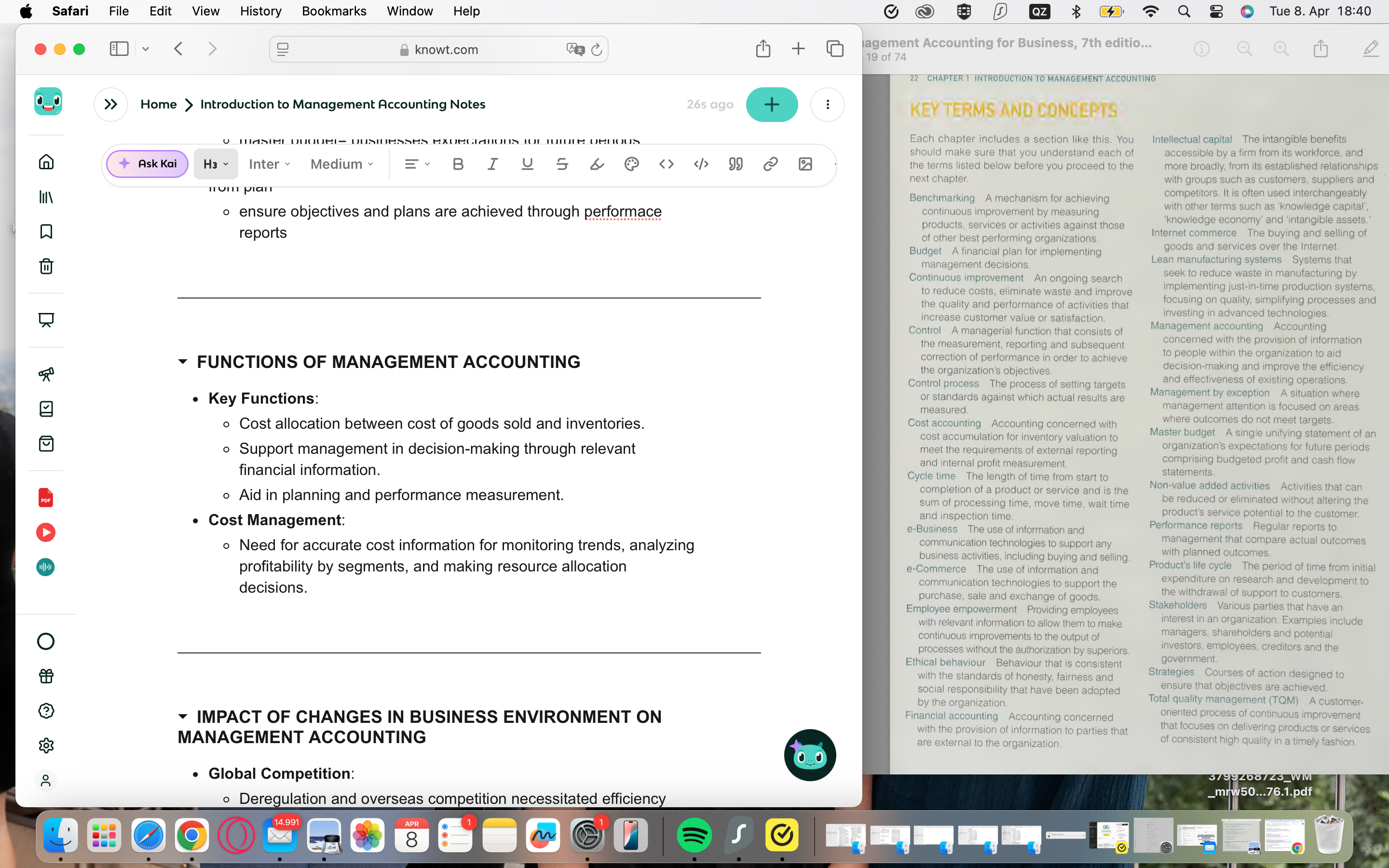
period from expenditure on research and development to time at which support to consumers is withdrwan-
Technological Advancement:
Shortened product life cycles require rapid adaptation and innovation to maintain competitiveness.
Impact of information technology
e-business, e-commerce and internet commerce have increased and had a great impact
Environmental and Sustainability Issues:
Companies accountable for ethical standards; emphasis on environmental reporting and sustainability practices.
focus on value creation
cost management seeks to eliminate non-value added activities and enhance value to product.
intellectual capital (intangible assets) includes knowledge, skills, and experience that contribute to a company's competitive advantage, supporting both innovation and long-term value creation.
Consumer orientation
next point
CUSTOMER SATISFACTION AND SUCCESS FACTORS
Key Success Factors:
Cost-efficiency, quality, reliability, timely delivery, and innovative product offerings become essential to securing customer satisfaction.
Continuous Improvement Philosophy:
Emphasizes the reduction of costs and enhancement of quality and delivery.
Innovation:
Continuous development of new products and services and adapting to customer needs is crucial for business success.
Benchmarking= the process of comparing business processes and performance metrics to industry bests or best practices from other companies.
SUMMARY
Understanding accounting's role in management, its distinction from financial accounting, and the implications of business environment changes is crucial for effective decision-making.