Intro to Linguistics
MORPHOLOGY
Morphology: the form (structure) of words
Mental Lexicon: words and their information are associated with them are stored in a mental lexicon
Lexical categories: verbs, nouns, adjectives, adverbs, pronouns, determiners, auxiliaries, prepositions, conjunctions.
Nouns: May be marked with plurals and possessives. They are syntactic; they can be preceded by modifiers such as determiners (the book, a book), adjectives (red book), numbers (two books), possessives (her book). They can serve as the subject of a sentence, object of a sentence, or object of a preposition.
Adjectives: They are comparative (happier) and superlative (happiest). Syntactically, they precedes nouns, they can be preceded by too or very, and fit the frame “it seems… “
Adverbs: can be derived from adjectives like adding -ly. Syntactically, they may immediately precede or follow verb (quickly ran; ran quickly), may start or end a sentence (quickly she ran to the store; she ran to the store quickly), and provide information about time (then, yesterday) or place (here).
Pronouns: Closed class with limited numbers (I/me, you, he/him, she/her, it, we/us, they/them). They change in form depending on whether they serve as an object or a subject (I saw her; she saw me). Syntactically, they can be substituted for a noun phrase and can be the subject /object of a sentence or object of preposition (I saw him; I stood on it).
Auxiliaries: Irregular, limited number of words (be, have, will, should, can). They preced the main verb.
Prepositions: Do not take suffixes or prefixes. Closed class with limited words (at, to, for, from, about, above, under, on, before).
Determiners: Do not take suffixes or prefixes. Closed class with limited words (the, a, an, some, two, three, any).
Conjuctions: Do not take suffixes or prefixes. Closed class with limited words (and, or, but, while, because). They link two words or phrases together.
Open class class lexical categories: have many members and can have new members added to them. (Nouns, verbs, adjectives, adverbs)
Closed class lexical categories: typically small and do not have new members added to them. (Pronouns, determiners, conjuctions, prepositions)
Morpheme: the smallest unit with meaning or grammatic function.
Types of morphemes:
Stem (also called root or base): The core of the word to which the morephemes attach. Carries the main semantic content.
Affix: the morphemes that attach to the stem. These include prefix, suffix, infix, circumfix (interweaving)
Inflectional morpheme: creates different grammatical form of the same word. They give grammatical information about the word and are required for the root to make sense. They are highly productive (can go on most words).
Derivational morpheme: create new words out of other words. They change the meaning of the word or its lexical category.
Building words with morphemes:
Begin with root (underline it and identify its lexical category)
Add one morpheme at a time (each nod should be a word, derivational morphemes go first).
Morphological processes:
Compounding: a new word is formed from two independent words. In compound words, the stress is usually on the first word only.
Alternation: morpheme interchange (men/man).
Suppletion: Irregular word formation. Inflected forms are phonetically unrelated to the shape of the root. (is/was, go/went).
Reduplication: process of forming new words via repetition. Full reduplication is when the whole morpheme is repeated. (do you like-like him?). Partial reduplication is when part of a morpheme is repeated (fanchy-schmancy).
SYNTAX
The structure of phrases and sentences.
A sentence is: structured, ruled, and has a hierarchical collection of constituents.
Syntax: the way words are organized into phrases and phrases into sentences. It allows us to make sentences, ask questions, and express relationships between events and entities. Much of it happens below the level of consciousness, but it is still complex and systematic. Is part of communicative intent.
Constituents: syntactic chunks. A grouping of words that forms a coherent syntactic or semantic unit, a syntactic unit that functions as part of a larger unit within a sentence. (Ex. The word is the smallest constituent of a sentence. The sentence itself is the largest constituent. Each phrase is also a constituent.)
Lexical ambiguity: same word has different meanings (homonymy)
Structural/syntactic ambiguity: different meanings are caused because the same sequence of words has multiple possible constituent structures.
Tests for constituency:
Substitution:
Can it be substituted by a pro-word? (pronoun, form of “do”, adv. like here or there)?
Can you replace it with a question word and then answer the question with that exact phrase?
Movement: if some part of a sentence can be moved to the beginning of a sentence, it’s a constituent. (ex. I went to the library before I went home vs Before I went home, I went to the library).
Clefting: a special kind of movement. (ex. It was the black cat that ran up the tree vs. It was up the tree the black cat ran).
Coordination: if you can coordinate two strings of words with “and” and can then switch the order, then each chunk is likely a constituent. (The tiger ate the meat and drank the water vs the tiger drank some water and ate the meat)
Major Types of Constituents:
Sentences (S): entire sentence; contains noun phrase and a verb phrase.
Noun Phrase (NP): must contain a noun or a pronoun. One NP can be substituted for another NP (ex. the black cat ran up the tree vs my great aunt ran up the tree).
Verb Phrase (VP): must contain a verb. One VP can be substituted for another VP. (ex. the black cat ran up the tree vs the black cat ate).
Prepositional Phrase: Prepositional and noun
Phrase structure rule: a rule that describes the composition of constituents. PSR’s are used to describe the relationship of constituents to one another. They can be used to generate well formed sentences but should not generate ungrammatical sentences.
Every chunk of a PSR is a node on a syntax tree diagram. They do not have to be binary.

Tree diagrams: representation of syntactic structures.
They illustrate linear order and hierarchical structure of sentences and their constituents.
S(entence) at the top, branching to NP on the left and VP on the right.
Lines should never cross
Each node represents a constituent.
Steps for drawing a tree diagram:
Write down the entire sentence with plenty of space above it
Label the lexical category of each word
Syntactic Structures:
Co-Occurence requirements: for some expressions, if they show up in a sentence, then another expression is required to occur in that sentence as well. (ex. the verb “hit” requires an object).
Argument: linguistic expression that must occur if some other expression also occurs.
Adjunct: linguistic expression whose occurence in an expression is optional.
Ex: the cat ran vs the cat ran up the tree. Up the tree is not grammatically necessary.
Subjects and objects: when there’s just one argument (noun phrase) it will be the subject. When there are two arguments, one is the subject and the other is the object.
The subject is the noun which is doing the event.
The object is the noun which is having something done to it.
Transitivity
intransitive verb: a verb that takes only one argument (it does not take an object) ex: the dog slept.
transitive verb: a verb that takes two arguments (a subject and an object) ex: the dog chased the man.
distransitive verb: a verb that takes three arguments (a subject, object, and indirect object) ex: I gave a mouse a cookie.
Grammatical Relations: the relationship a NP has with a verb (predicate).
Oblique: the object of a preposition. ex: Mary put the book on the table.
SEMANTICS
What is meaning?
The function of language is communication - to transmit meaning.
Morphology and syntax allow us to combine meaningful parts (stems, affixes, words) to create bigger meaningful parts (words, phrases, sentences).
Semantics: focuses on meaning; the study of meaning in general (words, sentences), and the study of the relationship between language and the world (truth conditions, implicatures). There are two types of semantics:
Lexical semantics (the meaning of words)
Compositional semantics (the meaning of phrases and sentences)
Sense: a mental representation of an expression’s meaning.
Referent: the specific entity in the world to which some expression refers.
Reference: the collection of all referents of an expression.
Two expressions can have the same referent but different meaning. (Ex. George Washington was the first President of the US vs George Washington was George Washington) - two noun phrases that share a referent but have different meanings.
Three Types of Meaning
Denotation: linguistic meaning (referential meaning - relationship between the word and the item in the world that it denotes).
Connotation: social and affective meaning
Referential meaning: a word’s literal meaning; denotation.
Social meaning: information about the speaker’s background or the context.
Affective meaning: information about the speakers emotions or attitude.
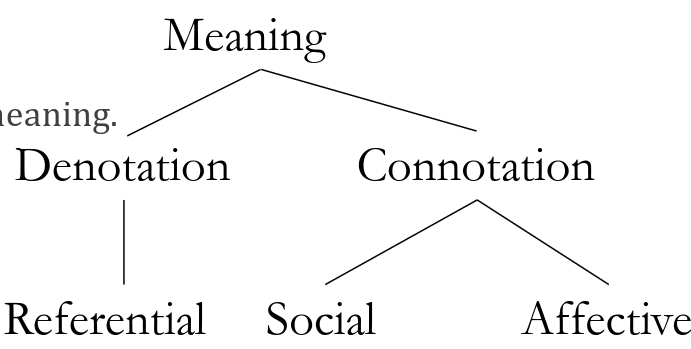
Words can share referential meaning but have different social and/or affective meanings. (Ex: sofa/couch, protest/riot, murder/homicide).
Lexical Semantics
Semantic Relationships:
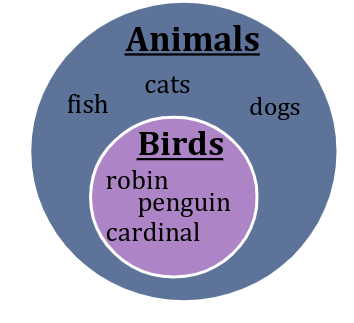
A hierarchiacal relationship in which X (hyphonym) is a kind of Y (hypernym).
Hyperonym: superordinate term
(co-)hyphonym(s): subordinate term
Meronyms: the referent is a part of another item (Ex. finger is a part of a hand).
Synonyms: lexical intems with the same (referential) meaning.
Antonyms: relationship in which the lexical items are opposite with respect to some aspect of their (referential) meaning.
complementary: denial of one implies assertion of the other (if one thing is true, the other can’t be true ex: pass or fail).
gradable: meanings are opposite but they lie on a spectrum (ex: hot and cold).
reverse: one word in the pair suggests movement that “undoes” the movement suggested by the other (ex. left and right)
converse: opposing points of view; for one member of the pair to have reference, the other must as well. (In order for X to happen, Y must happen also; Ex in order for something to be receive, someone has to have sent it).
Polysemy: One word with two or more related meanings. (ex. leg of body or leg of chair).
Conceptual Metaphors: Large scale metaphors that impact several different areas within language.
Competing approaches to word meaning:
Componential analysis: the meaning of a word is reducible to a binary set of features.
Prototype theory: the meaning of a word is “fuzzy”, based on exemplars and similarities
Componential analysis:the analysis of lexical meaning using a set of binary sematic features. The meaning of a word is said to be equivalent to the sum of each feature for which it has a plus value. Difference between words can be explained by comparing features in which they differ.
 Prototype theory: Sees meanings as being related to cognitive categorization. Categories have members which are more “central” or “prototypical”; these are the best representations of the categories. The “mental images” associated with concepts may be closely connected to their prototypical examples.
PRAGMATICS
How context affects language use.
Context: could be a simple observation, an indiret request, an apology, an expression of sympathy (ex. “It’s cold in here”). - Language and context are interdependent and symbiotic.
Dietetics: “Placeholder” words whose meaning is always determined by the context in which they are uttered.
pronouns: he, she, it…
spatial deictics: here, there…
temporal deictics: now, then, today…
Linguistic context: what has already been said. For example, “Yes” can mean “Yes, I will marry you” because of the question that was already asked.
Situational context: non-linguistic factors that affect meaning like
shared knowledge about the world
physical environment
what’s happening
it does not need to be previously mentioned in the discourse in order for speakers to understand what others mean
Social context: includes information about the speakers and what each of their roles are
Discourse markers: “Filler words” that help facilitate conversational flow, manage relationships between conversational participants. They can
Start/change a topic: so, well then,
Connect stretches of discourse together: therefore, as a result,
Confirm the listener understands: you know, right?
Fill a pause: like, you know
“I’m listening”: uh-huh
Felicitous: utterance is appropriate relative to context in which it occured
Infelicitous: utterance is innappropriate
The # is used to mare infelicity.
Rules of conversation:
Language use, like other forms of social behavior, is governed by social rules.
These rules protect the integrity of the conversation.
Speaker takes into account what the listener already knows
Grice’s Cooperative Principle: speaker’s ‘intend’ for successful communication to take place and obey cultural norms of talk.
Grice’s Maxims: rule of thumb that cooperative speakers generally follow. Guidance that helps ensure effective communication. There are four maxims: quality, relevance, quantity, manner.
Maxims of Quality: be truthful; the contribution one makes is true to the best of one’s knowledge.
Maxims of Quantity: make your contribution as informative as required. Do not make your contribution more informative that is required. Ex: Is there a gas station nearby? Yes, this is where it is.
Maxims of Relevance: be relevant.
Maxim of Manner: avoid obscurity and ambiguity. Be orderly, clear, and brief. For example, a baking recipe that is out of order and has no measurements.
LANGUAGE ACQUISITION
Preliminaries about Child Acquisition:
Children learn the language of the communities in which they are raised
There is no genetic basis for the language (or dialect) a child ends up speaking
Children all over the world go through similar stages in the development of language
Basic Observations:
Children learn to speak without being explicitly being taught
All typical developing children learn a language successfully through normal exposure
Children learn very rapidly
Stages of Language Acquisition:
Birth-8 weeks | newborn reflexive stage |
|---|---|
2-4 months | different cries, gurgling, squealing, cooing |
4-6 months | vocal play (consonant-like sounds) |
7-9 months | repeated babbling intonation |
10-11 months | variegated babling |
12-18 months | one-word stage stage |
18-24 months | two-word stage: nou-like word + predicate like words |
2 years | prepositons, pronouns, sequence of 2-3 sentences |
4 years | basic grammar rules, tells stories, regular inflection, some irregular forms |
Children’s Pronounciation: some ways in which children’s pronunciation many not match adult forms:
late-acquired sounds are substituted or omitted
consonant clusters are simplified
sequencing errors and other types of simplification
Final consonant devoicing: the child devices word-final consonants (ex. bet instead of bed)
Initial C voicing: word-inital voiceless consonants are pronounced as voiced by the child (ex. bik instead of pig)
gliding
consonant harmony
stopping: word-inital fricatives and affricative are pronounced as stops
consonant cluster reducation: in a cluster, the child does deletion
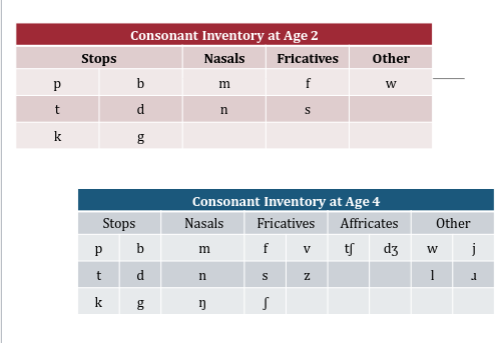 What determines acquisition order?: Frequency, ease of production, functional load of the sound
The FIS Phenonmenon: children can percieved more sounds (and phonetic differences) than they can produce.
How do we study language acquisition?
High-amplitude sucking procedure:
infant is given a pacifier that is connected to a machine that tracks sucking rate.
each time the infant sucks on the pacifier, a sound is played
infant sucks on the pacifier until bored (habituation - sucking rate decreases)
a different sound is played
if the infant starts sucking faster, they’re showing interest in the sound - indicates they recognize it as a different sound
(no change in sucking rate = infant doesn’t perceive different sound)
head-turn preference procedure:
two speakers are placed on opposite sides of a room, with a neutral stimuli in the middle ( a flashing light)
infants prefer to look towards stimuli that are familiar
if a child is primed on a stimulus,a ND then spends a longer time turned towards that stimulus when repeated, it indicates that they remember or are familiar with
preferential looking procedure:
two pictures appear on seperate screens
prompt: where’s mommy?
if child looks towards mother, she/he understands that word
The Innateness Hypothesis: the idea that infants are bornw with a certain degree of knowledge regarding the fact that language have features and they are supposed to “figure out” what those features are. THe set of known features shared by all language had been referred to as Universal Grammar.
Infants need to be able to:
distinguish different phonemes from one another and be able to do so in the context of variation (talker, rate, etc)
distinguish only the phonemes that are important in the particular language
learn what types of acousitc changes are important linguistically and which are not
distinguisn their language from other languages, or distinguish different languages from one another (especially infants in billingual homes)
What can babies actually do:
before birth: able to recognize their mother’s voice and even their mother’s native language
soon after birth, accelerated language acuqisition and development process
by 6 months: able to connect words they hear frequently with objects
by 8 months: able to associate novel words with novel objects
Morphological Overgeneralization: children extends a rule beyond the context in which it applies:
past-tense verbs (ex. eaten, maked)
plurals (ex. peoples)
This shows that young children have an unconscious awareness of morphological rules.
Developement of Morphology & Syntax:
Negation: sentence-inital no: no baby sleep, I no sleep.
Interrogatives: Question intonation only: Why you sad?
The Critical Period Hypothesis: an age after which it is impossible to acquire language with native-speaker fluency. A period of brain development after which language learning is not so automatic.
LANGUAGE AND THE BRAIN
Neurolinguistics: the study of the neural and electrochemical bases of language development and use.
Psycholinguistics: the study of acquisition, storagem comprehension, and production of language.
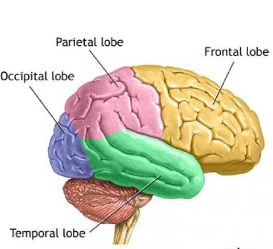
The frontal lobe
location: front of the brain
functions: language production, primary motor cortex, higher thinking.
The parietal lobe:
location: middle of the brain above the temporal lobe.
Functions: integration of sensory information, processing of vision and space around you.
The occipital lobe:
location: back of the brain
functions: primary visual cortex, visual stimuli
The temporal lobe:
location: under the parietal lobe
functions: auditory stimuli
LateralizationL the brain is divided int two hemispheres; each hemisphere is responsible for different cognitive functions. For most people, language processing happens in the left hemisphere.
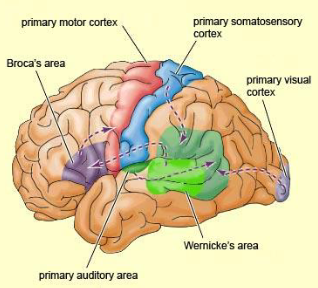 Cortex: thick membrane covering the brain; several areas have specialized functions relating to language.
motor cortex: sends signals to your muscles (including those of face, jaw, and tongue)
auditory cortex: recieves and identifies auditory signals
visual cortex: recieves and interprets visual stimuli
Broca’s area: located at base of motor cortex. Primary involved in production of language:
organization of articulatory patterns of language
inflectional morphemes
function words
sentence structure
pronouns
Wernicke’s area: located near back section of auditory cortex. Primarily involved in language perception and comprehension.
comprehension of words and sentences
selection of words from mental lexicon
Aphasia: inability to perceive, process, or produce language because of physical damage to the brain. Found in very few people suffering from damage to the right hemisphere. Usually the result of a stroke or an accident.
Broca’s Aphasia: results from damage to Broca’s area, typically causes difficulty in speech production. Broca’s aphasics speak or sign haltingly. (English speakers typically have problems with function words and inflectional suffixes). Most Broca’s aphasics do not have a problem understanding the speech of others.
Wernicke’s Aphesia: result of damage to wernicke’s area. Receptive disorders → difficulty understanding the speech of others. Also have trouble interpreting words from their mental lexicon, so speech is often semantically incoherent.
Speech perception: the process of recieving and interpreting messages.
McGurk Effect: illustrates that we don’t merely rely on acoustic signal to procecss and interpret sounds bu we rely on visual cues as well.
SOCIOLINGUISTICS
The relationship between language and social structures.
Sociolinguistics is the study of the relationship between language varieties and social structure. It also involves studying the interrelationships among language varieties. Language and social norms are dynamic and interconnected.The relationshup between them is not static.
Mutual Intellegibility is the question: can speakers from both varieties understand one another? Linguistics would like to use mutual intelligibility to distinguish language vs dialect - but there are other political and social issues.
Dialect is the language variety characteristic of a particular social group. Everybody speaks a dialect.
- A group of people who speak the same dialect is a speech community.
No dialect or language is objectively superior to any other. Mainstream English is an idealization.
Dialects and language variation are correlated with factors such as region, socioeconomic status, ethnicity, gender, age, and more. But it is not correlated with intelligence or education alone. Correlation does not mean causation. Communities and speakers use speech that exhibits characteristics of multiple factors.
Language variation takes place at all linguistic levels: phonetics and phonology, morphology, syntax, lexicon, semantics, etc.
Phonetic variation: differences in pronunciation.
Accent: the pronounciation of a particular social group.
Morphological variation: differences in morphological structure.
Syntactic variation: variation in how phrases and sentences are structured.
Semantic variation: the same words means diff
erent things in different language varieties.
Lexical variation: different words for the same thing.
Prestige: level of regard or value that a speech community places on a particular language variety. It is often assigned relative to other language varieties, may be tied to other linguistic features, is closely tied to notions of group identity. Which variety is considered to be more prestegious may vary depending on audience and/or context.
Overt prestige: when people model their speech after the dialect that is more prestigious to then. Often the dialect with the most prestige is the standard.
Covert prestige: the standard is not the most prestigious for all people, however covert prestige is when the speaker chooses to differ from the standard and assimilate to a different non-standard language variety.
Isogloss: the geographical boundary marking the limit of regional distribution of a particular feature.
Isogloss bundle: when many different isoglosses fall approximately in the same location.
Chicano English: often by some second or third generation Mexican descendant. May or May not be speakers of Spanish, Chicano English speakers are monolingual.
Social factors that affect language: ethnicity, class, gender, socioeconomic status.
Gender: men and women talk differently. Women tend to use more overt prestige, standard variants.
Perception Bias and Pet Peeves: when a skewed understanding of a group of people affects decisions or assumptions we make about said groups.
Vocal Fry: also known as “creaky voice”. A lower vocal register commonly associated with young women.
Age: younger speakers often speak differently that older speakers, part of natural language change.
Style and register: an individual speaker speaks differently in different contexts.
Speech Styles: systematic variations in speech based on factors such as topic or purpose, setting, and addressee
Registers: refers to different levels of formality and are characterized by an entire set of linguistic features. Markers of register can be lexical, phonological, morphologicalm syntactic, semantic.
Automatically adjusting from one speech style to another is known as style shifting.