Chapter 10 - Democracy in America [1815-1840] (good)

OVERVIEW
This chapter covers the "Age of Jackson"—a period when political democracy expanded dramatically for white men while simultaneously excluding women, African Americans, and Native Americans. The era was defined by tensions between nationalism and sectionalism, debates over federal versus state power, and the market revolution's impact on politics.
THE TRIUMPH OF DEMOCRACY
Property and Democracy
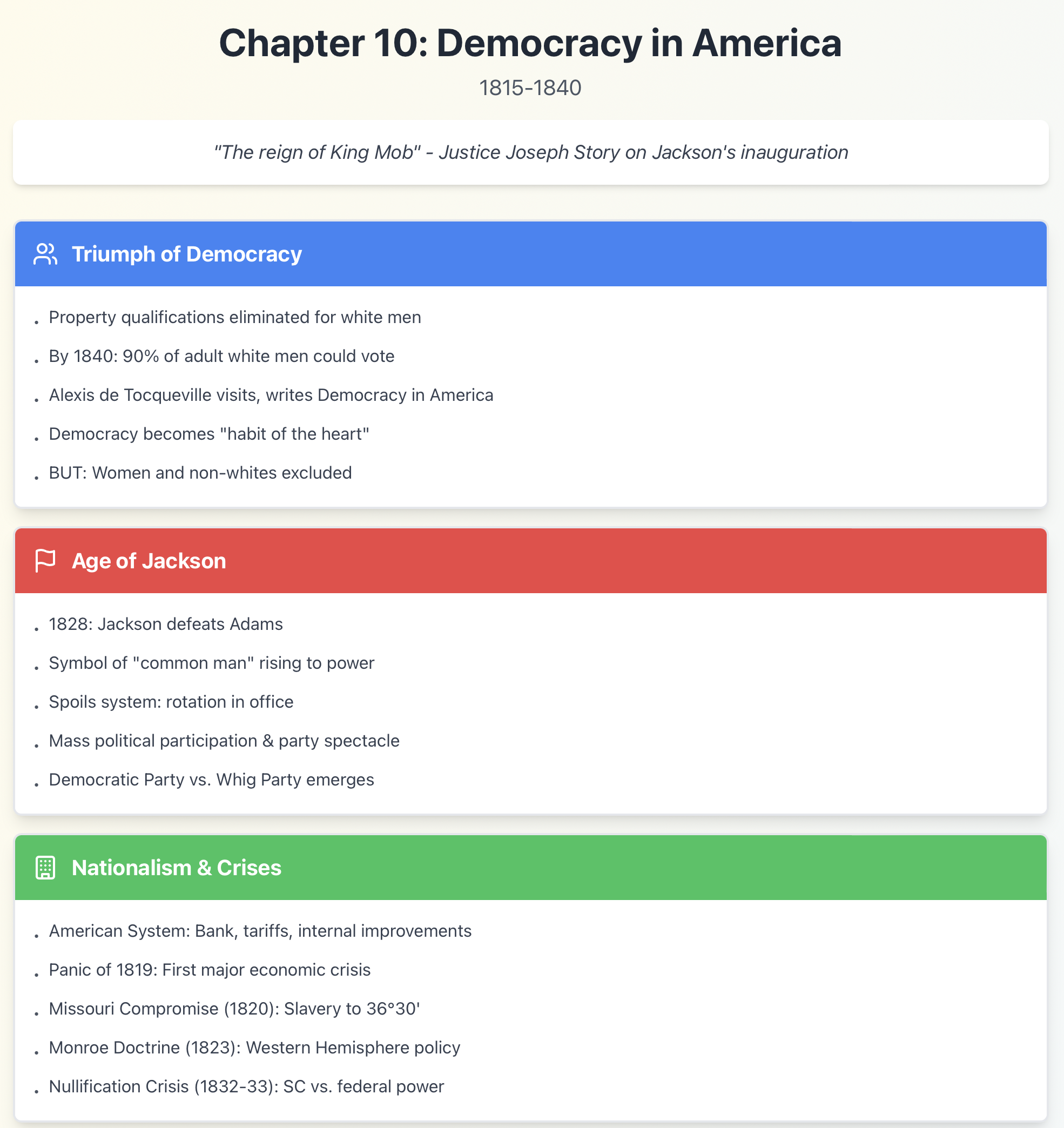
By the 1820s-1830s, property qualifications for voting collapsed across America
New states entering the Union required no property ownership to vote
Older states held constitutional conventions to eliminate these requirements
Significance: Voting rights shifted from property ownership to simply being a white male citizen—reflecting the era's individualism where "ownership of one's self" replaced property ownership as the basis of citizenship
The Dorr War (1841-1842)
Rhode Island was the exception—maintained property requirements ($134 real estate value or $7/year rent)
Thomas Dorr led reformers who drafted a new constitution extending suffrage to all white men (while removing it from blacks)
President Tyler sent federal troops; movement collapsed
Importance: Demonstrated the intense passion surrounding white male suffrage and how exclusion from voting was seen as fundamentally un-American
Alexis de Tocqueville
French aristocrat who visited America in the 1830s, wrote Democracy in America (1833)
Key insight: Democracy was more than voting—it was a "habit of the heart," a culture of equality, individual initiative, and active civic participation
Significance: Recognized that democracy had become central to American identity and freedom itself
Information Revolution
Steam-powered printing led to explosion of newspapers (weekly circulation in U.S. exceeded Europe's despite smaller population)
"Penny press" made newspapers affordable at one cent vs. six cents
Low postal rates helped newspapers circulate nationally
Political parties sponsored newspapers in every region
Alternative papers emerged: Freedom's Journal (first black newspaper), The Liberator (abolitionist), Cherokee Phoenix
Importance: Created an informed, engaged electorate and made politics a form of mass entertainment
Limits of Democracy
Women lost voting rights (New Jersey added "male" in 1807)
Free blacks were systematically disenfranchised in new states and older ones (NY raised requirement to $250 for blacks; NC, PA stripped blacks of vote)
By 1860, only 5 New England states allowed black voting (containing 4% of free black population)
Key Concept: As democracy expanded for white men, exclusions became based on "natural incapacity" rather than economic dependency—nature, not economics, justified keeping women and non-whites from voting
A Racial Democracy
Democracy became increasingly identified with whiteness
Minstrel shows popularized racist stereotypes (Jim Crow character)
"Scientific" theories of racial superiority/inferiority emerged
Race replaced class as the boundary of political participation
Significance: White male immigrants could vote immediately upon arrival; free blacks whose ancestors lived in America for centuries could not
NATIONALISM AND ITS DISCONTENTS
The American System
Proposed by Henry Clay, supported by President Madison's 1815 message
Three pillars: (1) New national bank, (2) Protective tariff, (3) Federal funding for roads and canals ("internal improvements")
Goal: Economic development and national unity through infrastructure
Problem: Madison vetoed the internal improvements bill, believing it required constitutional amendment
Tariff of 1816 and Second Bank of the United States (1816) did pass
Second Bank of the United States
Private corporation serving as government's financial agent
Issued paper money, collected taxes, paid debts
Supposed to regulate state banks and ensure stable currency
By 1820s, over 200 state banks existed, printing their own paper money
Importance: Bank's power and the instability of paper money would become central political issues
Panic of 1819
First major economic crisis of the market revolution
Caused by: speculation in western lands, overissuance of paper money, falling European demand for American products
Banks demanded loan repayment; farmers and businesses went bankrupt; urban unemployment rose
Impact: Deepened American distrust of banks and paper money, undermined the Second Bank's reputation
McCulloch v. Maryland (1819)
Maryland tried to tax the Bank of the United States
Chief Justice John Marshall ruled: (1) Bank was constitutional under "necessary and proper" clause, (2) States cannot tax federal institutions ("power to tax is power to destroy")
Significance: Affirmed broad interpretation of federal power and national supremacy over states
Missouri Compromise (1820)
Missouri applied for statehood with slavery; Rep. Tallmadge proposed restricting slavery there
Debate shattered Republican unity along sectional lines
Compromise: (1) Missouri admitted as slave state, (2) Maine admitted as free state, (3) Slavery prohibited north of 36°30' line in Louisiana Purchase
Importance: First major crisis over westward expansion of slavery; Jefferson called it "a fire bell in the night" warning of future conflict
NATION, SECTION, AND PARTY
Monroe Doctrine (1823)
Written by Secretary of State John Quincy Adams
Three principles: (1) No new European colonization in Americas, (2) U.S. won't intervene in European wars, (3) Europe must not interfere with Latin American republics
Significance: America's "diplomatic declaration of independence," claimed U.S. dominance in Western Hemisphere
Election of 1824
Four candidates: Jackson, Adams, Crawford, Clay
Jackson won popular vote but no electoral majority
House chose Adams (with Clay's support); Adams made Clay Secretary of State
"Corrupt bargain" charge haunted Clay's career
Importance: Laid groundwork for new two-party system (Jacksonians vs. Adams-Clay supporters)
John Quincy Adams's Presidency
Vision of activist federal government promoting economic development
Called for national university, observatory, naval academy, federal internal improvements
Famous statement: "Liberty is power"
Failure: Congress rejected most proposals; strict constructionists opposed expanding federal authority
THE AGE OF JACKSON
Andrew Jackson
Embodied contradictions: self-made man but wealthy slave owner; democrat but supported Indian removal; nationalist but champion of states' rights
Inaugurated 1829 after defeating Adams in 1828
Significance: Symbolized democratic opportunities and the "common man" in politics
The Party System
Politics became mass spectacle—parades, rallies, conventions engaged millions
Professional politicians organized party machines in every neighborhood
"Spoils system": government jobs given to party loyalists (Jackson called it "rotation in office")
Newspapers became partisan organs
Importance: Political parties became essential to governing; national parties helped unite a sectionally divided country
Democrats vs. Whigs
Democrats: Favored limited government, feared concentrated power and "nonproducers" (bankers, speculators), supported state over federal power, opposed moral legislation, attracted farmers, workers, southern planters, immigrants
Whigs: Supported American System, believed government should promote economic development and moral improvement, attracted businessmen, commercial farmers near transportation routes, evangelical Protestants
Core Debate: "Public" vs. "private" freedom—whether government power threatened or enhanced liberty
Nullification Crisis (1828-1833)
South Carolina opposed "tariff of abominations" (1828)
John C. Calhoun developed nullification theory: states could nullify federal laws exceeding constitutional powers
Based on "compact theory"—Constitution was agreement among sovereign states
SC threatened to nullify tariff; Jackson prepared to use force
Resolution: Compromise tariff (1833) reduced rates; SC rescinded nullification
Significance: Established Jackson's commitment to Union over states' rights; gave South a political philosophy for defending slavery
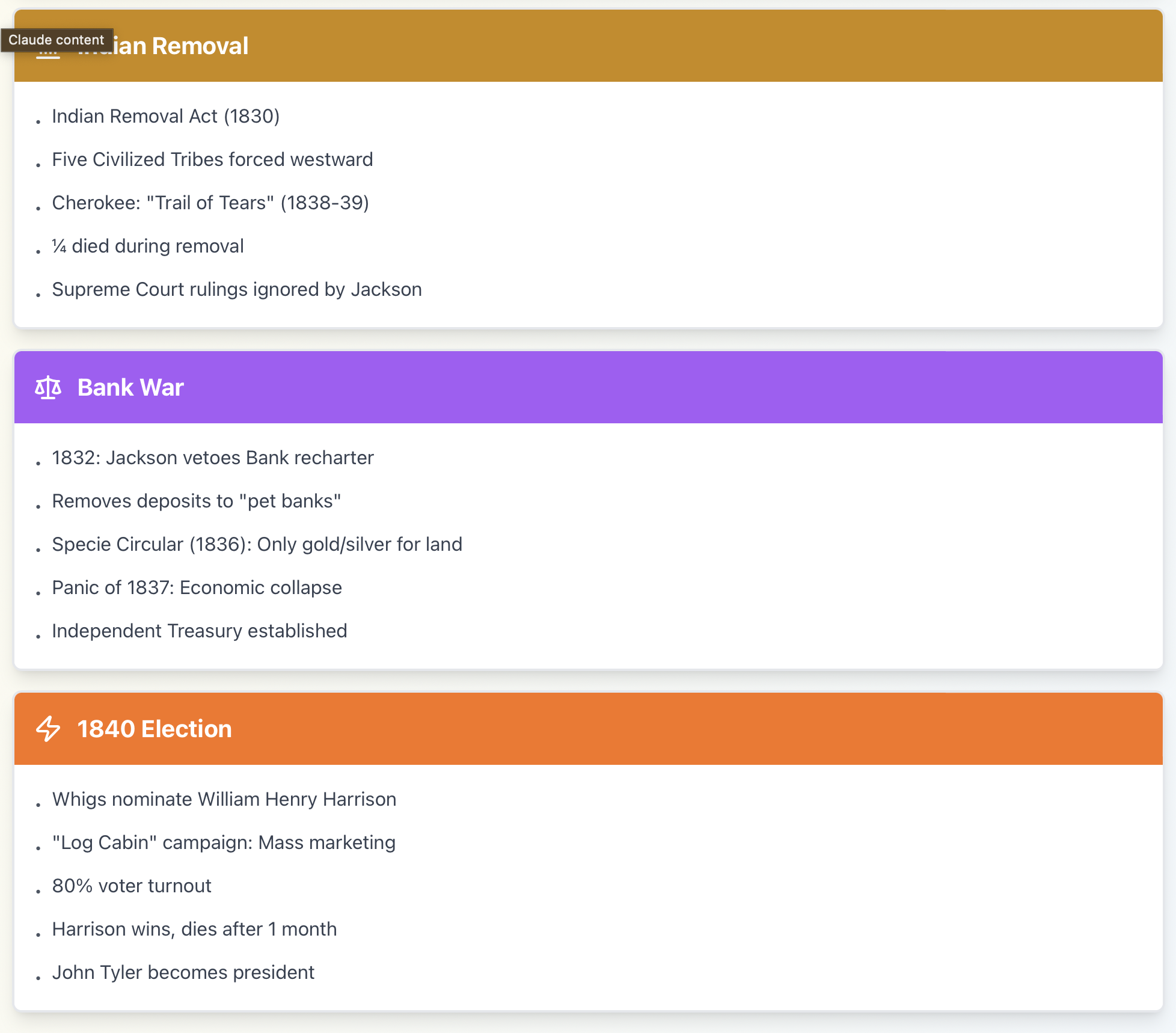
Indian Removal Act (1830)
Provided funds to remove Five Civilized Tribes (Cherokee, Chickasaw, Choctaw, Creek, Seminole) from Southeast
Cherokee had adopted white ways (schools, written laws, constitution, farming, slavery)
Supreme Court cases: Cherokee Nation v. Georgia (1831)—Indians were "wards" of federal government; Worcester v. Georgia (1832)—Georgia's actions violated Cherokee treaties
Jackson allegedly said: "John Marshall has made his decision, now let him enforce it"
Trail of Tears (1838-1839): 18,000 Cherokee forcibly removed; at least 1/4 died
Seminoles resisted in Second Seminole War (1835-1842)
Impact: Completed removal of Indians east of Mississippi; reinforced racial definition of American nationhood
THE BANK WAR AND AFTER
Bank War
Nicholas Biddle headed Second Bank; had power to regulate state banks and create stable currency
Jackson saw Bank as "Monster Bank"—corrupt union of political authority and economic privilege
1832: Congress rechartered Bank early; Jackson vetoed
Jackson's Veto Message: Bank gave special privileges to "rich and powerful" at expense of "humble members of society"; declared himself defender of common people
Significance: Jackson enhanced presidential power through aggressive use of veto and direct appeals to public
Pet Banks
Jackson removed federal deposits from Bank of the United States, placed them in state "pet banks"
These banks issued massive amounts of paper money (from $10 million in 1833 to $149 million in 1837)
Speculation in land and internal improvements soared
Result: Economic instability that would lead to panic
Panic of 1837
Triggered by: Jackson's Specie Circular (1836—only gold/silver for land), British demand for hard currency, declining cotton demand
Depression lasted until 1843: prices fell 25%, businesses failed, unemployment soared, labor movement collapsed
Nine states defaulted on debts
Impact: Led to Independent Treasury (1840)—completely separated federal government from banking system
Election of 1840
Whigs nominated William Henry Harrison (military hero) without platform
"Log cabin" campaign—promoted Harrison as common man despite his wealth
Turnout hit 80% of eligible voters
Harrison won decisively but died one month into term
John Tyler: States' rights Democrat turned Whig; vetoed Whig programs; accomplished little
Significance: Demonstrated triumph of mass democratic politics and party organization; showed presidents needed party support to govern
KEY THEMES
Expansion and Exclusion: Democracy expanded dramatically for white men while systematically excluding women, blacks, and Indians
Market Revolution's Political Impact: Economic change drove political conflict over banks, tariffs, internal improvements, and government's role
Nationalism vs. Sectionalism: Constant tension between national authority and state sovereignty, especially over slavery
Rise of Modern Politics: Development of two-party system, mass political participation, professional party organizations
Presidential Power: Jackson dramatically expanded executive authority through veto power and direct popular appeals
Race and American Identity: Freedom and democracy became increasingly defined in racial terms—as privileges for whites only