Chapter 5: The Periodic Table
Elements are arranged vertically in the periodic table in groups that share similar chemical properties.
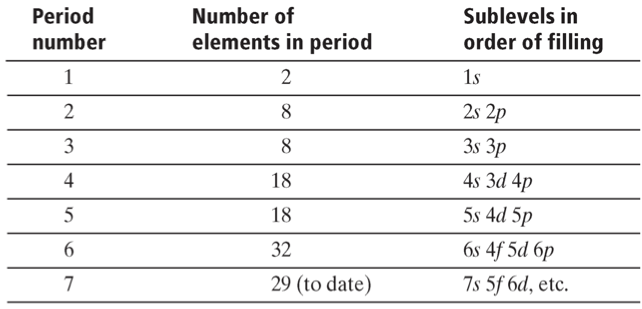
Elements are also organized horizontally in rows or periods.
The elements in Group 1 of the periodic table are known as the alkali metals.
The elements of Group 2 of the periodic table are called alkaline-earth metals.
(Less reactive than alkali metals, but are still too reactive to be found in nature in pure form)
Hydrogen does not share the same properties as the elements of Group 1 despite its electron configuration of 1s^1.
Helium has an ns² group configuration yet it is part of Group 18.
Transition elements: The d-block elements are metals with typical metallic properties.
The p-block elements consist of all the elements of Groups 13-18 except helium.
Main-group elements: The p-block elements together with the s-block elements.
Halogens: The elements of Group 17.
(Most reactive nonmetals)
The metalloids, or semiconducting elements, are located between nonmetals and metals in the p block.
The metals of the p-block are generally harder and denser than the s-block alkaline-earth metals, but softer and less dense than the d-block metals.
The f-block elements are wedged between Groups 3 and 4 in the sixth and seventh periods.
The first row of the f-block, the lanthanides, are shiny metals similar in reactivity to the Group 2 alkaline metals.
The second row of the f-block, the actinides, are between actinium and rutherfordium The actinides are all radioactive.
Identify the block, period, group name, and element name, and relate reactivity for the elements with the following electron configuration:
a) [Xe] 4f^14 5d^9 6s1
Block: d
Period: 6
Group: 1
b) [Ne] 3s² 3p^5
Block: p
Period: 3
Group: 17
c) [Ne] 3s
Block: s
Period: 3
Group: 1
d) 4f^6 6s²
Block: f
Period: 6
Group: 2
Of Cs, Hf, and Au, which element has the smallest atomic radius? Explain
Cs, since it’s the one that's located the lowest in the periodic table.
Arrange the following elements in order of decreasing electron affinities: C, O, Li, Na, Rb, and F.
Li, Na, Rb, C, O, and F.
Which element is the most electronegative among C, N, O, Br, and S? Explain.
Br, since Bromine is the one located the farthest on the right.
Explain the following key concepts:
Atomic Radii: It is the size of an atom.
Electron Affinity: It is how much an atom wants to gain an electron.
Ionic Radii: Electrons repel each other so adding an electron makes an atom bigger.
Electronegativity: The ability of an atom to hold electrons tightly.
Ionization energy: The energy required to move an electron from the atom.
Valance electrons: The electrons available to be lost, gained, or shared in the formation of chemical compounds.
Periodic Law: States that the physical and chemical properties of the elements are periodic functions of their atomic numbers.