CELLULAR RESPIRATION REACTIONS
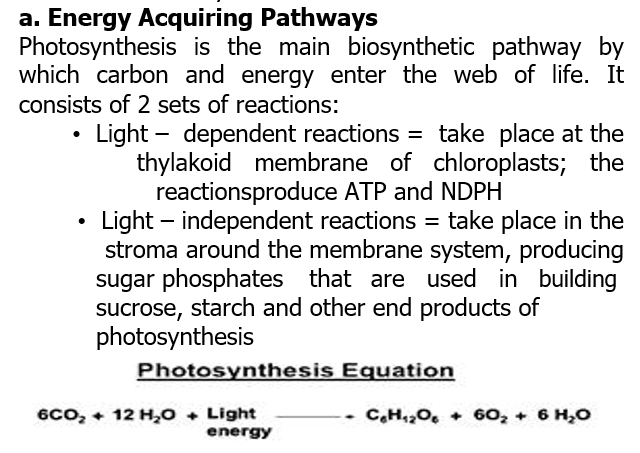
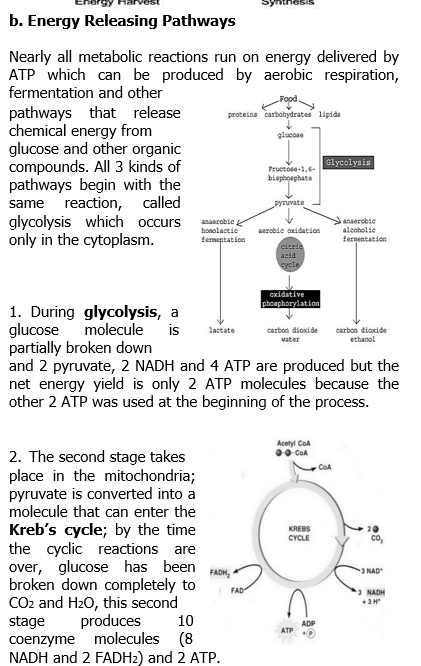
Glycolysis
• Series of reactions that break the 6-carbon molecule down into two 3-carbon molecules called pyruvate
• Yields 2 ATP molecules for every one glucose molecule broken down
• Yields NADH per glucose molecule
Anaerobic Cellular Respiration
• occurs in cytoplasm
• No oxygen used = "an"aerobic
• Results in no more ATP, final steps in these reactions serve ONLY to regenerate NAD+ so it can return to pick up more electrons and hydrogens in glycolysis
• End products such as ethanol and C02 (single cell fungi [yeast] in bear/bread) [ethanolic fermentation] or lactic acid (muscle cells) [lactic acid fermentation]
Aerobic Cellular Respiration
• occurs in mitochondria
• Oxygen required = aerobic
• 2 more sets of reactions occurring in the mitochondria - Kreb's cycle and Electron Transport Chain
Kreb's Cycle
•occurs in mitochondria
• Completes the breakdown of glucose
• Takes the pyruvate (3-carbons) and breaks it down, the carbon and oxygen atoms end up in C02 and H20
• Hydrogens and electrons are stripped and loaded onto NAD+ and FAD to produce NADH and FADH2
• Production of only 2 more ATP but loads up the coenzymes with and electrons t a move to the electron transport chain
Electron Transport Chain
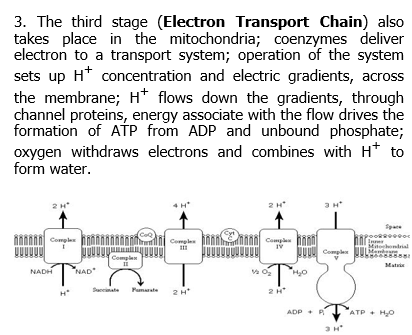
•Electron carriers loaded with electrons and protons from the Kreb's cycle move to this chain-like series of steps (staircase)
• As electrons drop the stairs, energy released to form a total of 32 ATP
1 FADH2— 1.5/ 2 ATP; 1 NADH = 2.5/3 ATP
• Oxygen waits up at the bottom of staircase, picks up electrons and protons, and in doing so, becomes water
• Oxygen acts as the final electron acceptor for this process.