Lesson 1: Cardiac Conduction
Lesson 1: Cardiac Conduction System
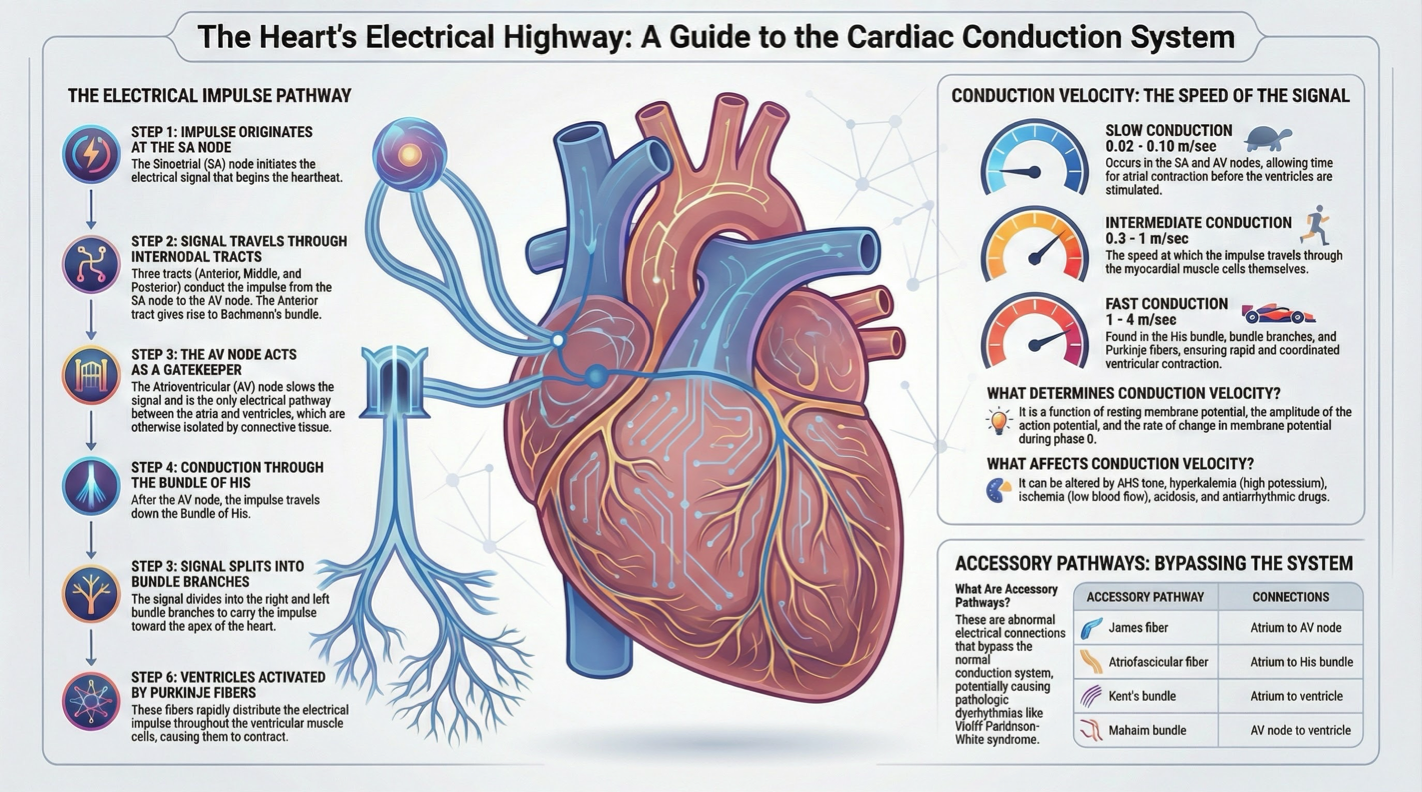
Components of the Cardiac Conduction System:
Sinoatrial (SA) node
Atrioventricular (AV) node
Bundle of His
Bundle branches
Purkinje fibers
Internodal Tracts:
Anterior internodal tract (Bachmann bundle)
Middle internodal tract (Wenckebach tract)
Posterior internodal tract (Thorel tract)
Conduction Velocities:
Slowest to Fastest: AV node < SA node < Myocardial muscle cells < His Bundle < Bundle branches < Purkinje fibers
Electrical Isolation:
Connective tissue isolates atria from ventricles; AV node acts as a gatekeeper for impulses.
Conduction Velocity
Velocity Values:
SA and AV nodes: (slow)
Myocardial muscle cells: (intermediate)
His bundle, bundle branches, Purkinje fibers: (fast)
Factors Affecting Velocity:
Resting membrane potential
Amplitude of action potential
Rate of change in membrane potential during phase 0
ANS tone
Hyperkalemia
Ischemia
Acidosis
Antiarrhythmic drugs
Accessory Pathways
Function of AV Node:
Only electrical pathway between atria and ventricles; maintains synchrony.
Accessory Pathways:
Bypass normal conduction pathways; can cause dysrhythmias (e.g., Wolff-Parkinson-White syndrome).
Examples:
James fiber
Atrio-hisian fiber
Kent's bundle
Mahaim bundle
Connections:
Atria to AV node
Atria to His bundle
Atria to ventricle
AV node to ventricle