Local Area Network Hardware
Local Area Network Hardware
What hardware is needed to make up a local area network?
Network hardware is a selection of essential components that enable the connectivity and communication of devices within computer networks
You need to understand the purpose of the following network hardware:
Router
Wireless access point (WAP)
Switch
Network interface card (NIC)
Transmission media
What is a router?
The router is responsible for routing data packets between different networks
An example of data the router can direct is, sending internet traffic to the right devices in your home
The router connects networks together, local area networks (LAN) to the wider internet which is a type of wide area network (WAN)
The router can manage and prioritise data traffic, which can help to keep connections stable
The router will assign IP addressed to the devices on the network

What is a wireless access point (WAP)?
The Wireless Access Point (WAP) allows wireless devices to connect to a local area network (LAN)
The WAP connects to a Switch or Hub via an Ethernet cable
The WAP range is limited so the use of multiple Wireless Access Points can be used for complete coverage or a home/business

What is a switch?
A Switch allows multiple wired devices to connect to a local area network (LAN)
The Switch is an active device, which means it can inspect network data and route it to the correct device, thus reducing traffic on the network
A Switch can contain extra Software to allow administration/configuration

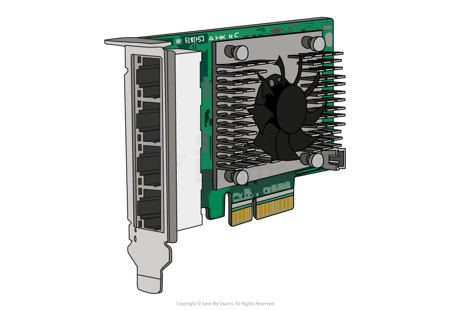
What is a network interface card (NIC)?
The Network Interface Card (NIC) is required for a computer to connect to a network
A NIC can be both wired and wireless and allows your computer to send and receive data over a network
What is transmission media?
Transmission media is the phrase used to describe the method of connecting a wired network
There are 3 main types of transmission media used
Unshielded Twisted Pair (UTP)
Coaxial (Copper)
Fibre Optic
Unshielded twisted pair (UTP)
A Twisted Pair cable is made up of insulated pairs of copper wires twisted around each other
Twister Pair is Low Bandwidth and more affordable than the other two cables, so is commonly found in Local Area Networks (LAN)
Coaxial
A coaxial cable is a medium bandwidth and more expensive than UTP
Coaxial cables are used to connect large-scale networks such as telephone networks and digital cable/satellite television
Fibre optic
A Fibre Optic cable, unlike the other two, is unaffected by electrical noise, making it the fastest in terms of data transfer
Fibre Optic is High Bandwidth and the most expensive
Fibre Optic is commonly used for high data volume networks and long-distance connections such as between cities/countries
Worked example
One piece of network hardware is a router. State 3 tasks carried out by a router. [3]
To answer the question you must simply identify 3 tasks a router does.
1 mark each to max 3 e.g.
Receive packets
Forward/send packets
Maintain a routing table
Identify the most efficient path to the destination / correct IP / correct location
Assign IP addresses to nodes / devices
Converts packets from one protocol to another