Populations
Page 521-531
Population: a group of individuals of the same species living in the same time, in the same geographical area, and able to interbreed
Determining one population from another can be done by considering how likely it is for members of the population to interbreed
Populations are dynamic
Characteristics that can be used to describe a population:
Popoulation density
Geographical distribution
Max. number of individuals that can be supported by the resources
Sampling methods: systematic and random
Systematic sampling: lines or grids are set up and measurement/counting occurs at specific, regular intervals
Random sampling: randomly chosen zones are chosen, and a specific amount of space is measured there. This is repeated.
Random sampling works best for sessile organisms, catch-mark-realease sampling works better for motile organisms
Catch-mark-release sampling/lincoln index method: some of a population is captured and marked, then released back into the wild. A secondary sample is then captured, and the ratio of marked to unmarked in the sample is assumed to be the same as in the rest of the population
Lincoln Index:

Carrying capacity: the stabilised number of individuals in a population which the habitat can feasibly support (plateau)
Young trees can store energy for years with little to no growth, waiting for old trees to die so they can take a spot in the sunlight
Limiting factors:
Surface area/capacity
Amount of resources such as food
Build-up of waste products su ch as CO2 and excrement
Predation
Disease
Density-dependent factors: limiting factors that depend on population density, such as the spread of disease
Positive feedback: when something increases the population and the result leads to more growth, i.e rapid reproduction
Example: during childbirth, a chemical is released that causes more contractions
Negative feedback: spread of disease, threat of predation, competition for resources - keeps populations from growing out of hand
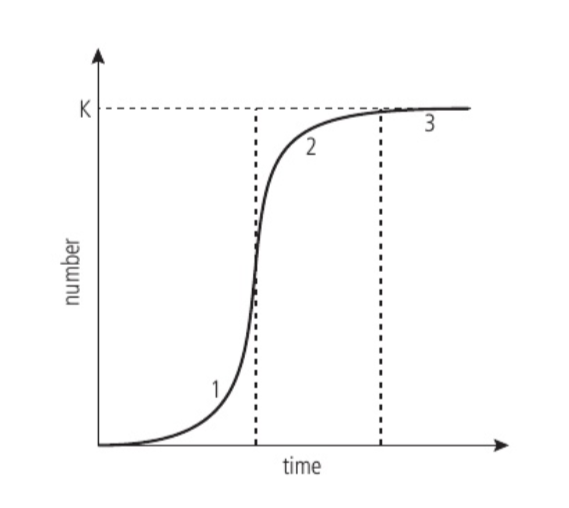
Reasons for phase 1- exponential growth:
Plentiful resources
Little to no competition
Good abiotic factors (no climate change)
Little to no risk of predation or disease
Reasons for phase 2- transitional period:
Increasing competition for resources
Predators attracted
Higher risk of disease
Class work 1:
Communities: a group of populations that are living and interacting together
Species: can produce fertile offspring by interbreeding
Ecosystem: a community and an abiotic environment
Understanding populations:
Population density: N= (mean # per quadrat) * (total area) / area of each quadrat
Percentage frequency: (number of organisms)/(total number of squares) * 100
Class work 2:
Lincoln index/capture-mark-recapture method
Sample size and size of recaptured individuals in the 2nd sample can influence the estimate
Allelopath