Linkage and Mapping
2/19/24
Refresher- Assortment
Independent assortment-assortment is the source of genetic variation
Recombination of homologous chromosomes- also plays a major role in genetic variation
Genes on the same chromosomes but vary far from each other can be considered “not-linked”→ they will behave the same as genes on different chromosomes because they too will be assorting independently
Chiasmata= crossing over
Crossing over (physical connection of DNA, followed by the exchange of genetic material between two homologs by breakage and reunion) ⬇
Recombination (exchange of unique genetic material between nonsidter chromatids during meiosis 1)⬇
recombinants (new combination, unlike the parents, of alleles)
Independent assortment of genes in the same chromosomes requires distance for recombination
Genes on the same chromosomes but not far away enough to meetr requirements for independent assortment- Linked Genes:
On the same chromosome and close to each other
Do NOT assort independently
In rare cases, when they close together alleles of linked genes cannot be separated by recombination; only parental gamete types are produced
In most cases, alleles of linked genes can be separated by crossing over, resulting in recombination- both parental and recombinant gamete types are produced
Two forms of Independent assortment:
Different chromosomes
Same chromosome but far apart
Linkage
Linkage
same chromosomes, very close together
if genes are linked there will always be more gametes with parental combination that recombinant gametes
Theres also Incomplete Linkage:
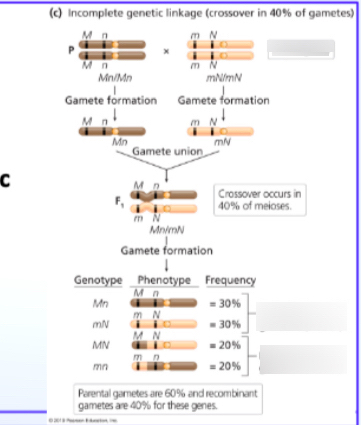
if some recombination can occur
when two or more genes tend to be inherited together and recombinant occur
Clue- when ½ is parental and ½ is recombinant
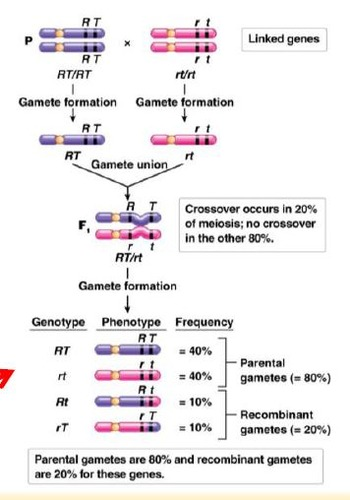
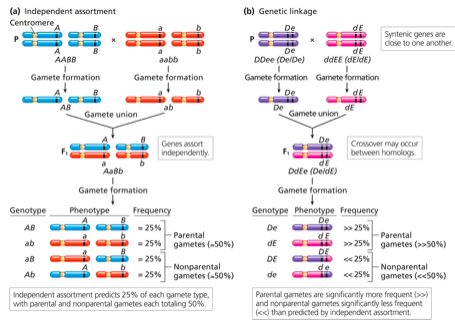
The genotypes of the F1 heterozygous parents in these crosses are written. RrTt and MmNn. This notation DOES NOT give you the information on the configuration of the alleles. If a question specifies a genotype in this way you are being asked to determine the configuration ⬇
Calculating Recombination Frequency:
A test cross reveals the frequency of the gamete genotypes in the heterozygous parent- the test cross tells us which gametes are combinant
Progeny phenotypes are determined by the gametes if the heterozygous parent only so we have a read out of gamete frequency
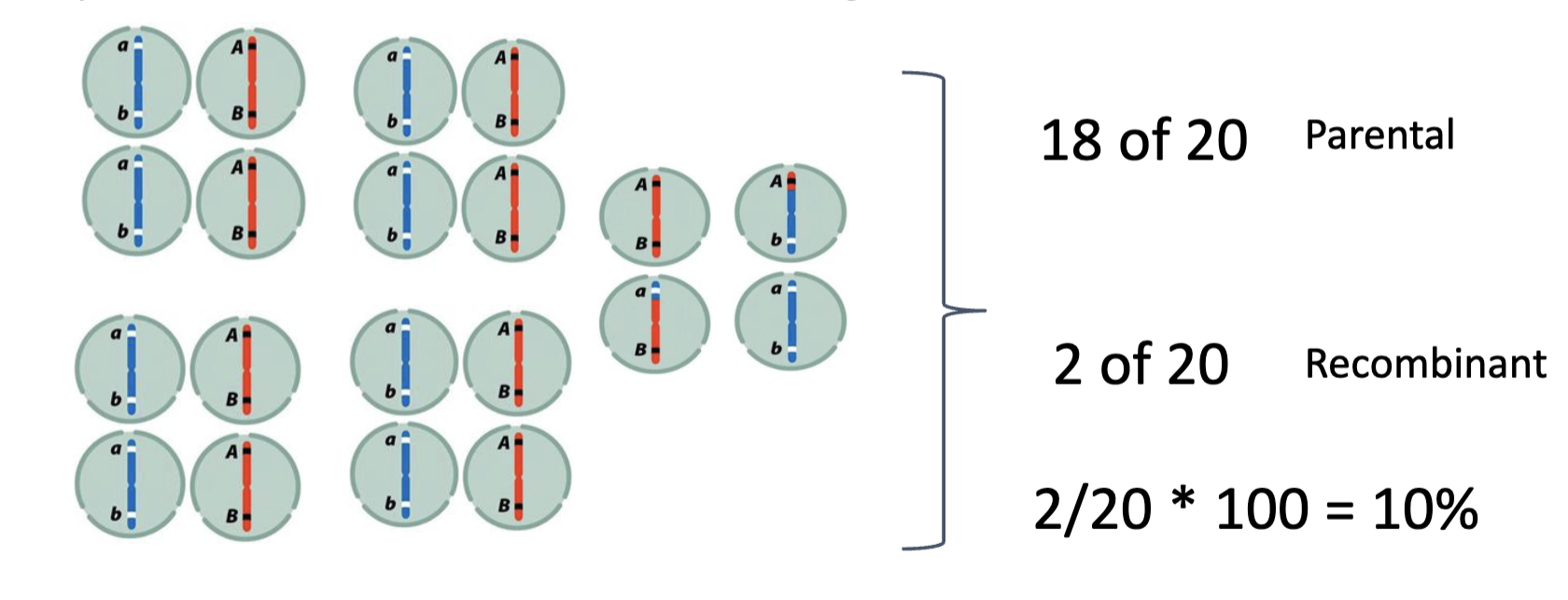
Recombinant frequency (r )= (total recombinants) /(total progeny)x 100
In a normal independent cross, there would be 50% recombinant and 50% parental gametes
Mapping
Two types of Maps:
Physical map- typically not enough
linkage map- used typically to find diseased genes, determine what genes are liked including diseased alleles, and also shows how linkage impacts allele frequencies in populations
Sturtevant’s Realization:
The closer the genes are together the less recombination there will be, the farther apart the genes are the more recombinant possibilities there are ⬇ (pair with the smallest frequency are the closest)
10 MU means that 10% of gametes are recombinant
MU of 0= complete linkage
MU of <50 between loci indicates incomplete linkage
MU= or > than 50 results in independent assortment
MU> 50 results form multiple distances added together
Linkage groups- groups of loci on the loci on the same chromosome (may not always be anchored to the chromosome)
Linkage maps- Graphic illustrations detailing the specific location of loci along a chromosome and the map distance between loci or MU (cM)(one map unit= 1 centiMorgan)
Genetic Linkage is a physical relationship between genes that are located near one another on a chromosome
Finding Diseased Genes
Use the lod score (log_10 of odds) when there is missing information and chi square when we have all the information
Genetic Markers- genetic mutations that are associated with a specific chromosomes or disease on a gene
Single Nucleotide Polymorphisms (SNPs) : a DNA sequence variants in which on base pair is substituted by another base pair
Haplotypes- consist if several genetic variants closely packed along a segment of a chromosome that tend to be inherited together (are linked). term is a contraction of “haploid genotype” where haploid is used to mean one chromosome.
Variation in Human Populations
humans have low genetic diversity (about ½ the expected amount)
MOST of our DNA is identical, each of us is about 99.6% indentical
MOST SNPs and other variants are present in multiple populations
GWAS- Genome-Wide Association Study
Probability based method based on hundreds of thousands of genetic markers are read out over the entire genome
Detects statistically significant associations between traits and groups of alleles (SNPs or haplotypes) in populations of organisms to spot where on different chromosomes influential genes are located
GWAS identifies the candidate genes ot genome regions and must be followed with functional genomic studies and medical studies in humans or in model organisms