MedED BRS Neuro Part 2
exteroreceptors - external
proprioreceptors - position and movement
muscle spindles (changes in muscle length)
golgi tendon organs (detect changes in tension in tendons)
joint receptors (detect start and end of movement)
enteroreceptors - within the bodies internal environmental e.g. movement through the gut and blood pH
sensory receptors also split into 5 types: chemoreceptors, photoreceptors, thermoreceptors, mechanoreceptors (pressure changes), nociceptors (detect tissue damage)
motor unit - smallest function unit to produce force in muscle contraction - involves a single motor neuron and all the muscle fibres it innervates
each motor neurone innervates multiple muscle fibres but each muscle fibre is only innervated by only one motor neurone.
gray ramus communicans vs white ramus communicans
lacrimal glands secrete tears
cranial parasympathetic nerves go to heart to slow it down and go to gut to increase level of digestion
EPILEPSY
excitatory and inhibitory neurones that release neurotransmitters
GABA transaminase - maintains concentration gradient for GABA reuptake
GABA is inhibitory - these bind to chlorine channels causing hypopolarisation of the membrane
NMDA receptors - slow component of excitatory transmission, permeable to both sodium and calcium ions
AMPA receptor - fast excitatory synapse, only permeable to sodium ions
4 classical drug targets - TIRE
Transport proteins - GABA transporters
Ion channels - Voltage gated sodium/calcium ion channels
Enzymes - GABA transaminase
Receptors - GABA/AMPA/NMDA receptors
Diazepam
Target - GABAa receptor
Present on post-synaptic neurone in temporal lobe
Effect
→ bind to and increase awareness of GABA activation of receptor
→ changes ion channel confirmation causing chlorine influx
→ decreased chance of seizures
Lamotrigine and Pregabalin
Both act on ion channels
Lamotrigine → voltage gated sodium ion channels
Pregabalin → voltage gated calcium ion channels
Blocks ion channels meaning less influx off ions
With lamotrigine less depolarisation so less neurotransmitter release
With pregabalin reduced vesicle exocytosis and neurotransmitter release
Levetiracem
Target - synaptic vesicle protein SV2A
Not part of the classical drug target (non-classical)
Important for fusion of vesicle to presynaptic neurone allowing exocytosis to take place
Interferes with vesicle fusion reduces exocytosis decreasing the ecxitatory activation of post-synaptic neurone
Valproate
Drug has multiple targets (broad spectrum)
VGSC, GABA transaminase etc…
Two potential issues with valproate
Teratogenic - avoided in females of childbearing age
Non-selective so large number of side effects due to hitting so many targets
AUTONOMIC NERVOUS SYSTEM
subdivision of PNS
involuntary - not under concious control
controls non-skeletal peripheral function
viscera, internal organs, smooth muscle and skin
autonomic nervous system pathway
stimulus detected by visceral sensory
sent to the peripheral nervous system and central nervous system
motor divison - efferent fibres
Split into somatic and visceral motor
visceral further split into parasympathetic and sympathetic
parasympathetic vs sympathetic
often innervate the same tissues but have opposing action
sympathetic - fight of flight
parasympathetic - rest and digest
effect on viscera:
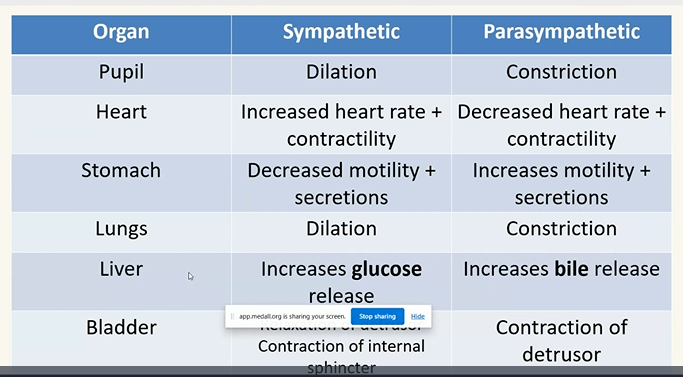
Blood pressure
Upon increase in blood pressure
Baroreceptors detect high bp
signals sent to peripheral nervous system
parasympathetic neurones to lower bp
sympathetic nervous system inhibited
Upon decrease in blood pressure
Baroreceptors fire less often
less signal through visceral motor neurones
parasympathetic effect decreases
sympathetic system isn’t inhibited - bp increases
Autonomic neurones
Pre-ganglionic neurones - originate in brain/spinal cord
Sympathetic are short by parasympapthetic are long
Post-ganglionic
sympathetic are long whereas parasympathetic are short
Locations of ganglions
Symapthetic - close to spinal cord
Parasympathetic - close to embedded within effector tissue
Neurotransmitters - all preganglionic neurones release ACh
Adrenal output
Adrenaline hormone from adrenal medulla
Into bloodstream and not at synapse (not an NT)
Sympathetic control is greater than parasympathetic control
Sympathetic trunk - long chains that run parallel to spinal cord
Necessary for the following
Mass activatoin
Co-ordinated fight/flight response e.g. heart rate increasing at the same time the lung constricts
Lung doesnt have direct sympathetic control - receives it by adrenaline for bronchodilation for instance
Micturition reflex
Pressure increase in bladder
Sympathetic keeps internal sphincter contracted
Pressure continues to rise
Visceral sensory info → brain
PNS dominates over SNS
Detrusor muscle contracts and urine leaves bladder
Summary of NTs and receptors
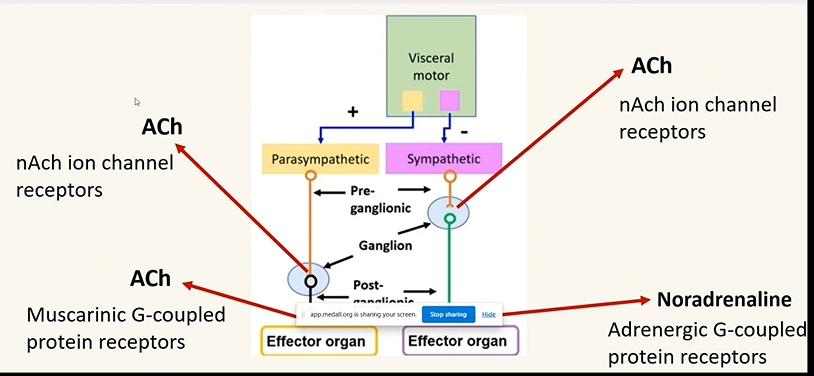
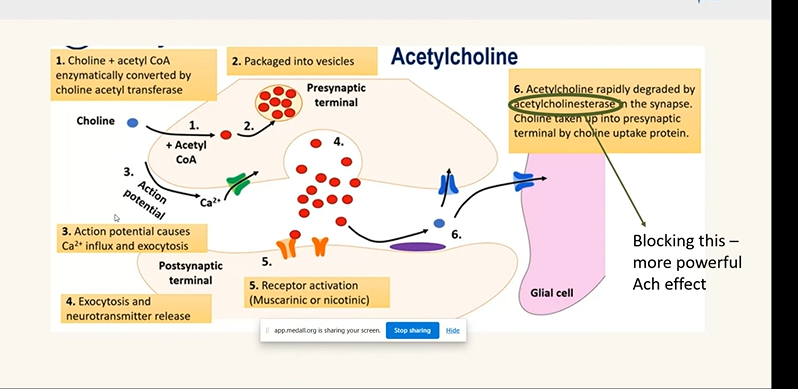
ACh Transmission
Noradrenaline transmission
Tyrosine converted to DOPA by tyrosine hydroxylase
DOPA converted to dopamine by DOPA decarboxylase
Dopamine packaged into vesicles with dopamine beta hydroxylase forming noradrenaline
Action potential causes calcium influx and exocytosis
Exocytosis and neurotransmitter releaaase
receptor activation
removal