Chapter 2 - The Physical Layer - Pt 1
Concise Version
The Physical Layer
Foundation upon which other layers build.
Properties of wires, fiber, wireless limit what the network can do.
Key problem: sending digital bits using analog signals, which is called modulation.
Theoretical Basis for Data Communication
Communication rates have fundamental limits.
Fourier analysis: A time-varying signal can be represented as a series of frequency components (harmonics).
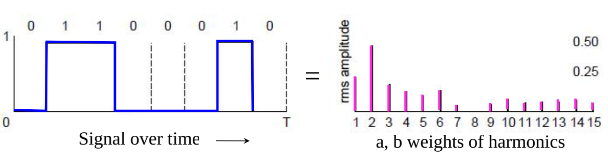
Signal over time can be decomposed into a sum of sine and cosine waves with different frequencies and amplitudes.
represent the weights of harmonics.

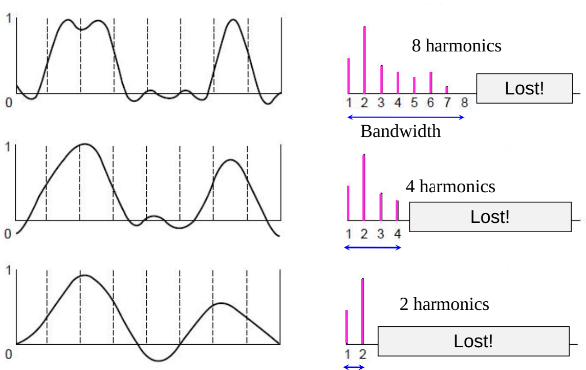
Bandwidth-limited signals: Having less bandwidth degrades the signal, resulting in loss of harmonics.
Maximum data rate of a channel is determined by:
Nyquist's theorem: Max. data rate bits/sec,
where is bandwidth and is the number of signal levels. This theorem relates data rate to bandwidth and the number of signal levels, indicating how fast a signal can change.
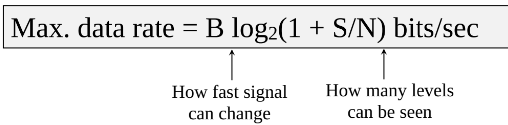
Shannon's theorem: Max. data rate bits/sec,
where is bandwidth, is signal strength, and is noise. This theorem relates data rate to bandwidth and signal strength relative to noise, determining how many levels can be seen.
Guided Transmission (Wires & Fiber)
Media have different properties, hence performance varies.
Storage media: Using tape/disk/DVD for data transfer can provide high bandwidth.
Example: Mailing a box with 1000 800GB tapes (6400 Tbit) takes one day (86,400 secs), resulting in a data rate of 70 Gbps. This data rate can be faster than long-distance networks, but the message delay is very poor.
Wires:
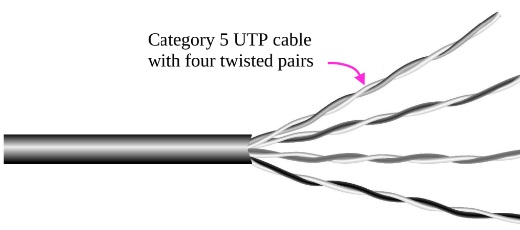
Twisted pairs: Very common, used in LANs, telephone lines. Twists reduce radiated signal (interference).
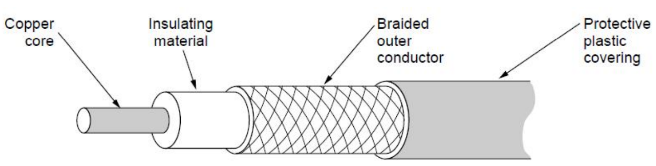
Coaxial cable: Better shielding and more bandwidth for longer distances and higher rates than twisted pair.
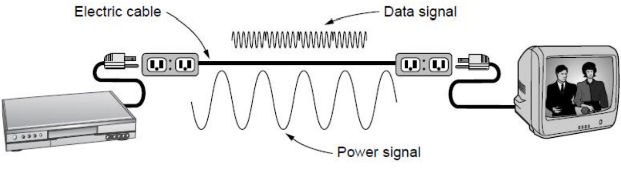
Power lines: Convenient to use but not suitable for sending data.
Fiber cables: Common for high rates and long distances, used in long-distance ISP links and Fiber-to-the-Home.
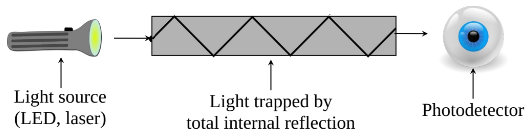
Light is carried in a thin strand of glass.
Light source (LED, laser) and photodetector are used.
Light is trapped by total internal reflection.
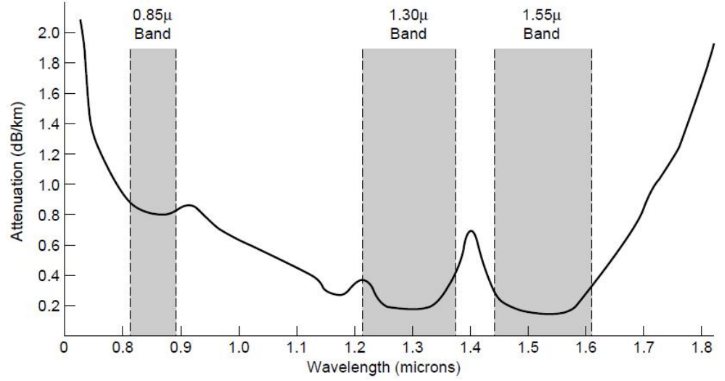
Fiber has enormous bandwidth (THz) and tiny signal loss, allowing high rates over long distances.
Types of fiber cables:
Single-mode: Core is narrow (10um), light can't bounce around. Used with lasers for long distances (e.g., 100km).
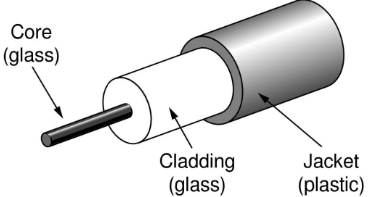
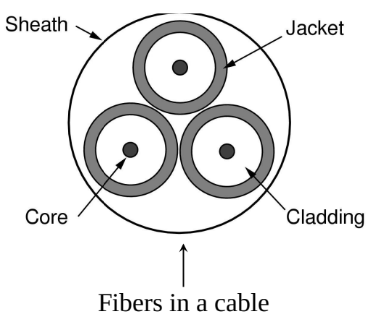
Multi-mode: Light can bounce (50um core). Used with LEDs for cheaper, shorter distance links.
Comparison of Wires and Fiber
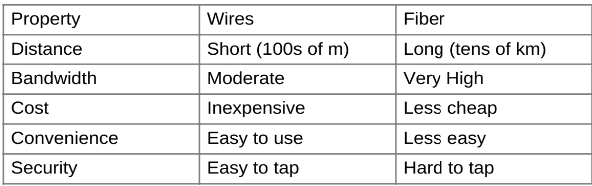
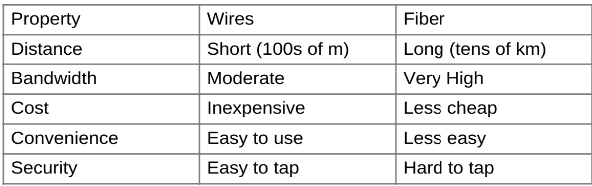
Distance: Wires - Short (100s of m), Fiber - Long (tens of km)
Bandwidth: Wires - Moderate, Fiber - Very High
Cost: Wires - Inexpensive, Fiber - Less cheap
Convenience: Wires - Easy to use, Fiber - Less easy
Security: Wires - Easy to tap, Fiber - Hard to tap
Link Terminology
Full-duplex link: Transmission in both directions at once (e.g., use different twisted pairs for each direction).
Half-duplex link: Both directions, but not at the same time (e.g., senders take turns on a wireless channel).
Simplex link: Only one fixed direction at all times; not common.
Wireless Transmission
Electromagnetic Spectrum
Radio Transmission
Microwave Transmission
Light Transmission
Wireless vs. Wires/Fiber
Electromagnetic Spectrum
Different bands have different uses:
Radio: wide-area broadcast.
Infrared/Light: line-of-sight.
Microwave: LANs and 3G/4G. ← Networking focus
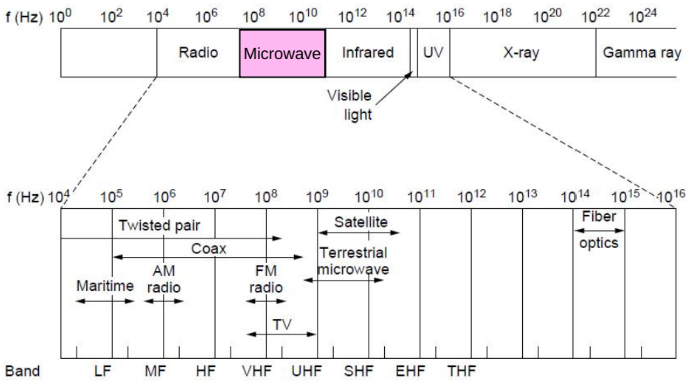
To manage interference, the spectrum is carefully divided, regulated, and licensed (e.g., sold at auction).
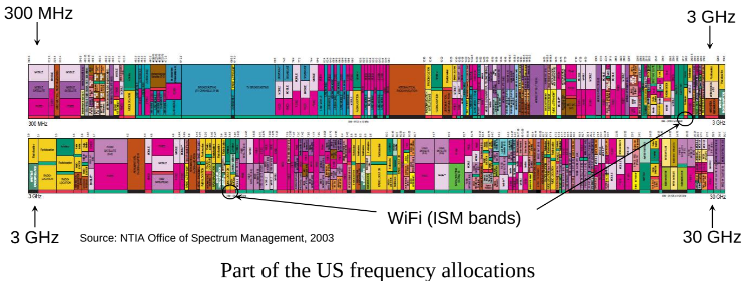
Unlicensed (“ISM”) bands:
Free for use at low power; devices manage interference.
Widely used for networking: WiFi, Bluetooth, Zigbee, etc.
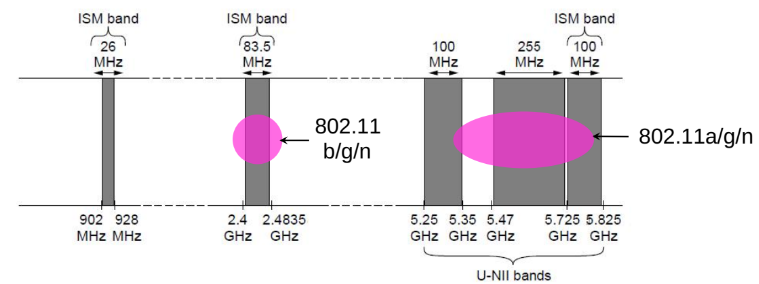
Radio Transmission
In the HF band, radio waves bounce off the ionosphere.
In the VLF, LF, and MF bands, radio waves follow the curvature of the earth.
Radio signals penetrate buildings well and propagate for long distances with path loss.
Microwave Transmission
Microwaves have much bandwidth and are widely used indoors (WiFi) and outdoors (3G, satellites).
Signal is attenuated/reflected by everyday objects.
Strength varies with mobility due to multipath fading, etc.
Light Transmission
Line-of-sight light (no fiber) can be used for links.
Light is highly directional and has much bandwidth.
Use of LEDs/cameras and lasers/photodetectors.
Detailed Version
The Physical Layer
Foundation upon which other layers build. The physical layer is responsible for the actual transmission of data over a communication channel. It deals with the physical characteristics of the network, such as voltage levels, data rates, and physical connections.
Properties of wires, fiber, wireless limit what the network can do. The physical medium used for transmission imposes limitations on the achievable data rate, distance, and reliability of communication. Different media have different bandwidth capabilities and are susceptible to different types of interference.
Key problem: sending digital bits using analog signals, which is called modulation. Digital data must be converted into analog signals for transmission over physical media. Modulation techniques are used to encode digital data onto analog carrier signals.
Theoretical Basis for Data Communication
Communication rates have fundamental limits. The maximum achievable data rate over a communication channel is limited by factors such as bandwidth, signal strength, and noise.
Fourier analysis: A time-varying signal can be represented as a series of frequency components (harmonics).
Signal over time can be decomposed into a sum of sine and cosine waves with different frequencies and amplitudes. Fourier analysis allows us to analyze the frequency components of a signal, which is useful for understanding its bandwidth and spectral characteristics.
a,b represent the weights of harmonics. These weights determine the contribution of each frequency component to the overall signal.
Bandwidth-limited signals: Having less bandwidth degrades the signal, resulting in loss of harmonics. When a signal is transmitted over a channel with limited bandwidth, higher-frequency components may be attenuated or filtered out, resulting in distortion of the signal.
Maximum data rate of a channel is determined by:
Nyquist's theorem: Max. data rate =2Blog2V=2Blog2V bits/sec, where BB is bandwidth and VV is the number of signal levels. This theorem provides an upper bound on the data rate for a noiseless channel. It states that the maximum data rate is proportional to the bandwidth and the number of signal levels used for transmission.
Shannon's theorem: Max. data rate =Blog2(1+S/N)=Blog2(1+S/N) bits/sec, where BB is bandwidth, SS is signal strength, and NN is noise. Shannon's theorem provides an upper bound on the data rate for a noisy channel. It states that the maximum data rate is proportional to the bandwidth and the signal-to-noise ratio (SNR).
Guided Transmission (Wires & Fiber)
Media have different properties, hence performance varies. Different types of guided media, such as twisted pair cables, coaxial cables, and fiber optic cables, have different characteristics in terms of bandwidth, attenuation, and susceptibility to interference.
Storage media: Using tape/disk/DVD for data transfer can provide high bandwidth.
Example: Mailing a box with 1000 800GB tapes (6400 Tbit) takes one day (86,400 secs), resulting in a data rate of 70 Gbps. This data rate can be faster than long-distance networks, but the message delay is very poor. This example illustrates that physical transport of storage media can sometimes provide higher bandwidth than traditional network connections, but at the cost of increased latency.
Wires:
Twisted pairs: Very common, used in LANs, telephone lines. Twists reduce radiated signal (interference). Twisted pair cables consist of two insulated wires twisted together to reduce electromagnetic interference. They are commonly used for Ethernet networks and telephone lines.
Coaxial cable: Better shielding and more bandwidth for longer distances and higher rates than twisted pair. Coaxial cables have a central conductor surrounded by an insulating layer and a braided shield. They offer better shielding and higher bandwidth than twisted pair cables and are used for cable television and high-speed data connections.
Power lines: Convenient to use but not suitable for sending data. Power lines can be used for data transmission using power line communication (PLC) technologies. However, power lines are not designed for data transmission and are susceptible to noise and interference, which limits the achievable data rate and reliability.
Fiber cables: Common for high rates and long distances, used in long-distance ISP links and Fiber-to-the-Home.
Light is carried in a thin strand of glass. Fiber optic cables transmit data as light pulses through thin strands of glass or plastic.
Light source (LED, laser) and photodetector are used. Light sources, such as LEDs or lasers, are used to generate the light pulses, and photodetectors are used to detect the light pulses at the receiving end.
Light is trapped by total internal reflection. Total internal reflection ensures that the light pulses remain within the fiber core and are not lost due to refraction.
Fiber has enormous bandwidth (THz) and tiny signal loss, allowing high rates over long distances. Fiber optic cables offer very high bandwidth and low signal loss, making them suitable for long-distance, high-speed data transmission.
Types of fiber cables:
Single-mode: Core is narrow (10um), light can't bounce around. Used with lasers for long distances (e.g., 100km). Single-mode fiber has a narrow core that allows only one mode of light to propagate. It is used with lasers for long-distance, high-bandwidth applications.
Multi-mode: Light can bounce (50um core). Used with LEDs for cheaper, shorter distance links. Multi-mode fiber has a wider core that allows multiple modes of light to propagate. It is used with LEDs for shorter-distance, lower-bandwidth applications.
Comparison of Wires and Fiber
Distance: Wires - Short (100s of m), Fiber - Long (tens of km)
Bandwidth: Wires - Moderate, Fiber - Very High
Cost: Wires - Inexpensive, Fiber - Less cheap
Convenience: Wires - Easy to use, Fiber - Less easy
Security: Wires - Easy to tap, Fiber - Hard to tap
Link Terminology
Full-duplex link: Transmission in both directions at once (e.g., use different twisted pairs for each direction). A full-duplex link allows simultaneous transmission and reception of data in both directions.
Half-duplex link: Both directions, but not at the same time (e.g., senders take turns on a wireless channel). A half-duplex link allows transmission in both directions, but only one direction at a time.
Simplex link: Only one fixed direction at all times; not common. A simplex link allows transmission in only one direction.
Wireless Transmission
Electromagnetic Spectrum
Radio Transmission
Microwave Transmission
Light Transmission
Wireless vs. Wires/Fiber
Electromagnetic Spectrum
Different bands have different uses:
Radio: wide-area broadcast. Radio waves are used for wide-area broadcasting, such as AM and FM radio.
Infrared/Light: line-of-sight. Infrared and light waves are used for line-of-sight communication, such as remote controls and optical communication.
Microwave: LANs and 3G/4G. Microwaves are used for wireless LANs (WiFi) and cellular communication (3G/4G).
To manage interference, the spectrum is carefully divided, regulated, and licensed (e.g., sold at auction). The electromagnetic spectrum is a limited resource, and its use is regulated by government agencies to prevent interference between different users.
Unlicensed (“ISM”) bands:
Free for use at low power; devices manage interference. The Industrial, Scientific, and Medical (ISM) bands are reserved for unlicensed use at low power levels. Devices operating in these bands must manage interference with other devices.
Widely used for networking: WiFi, Bluetooth, Zigbee, etc. The ISM bands are commonly used for wireless networking technologies such as WiFi, Bluetooth, and Zigbee.
Radio Transmission
In the HF band, radio waves bounce off the ionosphere. High-frequency (HF) radio waves can be reflected by the ionosphere, allowing for long-distance communication.
In the VLF, LF, and MF bands, radio waves follow the curvature of the earth. Very low frequency (VLF), low frequency (LF), and medium frequency (MF) radio waves can propagate along the surface of the earth, allowing for communication over long distances.
Radio signals penetrate buildings well and propagate for long distances with path loss. Radio waves can penetrate buildings and propagate over long distances, but they experience signal attenuation due to path loss.
Microwave Transmission
Microwaves have much bandwidth and are widely used indoors (WiFi) and outdoors (3G, satellites). Microwaves offer high bandwidth and are used for a variety of wireless communication applications, including WiFi, cellular communication, and satellite communication.
Signal is attenuated/reflected by everyday objects. Microwave signals can be attenuated or reflected by everyday objects, such as walls, furniture, and buildings.
Strength varies with mobility due to multipath fading, etc. The strength of microwave signals can vary with mobility due to multipath fading, which occurs when signals arrive at the receiver via multiple paths with different delays and amplitudes.
Light Transmission
Line-of-sight light (no fiber) can be used for links. Light waves can be used for line-of-sight communication without the need for fiber optic cables.
Light is highly directional and has much bandwidth. Light waves are highly directional and offer high bandwidth, making them suitable for high-speed communication.
Use of LEDs/cameras and lasers/photodetectors. Light-emitting diodes (LEDs), cameras, lasers, and photodetectors are used for light-based communication systems.