Lecture 33: Conservation Biology & Wildlife Management
Conservation Biology & Wildlife Management
Key Concepts
Concept 25.5: Extinction rates rose dramatically during five global mass extinction events.
Concept 56.1: Human activities threaten Earth’s biodiversity.
Concept 56.2: Population conservation focuses on population size, genetic diversity, and critical habitat.
Concept 56.3: Landscape and regional conservation help sustain biodiversity.
Learning Outcomes
Discuss drivers of historic mass extinction events and evidence for a sixth, human-induced mass extinction.
Define Conservation Biology and Wildlife Management and describe their interdisciplinary nature.
Explain why biodiversity must be considered at multiple levels and why protecting biodiversity is so important.
List the five major threats to biodiversity and provide examples.
Recount the classification of species rarity status.
Recall the drivers of an extinction vortex and distinguish between small populations and rapidly declining populations approaches.
Discuss conservation options across a range of management scales.
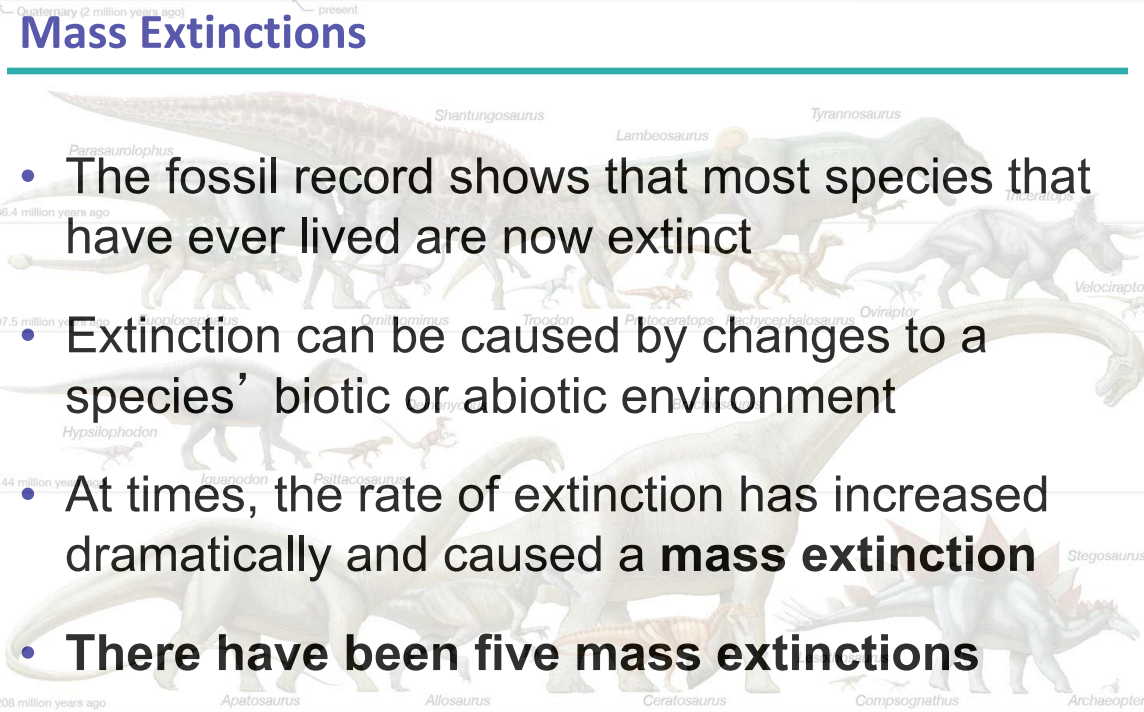
Mass Extinctions
The fossil record indicates that most species that have ever lived are now extinct.
Extinction can be caused by changes to a species’ biotic or abiotic environment.
The rate of extinction has increased dramatically at times, causing mass extinctions.
There have been five mass extinctions.
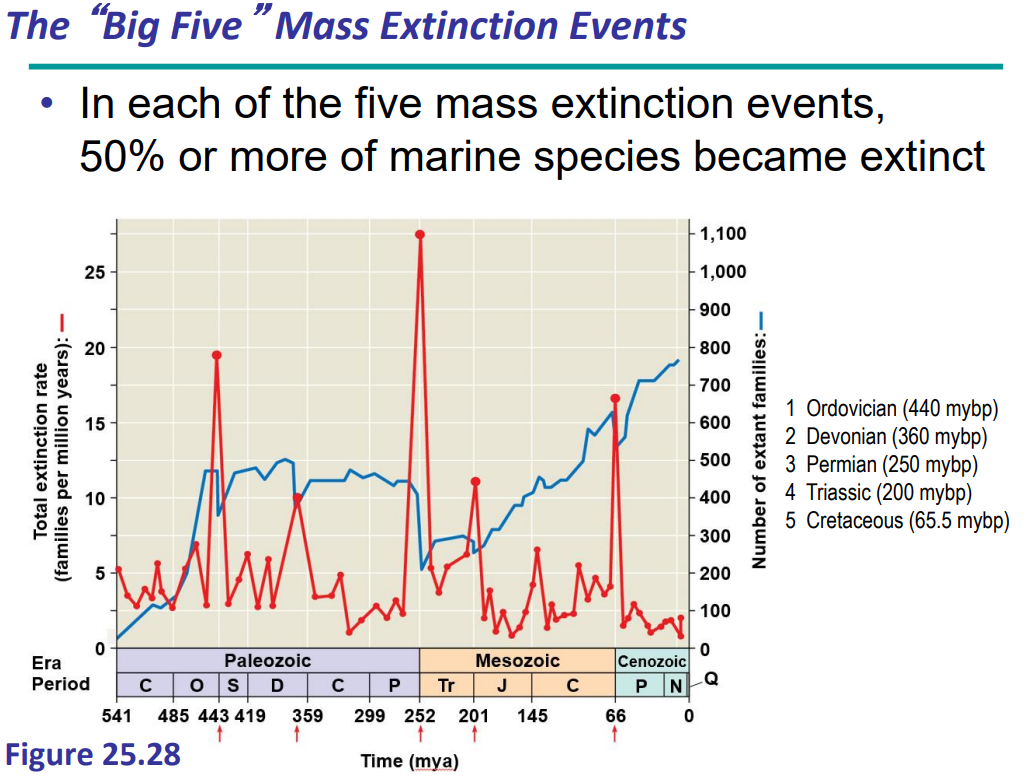
The "Big Five" Mass Extinction Events
In each of the five mass extinction events, 50% or more of marine species became extinct (this is what classifies them as mass extinctions).
Ordovician (440 mybp)
Devonian (360 mybp)
Permian (250 mybp)
Triassic (200 mybp)
Cretaceous (65.5 mybp)
Causes of Mass Extinctions
Mass extinctions happen because of climate change, extreme volcanic activity, asteroid impacts, or a combination of these.

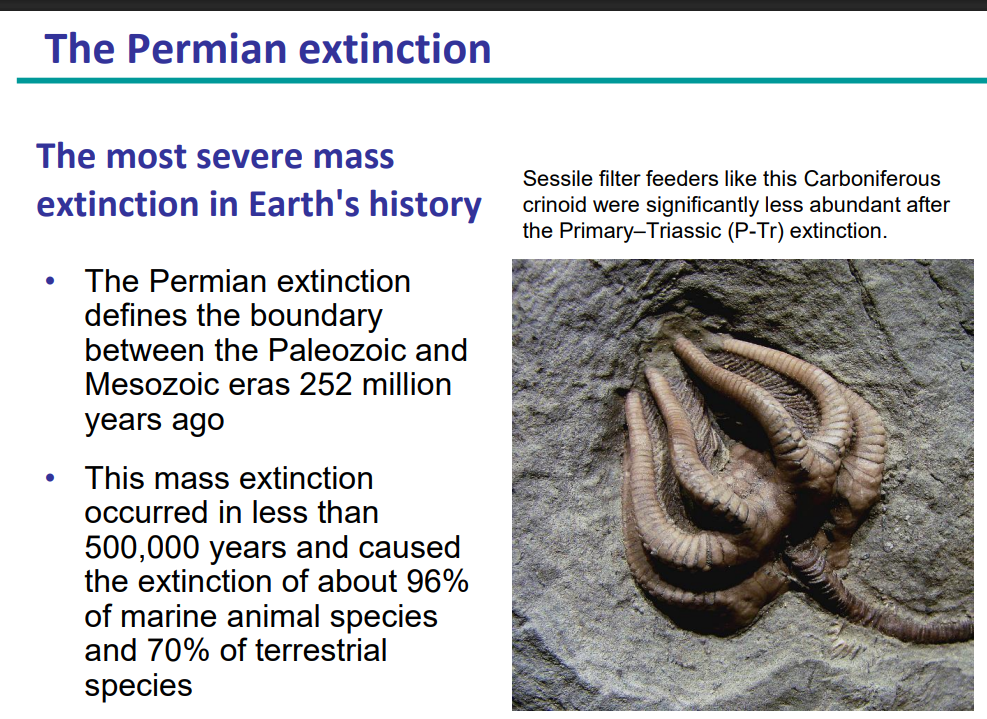
The Permian Extinction
The most severe mass extinction in Earth's history, marking the boundary between the Paleozoic and Mesozoic eras, 252 million years ago.
Occurred in less than 500,000 years and caused the extinction of about 96% of marine animal species and 70% of terrestrial species.
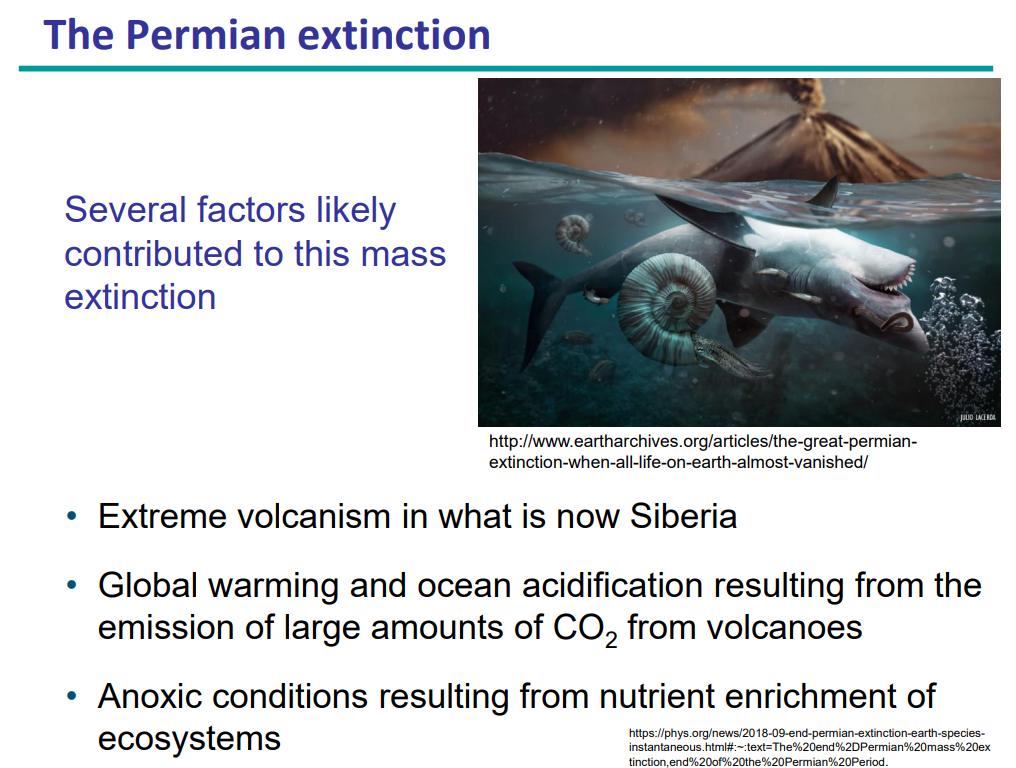
Likely caused by:
Extreme volcanism in what is now Siberia.
Global warming and ocean acidification resulting from the emission of large amounts of from volcanoes.
Anoxic conditions resulting from nutrient enrichment of ecosystems.
The Cretaceous Mass Extinction
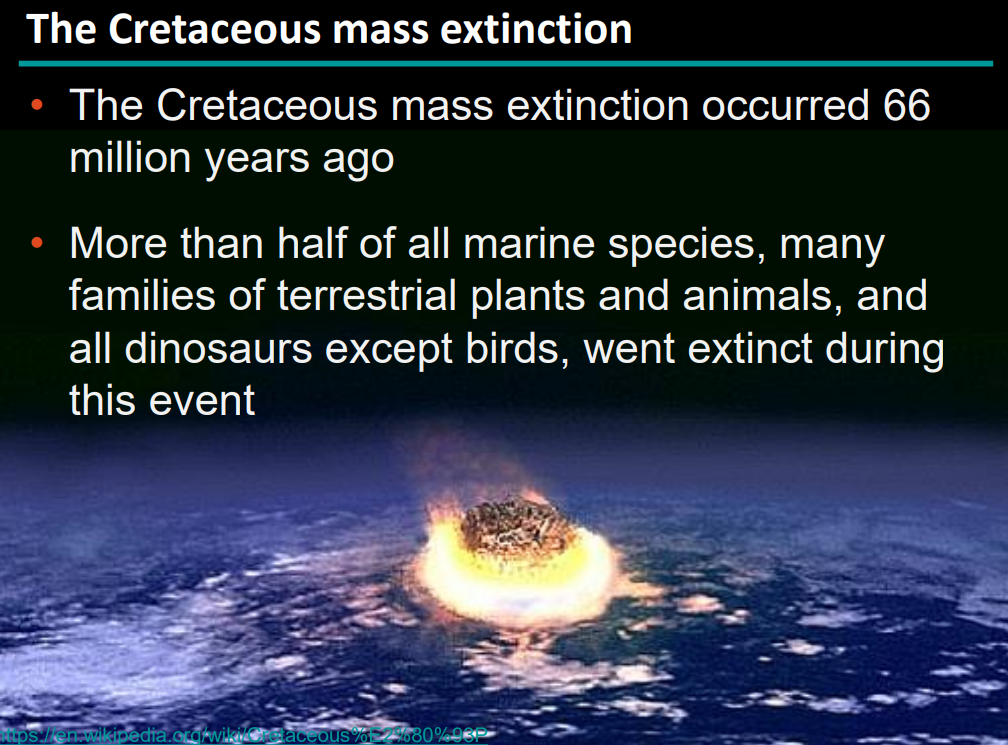
Occurred 66 million years ago.
More than half of all marine species, many families of terrestrial plants and animals, and all dinosaurs except birds, went extinct during this event.
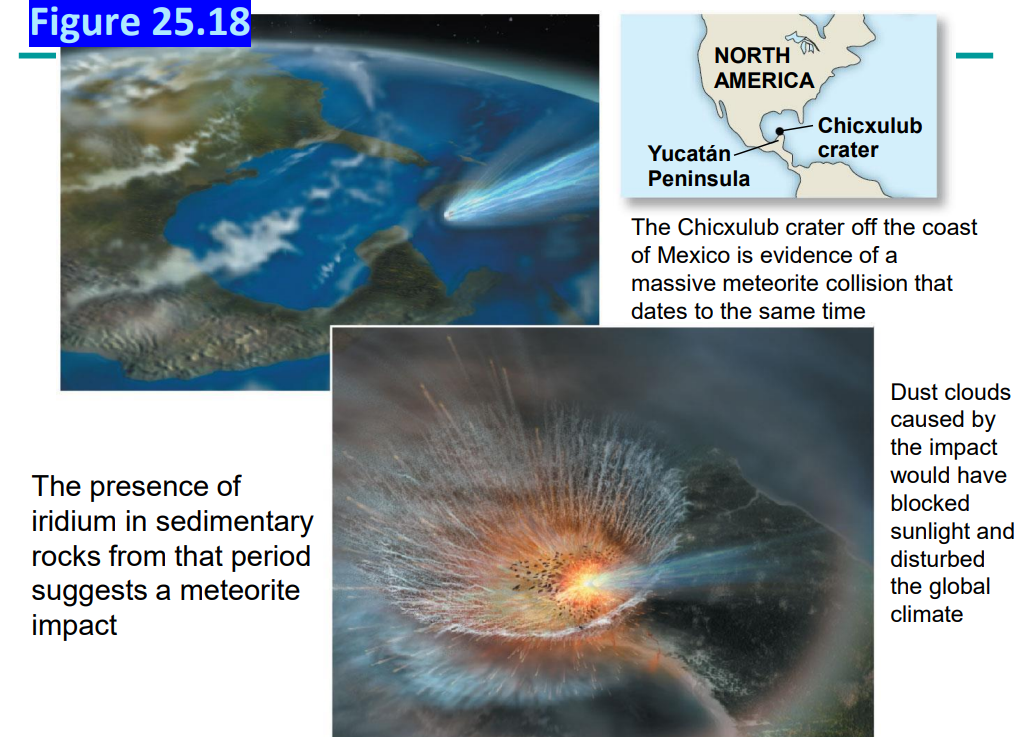
Evidence suggests a meteorite impact, indicated by the presence of iridium in sedimentary rocks and the Chicxulub crater off the coast of Mexico.
Dust clouds caused by the impact would have blocked sunlight and disturbed the global climate.
Recovery Time Following a Mass Extinction
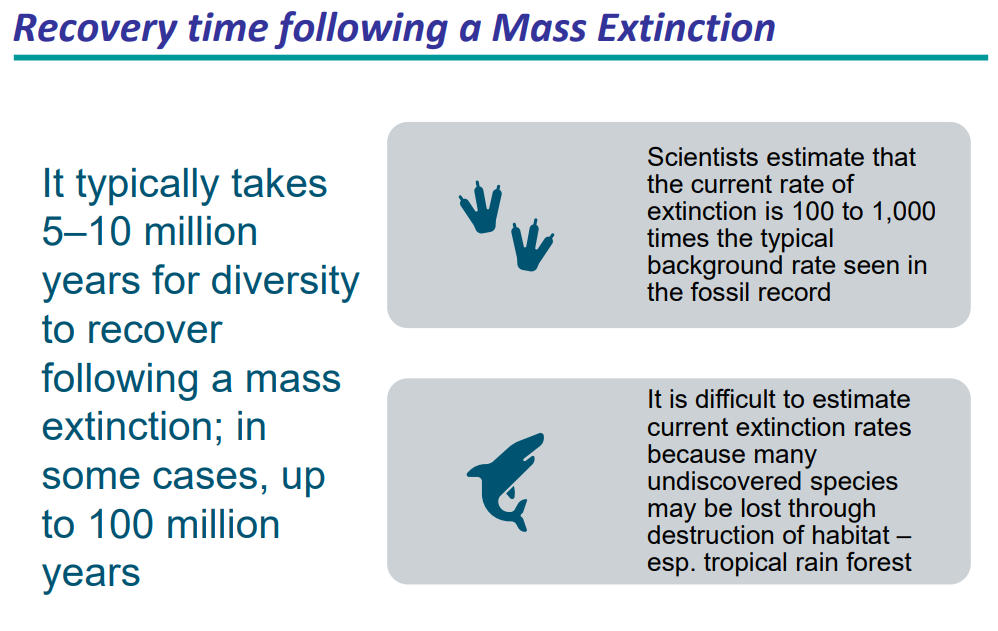
It typically takes 5–10 million years for diversity to recover following a mass extinction; in some cases, up to 100 million years (Permian)
The current rate of extinction is estimated to be 100 to 1,000 times the typical background rate seen in the fossil record.
It is difficult to estimate current extinction rates because many undiscovered species may be lost through destruction of habitat – esp. tropical rain forest.
The Holocene Extinction
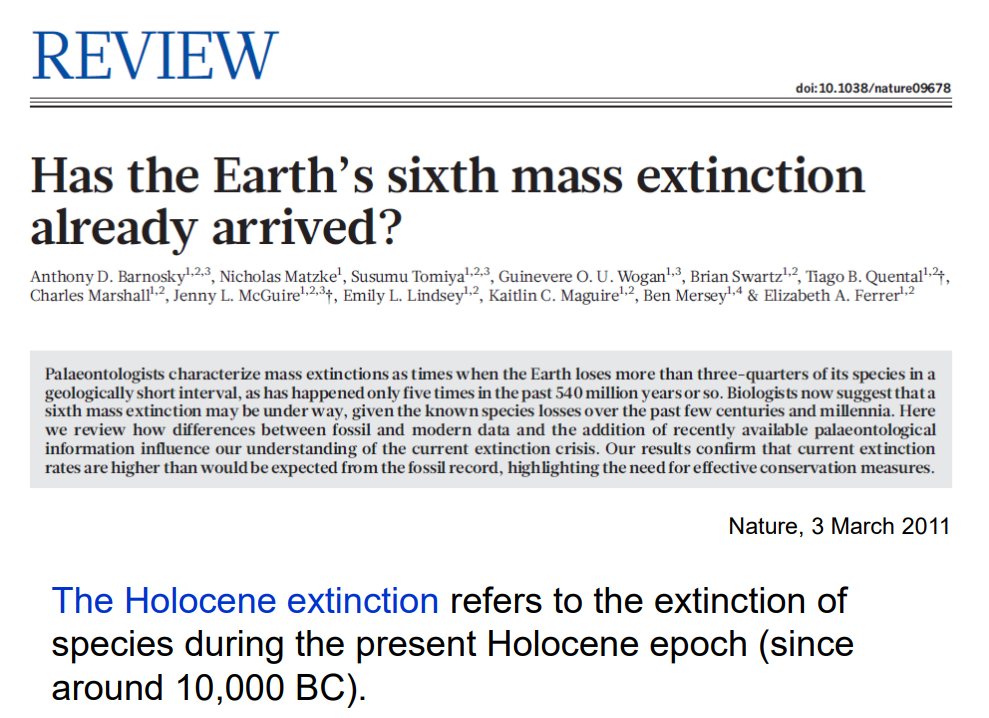
Refers to the extinction of species during the present Holocene epoch (since around 10,000 BC).
Started when humans drove the megafauna to extinction.
Human Activities Threaten Earth's Biodiversity
Examples of species driven to near extinction or extinction by human activities:
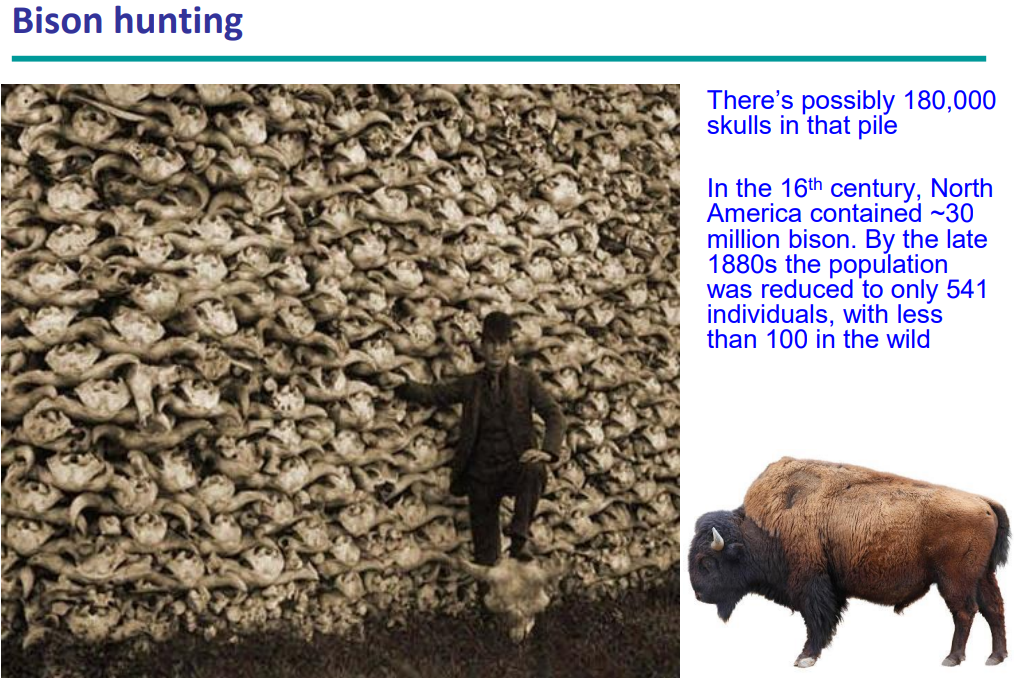
Bison: In the 16th century, North America contained ~30 million bison. By the late 1880s, the population was reduced to only 541 individuals.
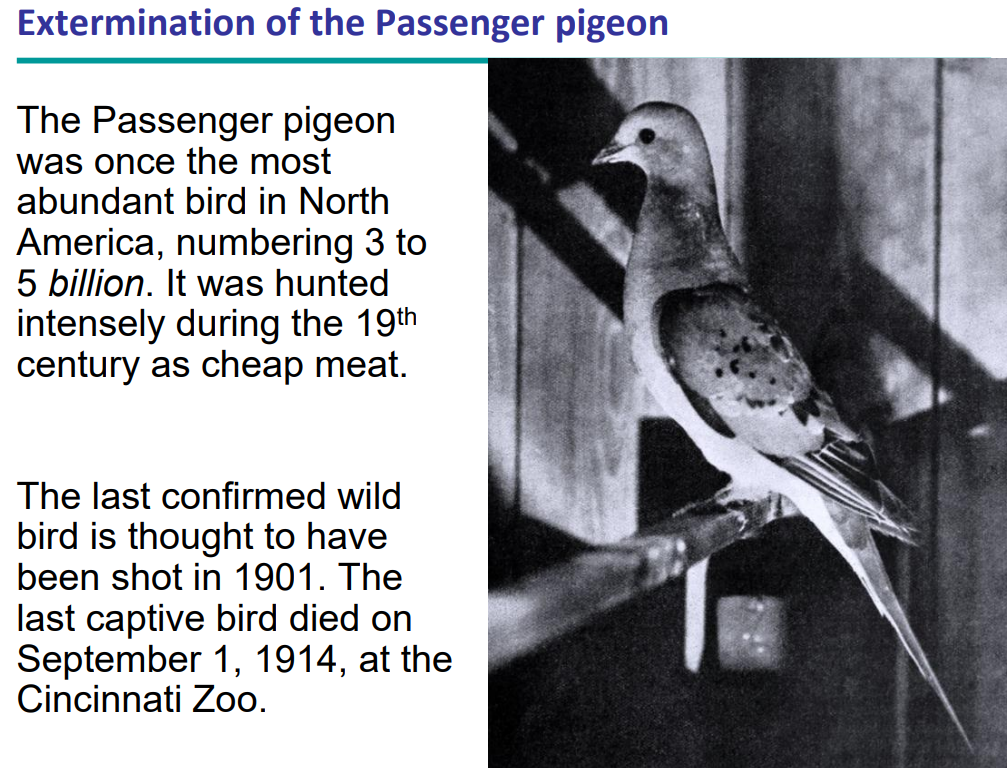
Passenger Pigeon: Once the most abundant bird in North America, numbering 3 to 5 billion. It was hunted intensely during the 19th century. The last captive bird died on September 1, 1914.
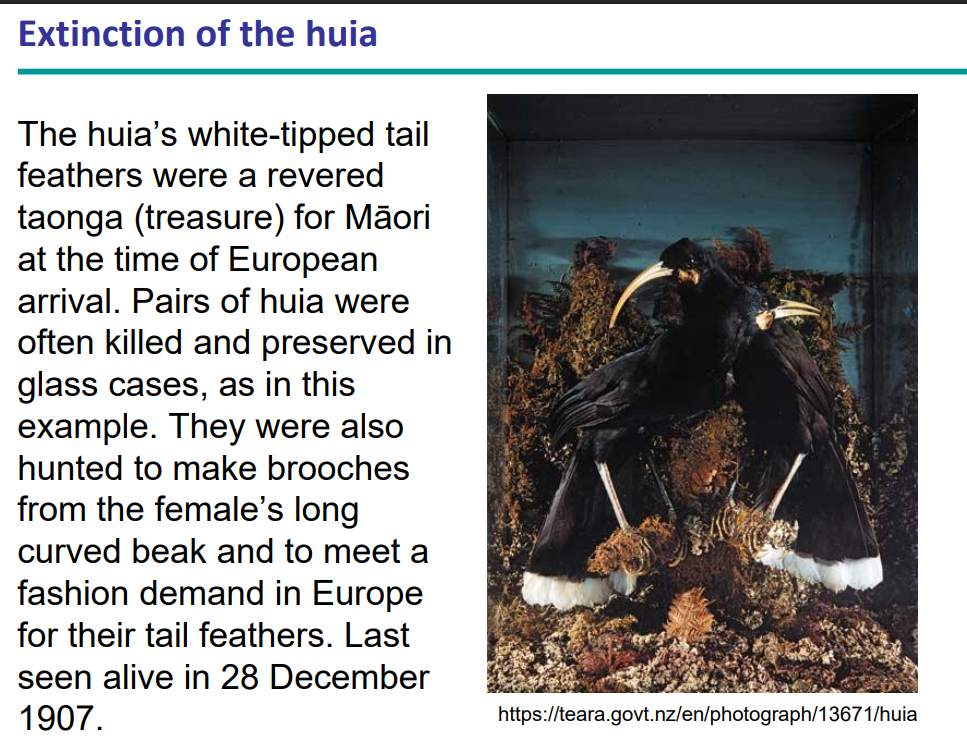
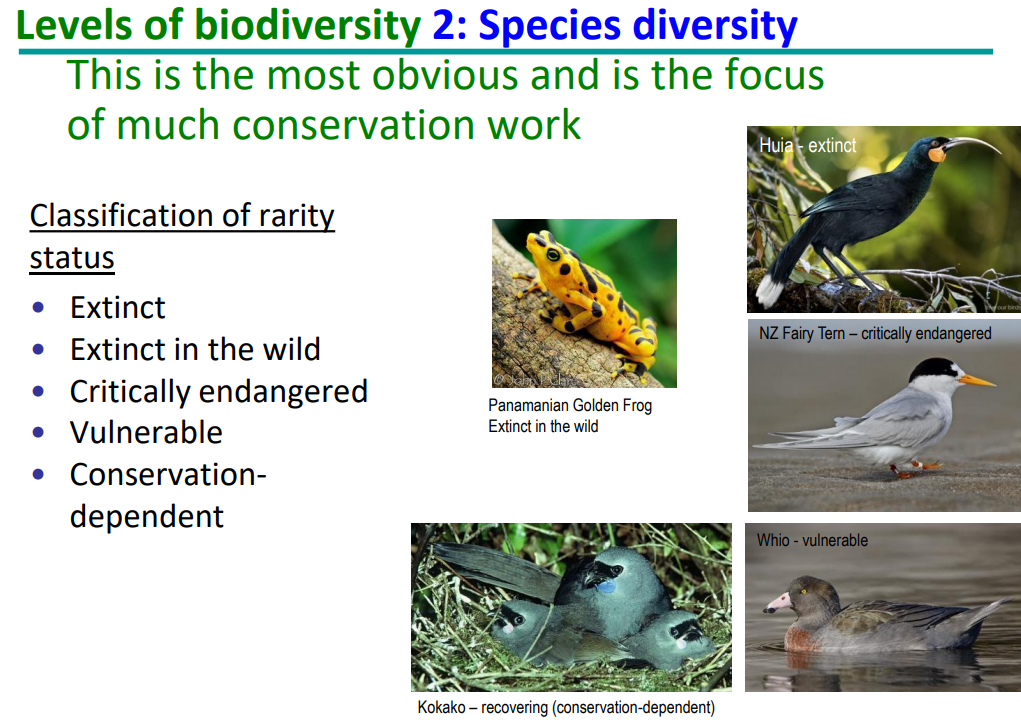
Huia: Hunted for its tail feathers and beaks, the last one was seen in 1907.
Conservation Biology and Wildlife Management
Conservation Biology: The management of nature and of Earth's biodiversity with the aim of protecting species, their habitats, and ecosystems from excessive rates of extinction and the erosion of biotic interactions.
It is an interdisciplinary subject that draws on various sciences and natural resource management.
Wildlife Management: Attempts to balance the needs of wildlife with the needs of people, using the best available science.
It can include gamekeeping, wildlife conservation, and pest control.
It draws on disciplines such as mathematics, chemistry, plant biology, zoology, ecology, climatology, and geography.
Considerations for Conservation Biologists
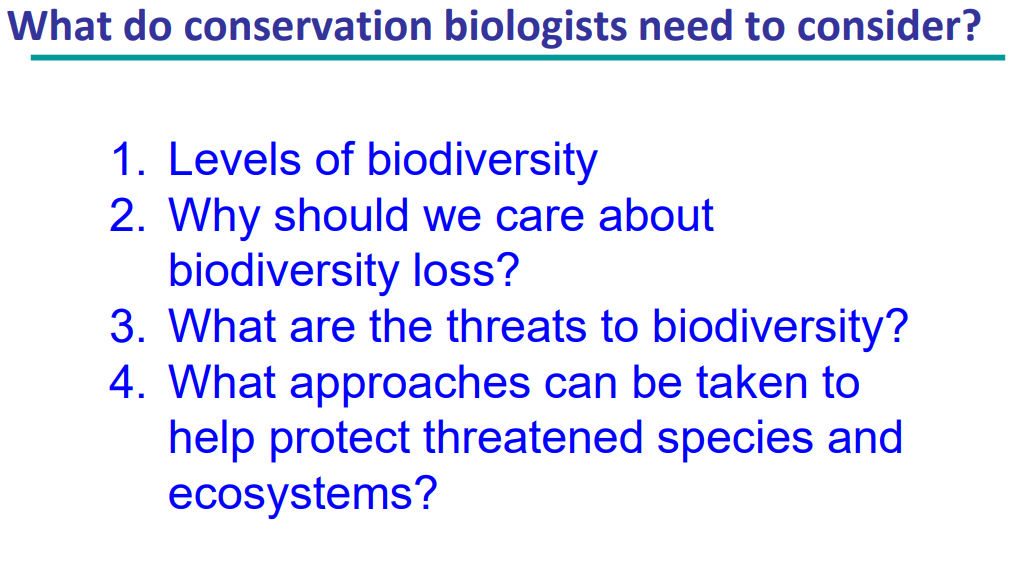
Levels of biodiversity.
Why should we care about biodiversity loss?
What are the threats to biodiversity?
What approaches can be taken to help protect threatened species and ecosystems?
Three Levels of Biodiversity
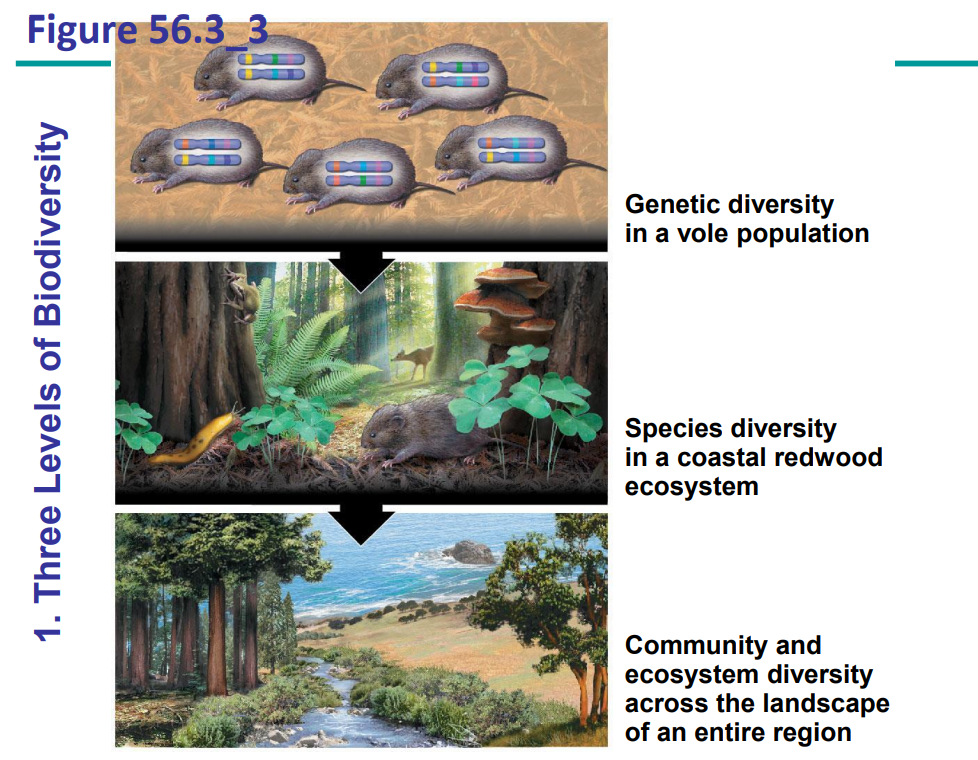
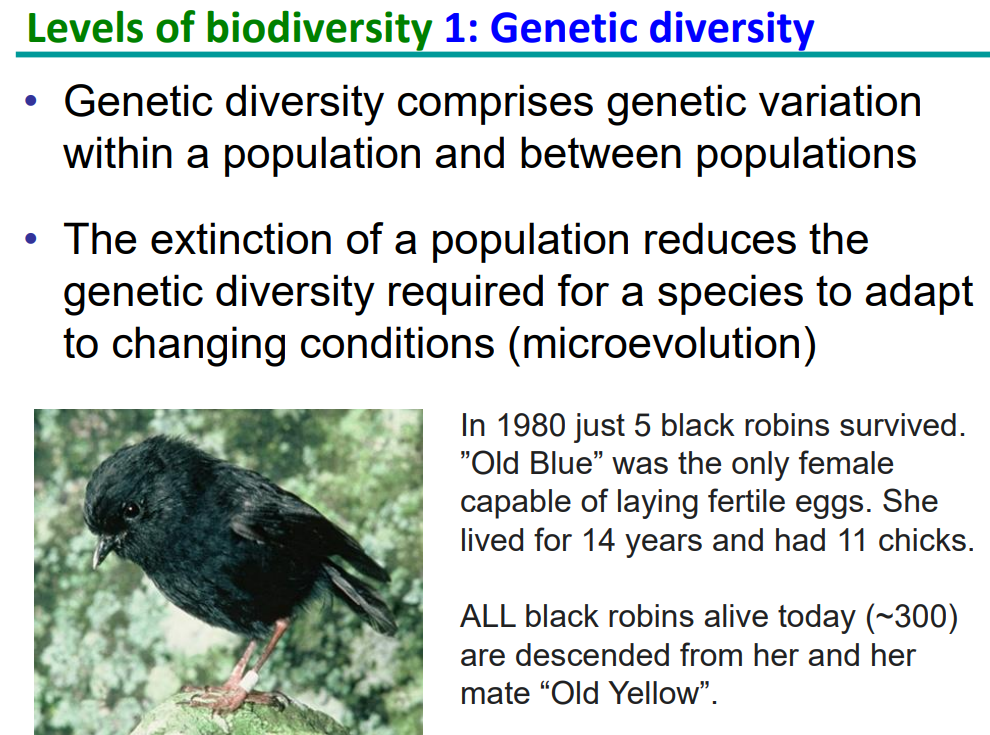
Genetic diversity: Genetic variation within a population and between populations. The extinction of a population reduces the genetic diversity required for a species to adapt to changing conditions (microevolution).
Example: Black robins descended from a single female.
Species diversity: Focus of much conservation work. Rarity status classifications include extinct, extinct in the wild, critically endangered, vulnerable, and conservation-dependent.
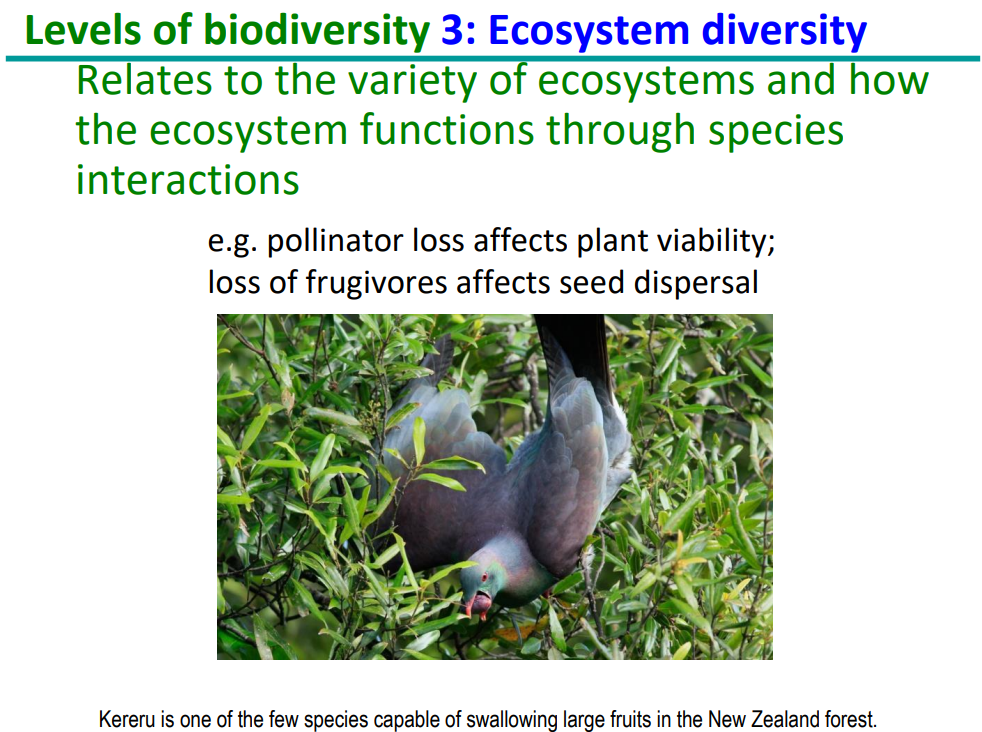
Ecosystem diversity: Variety of ecosystems and how the ecosystem functions through species interactions.
Example: Pollinator loss affects plant viability, and loss of frugivores affects seed dispersal.
Why Care About Biodiversity Loss?
Moral arguments (biophilia): Intrinsic right for other species to exist.
Utilitarian arguments: Species and genetic diversity have many practical benefits for humans.
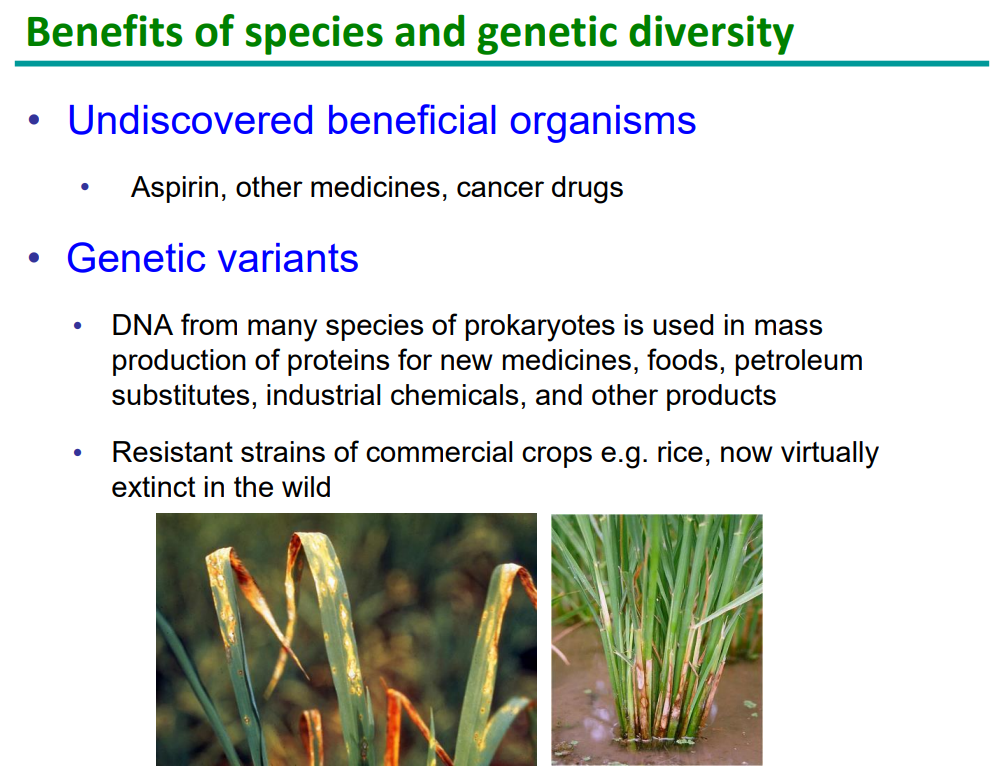
Benefits include undiscovered beneficial organisms, medicines, genetic variants, and resistant strains of commercial crops.
Ecosystem Services
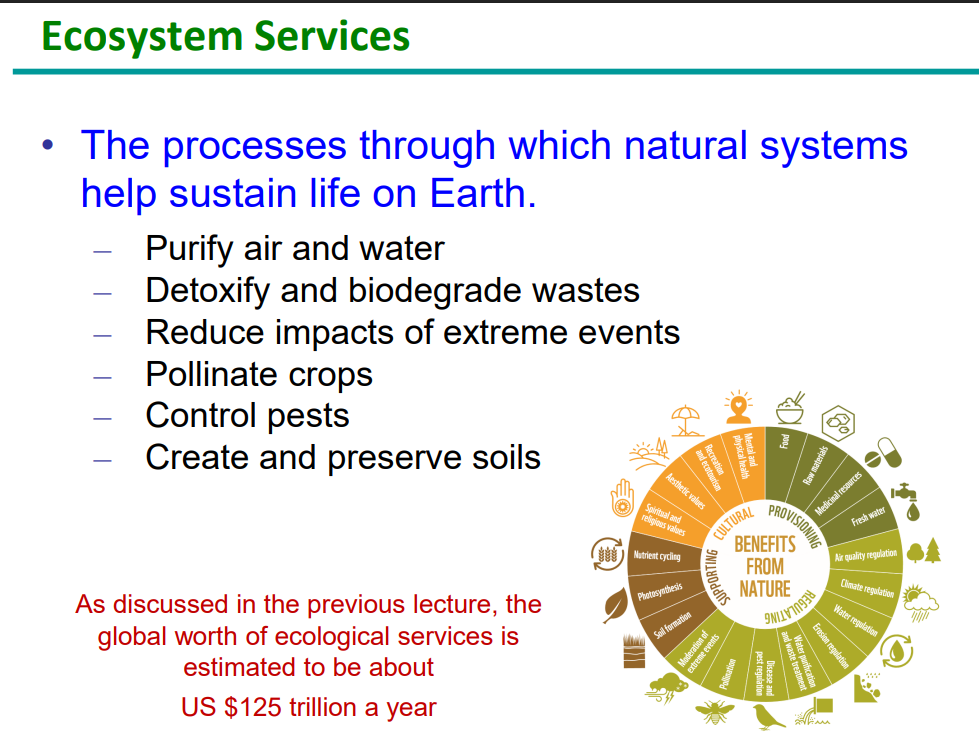
Processes through which natural systems help sustain life on Earth. These include:
Purifying air and water.
Detoxifying and biodegrading wastes.
Reducing impacts of extreme events.
Pollinating crops.
Controlling pests.
Creating and preserving soils.
The global worth of ecological services is estimated to be about US trillion a year.
Threats to Biodiversity
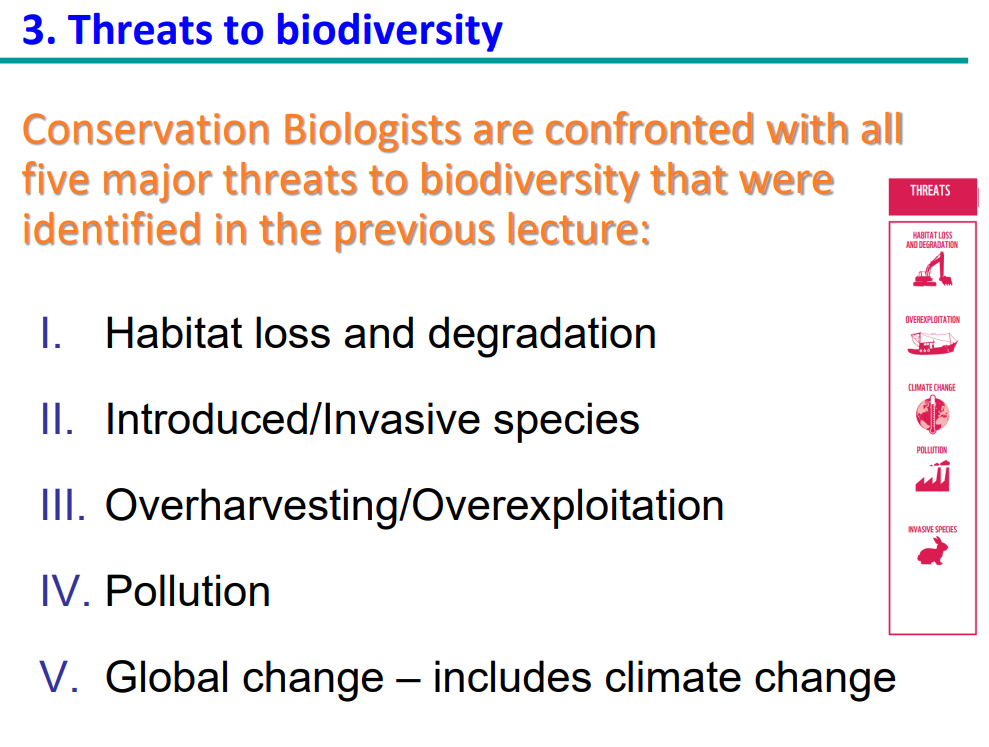
Conservation Biologists are confronted with five major threats to biodiversity:
Habitat loss and degradation: The single greatest threat to biodiversity.
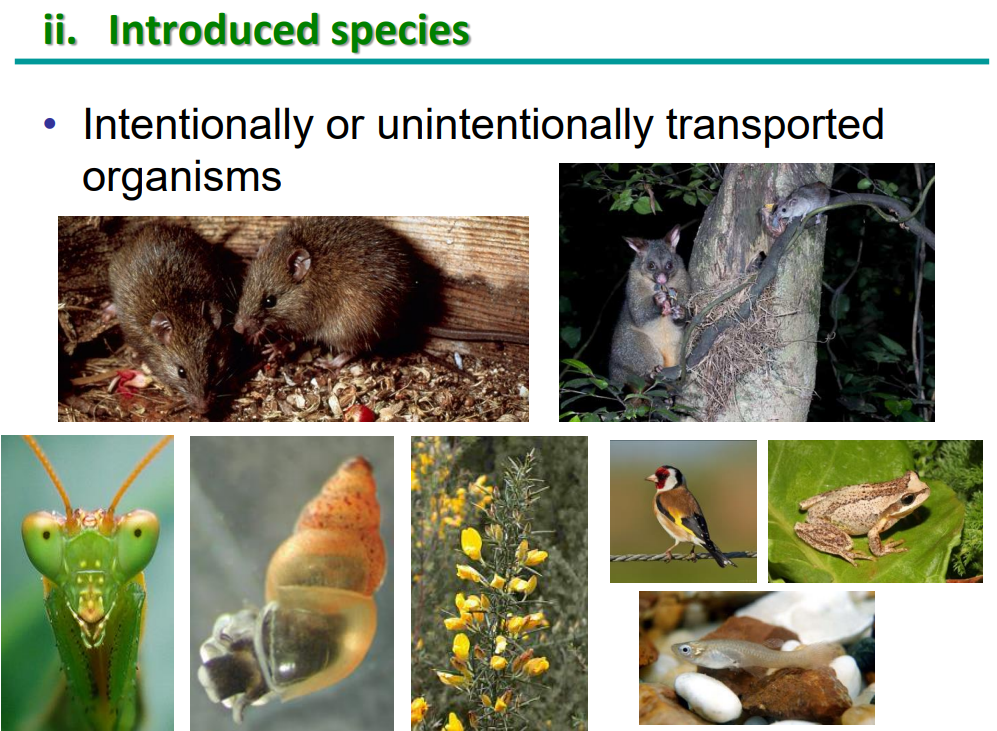
Introduced/Invasive species: Intentionally or unintentionally transported organisms.
Overharvesting/Overexploitation: Harvesting of wild organisms at rates exceeding the ability of the population to rebound.
Pollution
Global change: Includes climate change.
I. Habitat Loss and Degradation
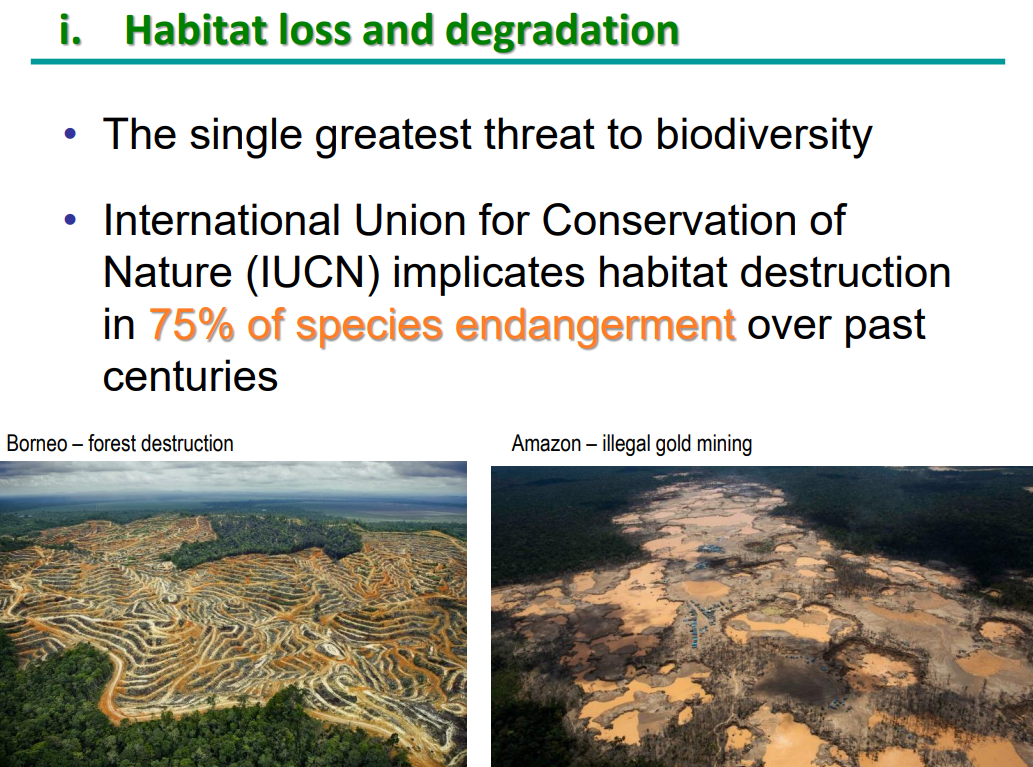
The single greatest threat to biodiversity.
The International Union for Conservation of Nature (IUCN) implicates habitat destruction in 75% of species endangerment over past centuries.
Examples include forest destruction in Borneo and illegal gold mining in the Amazon.
II. Introduced Species
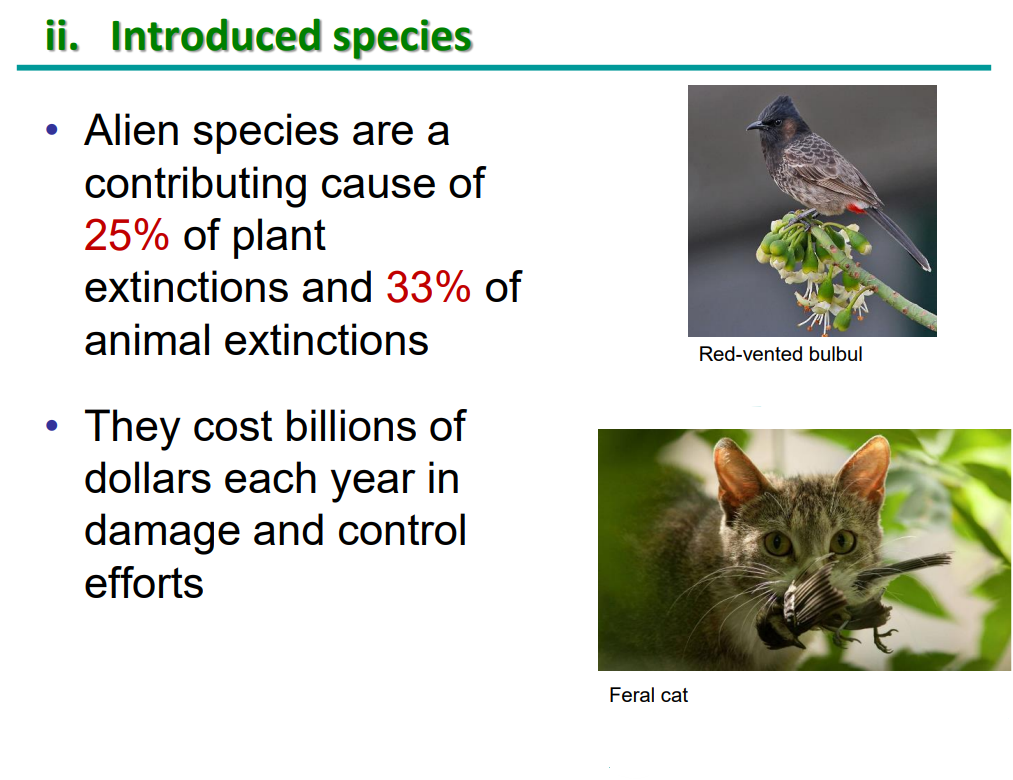
Alien species are a contributing cause of 25% of plant extinctions and 33% of animal extinctions.
They cost billions of dollars each year in damage and control efforts.
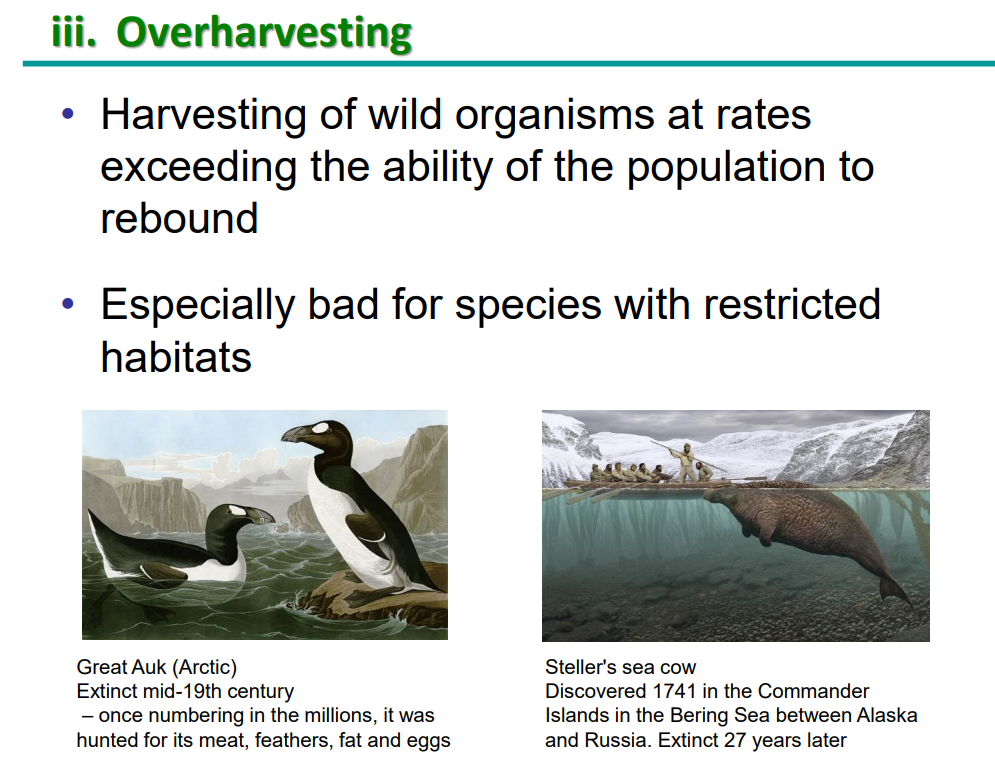
III. Overharvesting
Harvesting of wild organisms at rates exceeding the ability of the population to rebound.
Especially detrimental for species with restricted habitats.
Examples include the Great Auk and Steller's sea cow.
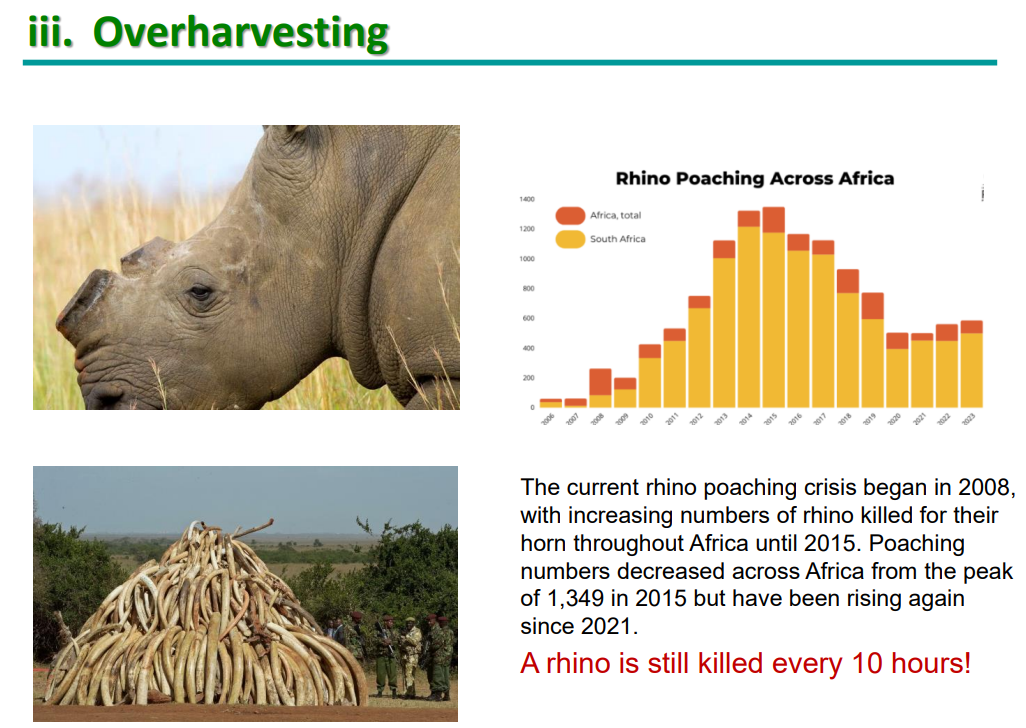
The current rhino poaching crisis, where a rhino is killed every 10 hours, began in 2008.
IV. Pollution
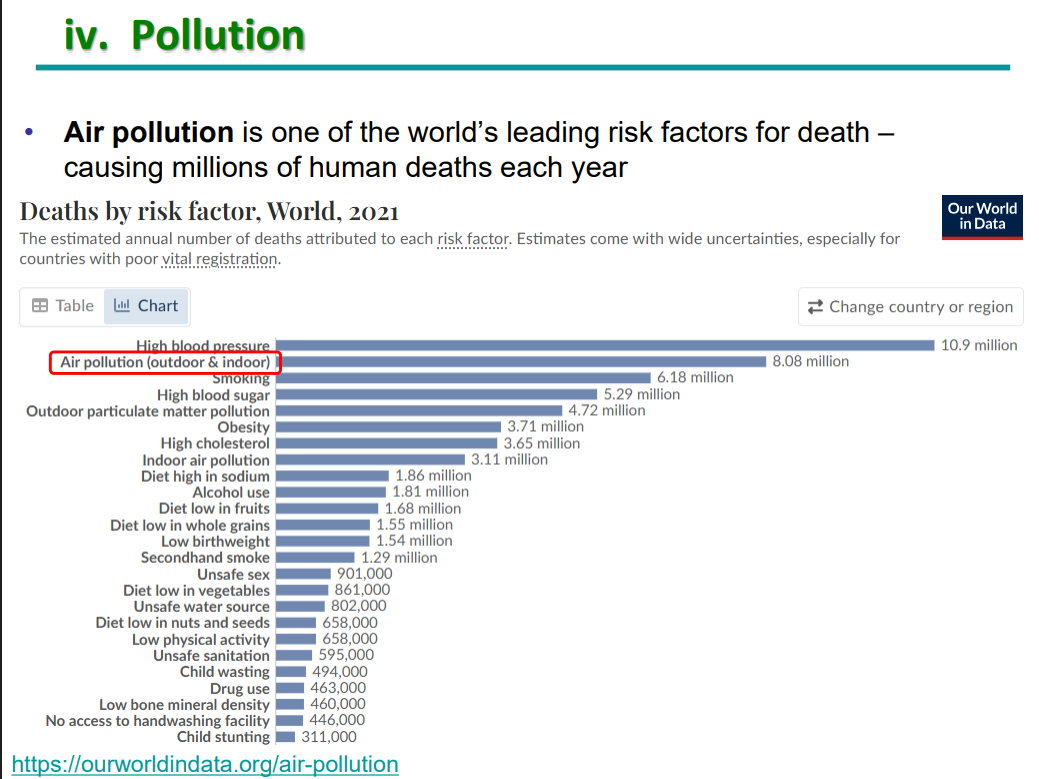
Air pollution is one of the world’s leading risk factors for death, causing millions of human deaths each year.
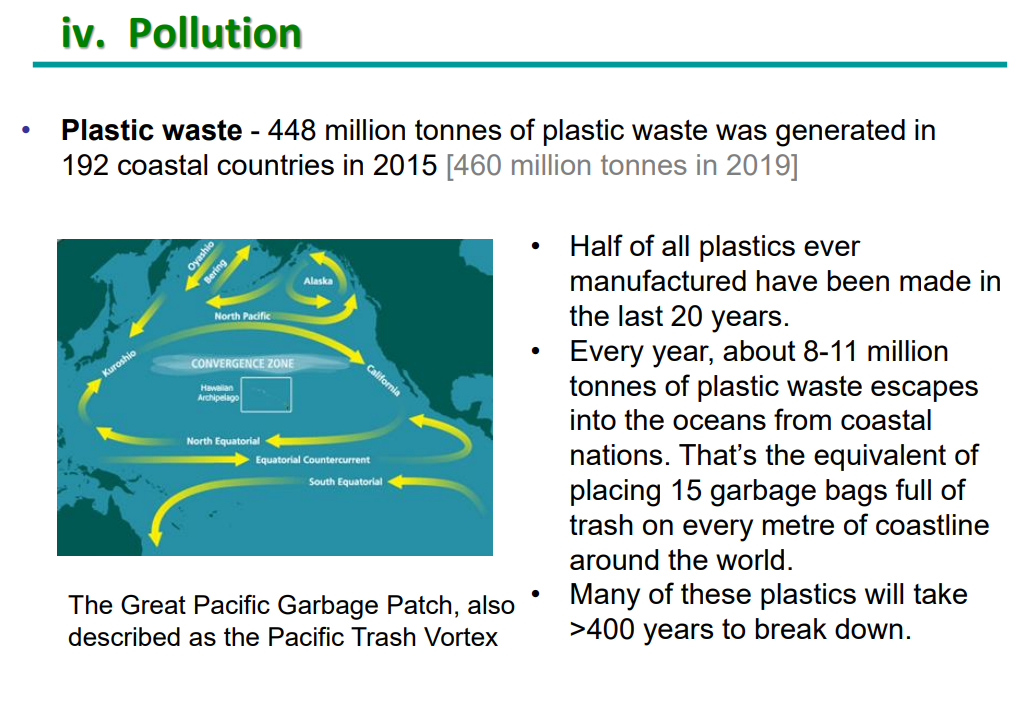
Plastic waste is a significant issue, with millions of tons generated annually, much of which ends up in the oceans.
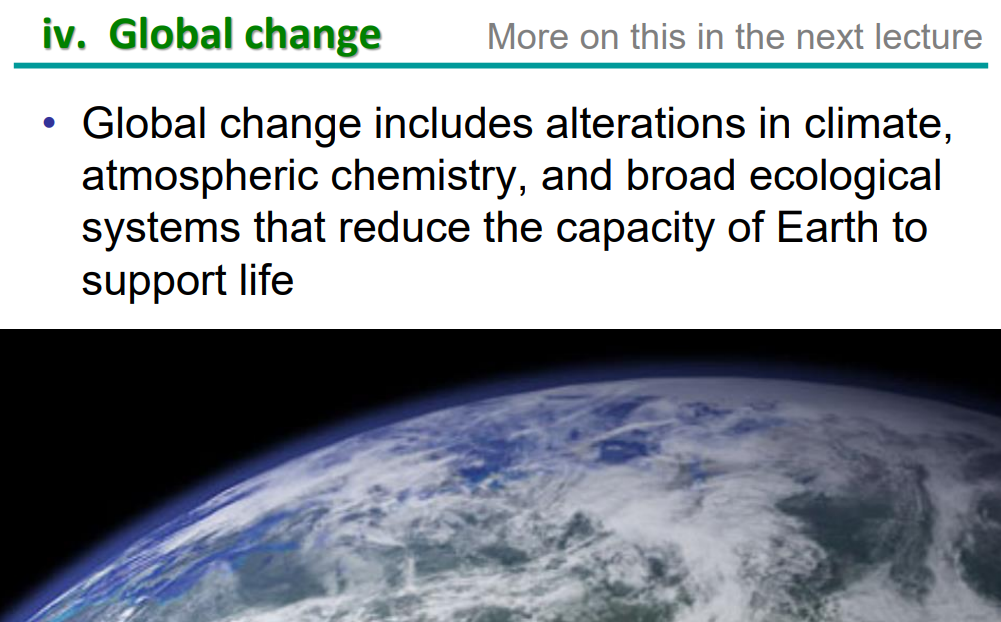
V. Global Change
Includes alterations in climate, atmospheric chemistry, and broad ecological systems that reduce the capacity of Earth to support life.
Population Conservation
Focuses on population size, genetic diversity, and critical habitat.
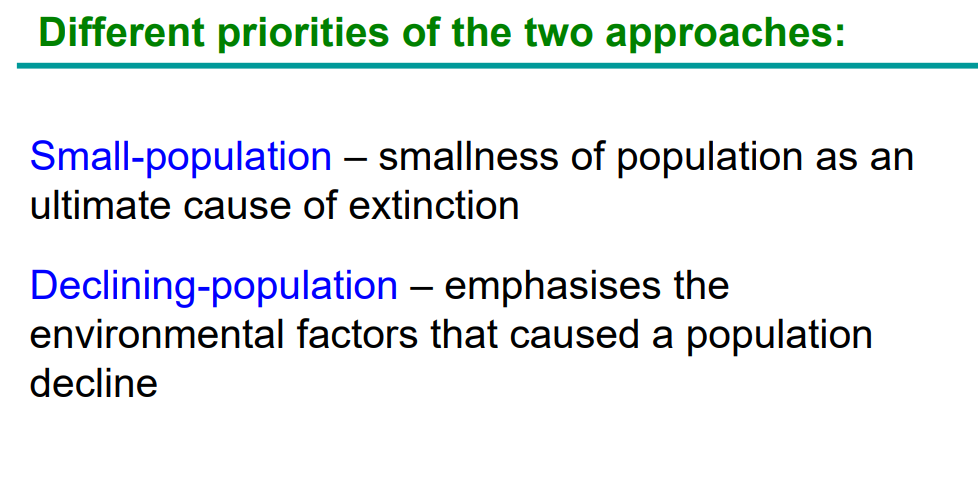
Two main approaches:
One focuses on small populations.
One focuses on rapidly declining populations.
1) Small-Population Approach
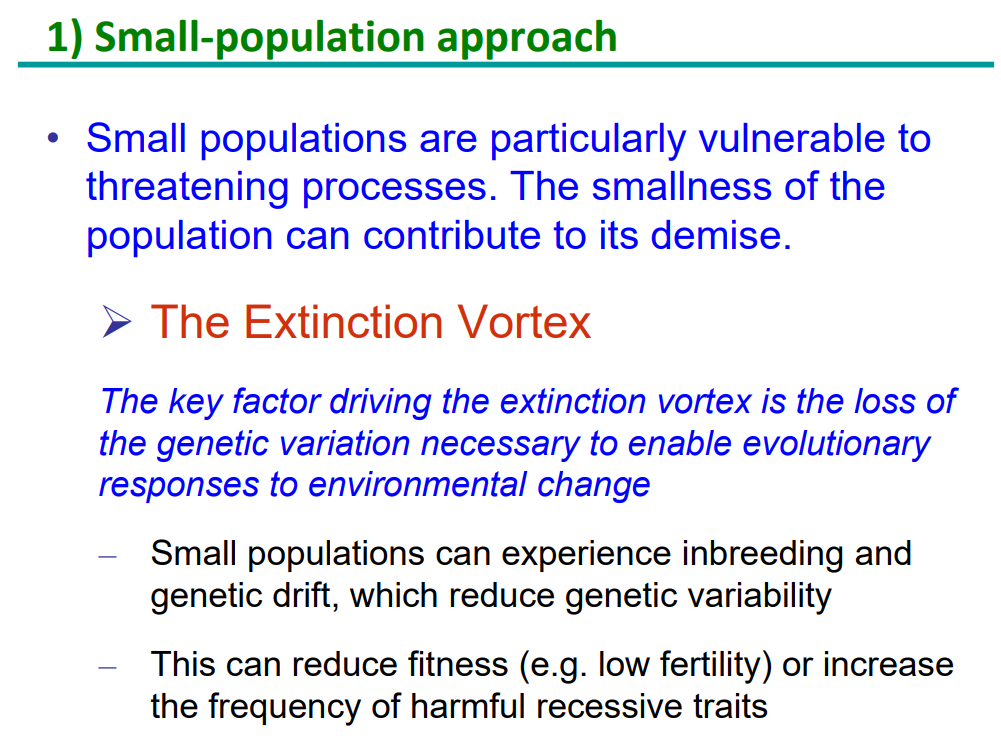
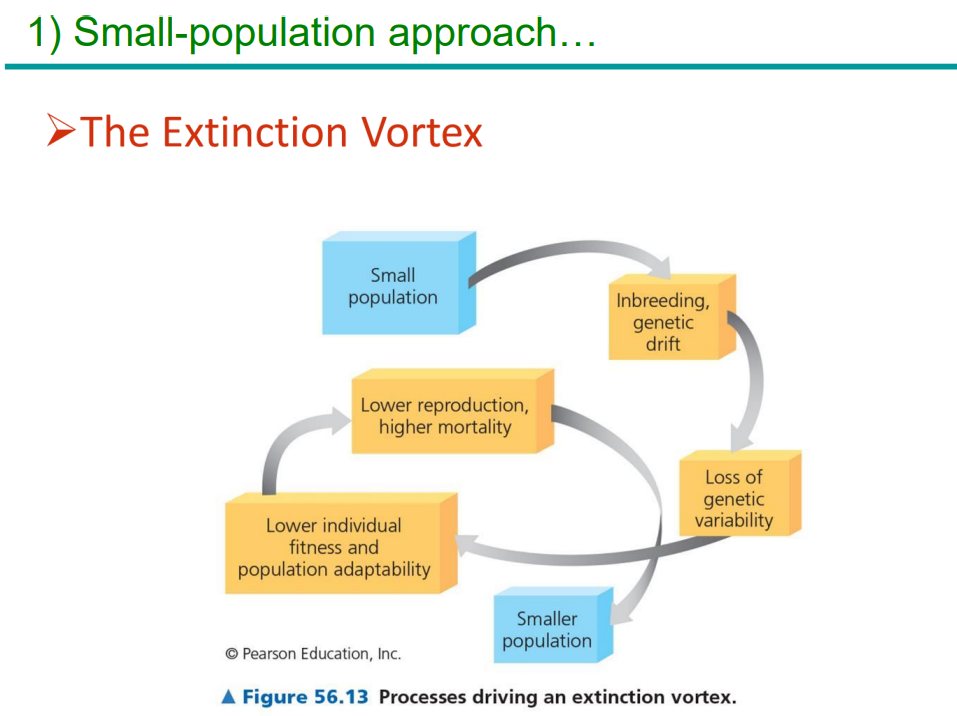
Small populations are particularly vulnerable to threatening processes. The smallness of the population can contribute to its demise.
The Extinction Vortex: The key factor driving the extinction vortex is the loss of the genetic variation necessary to enable evolutionary responses to environmental change.
Small populations can experience inbreeding and genetic drift, which reduce genetic variability.
This can reduce fitness (e.g., low fertility) or increase the frequency of harmful recessive traits.
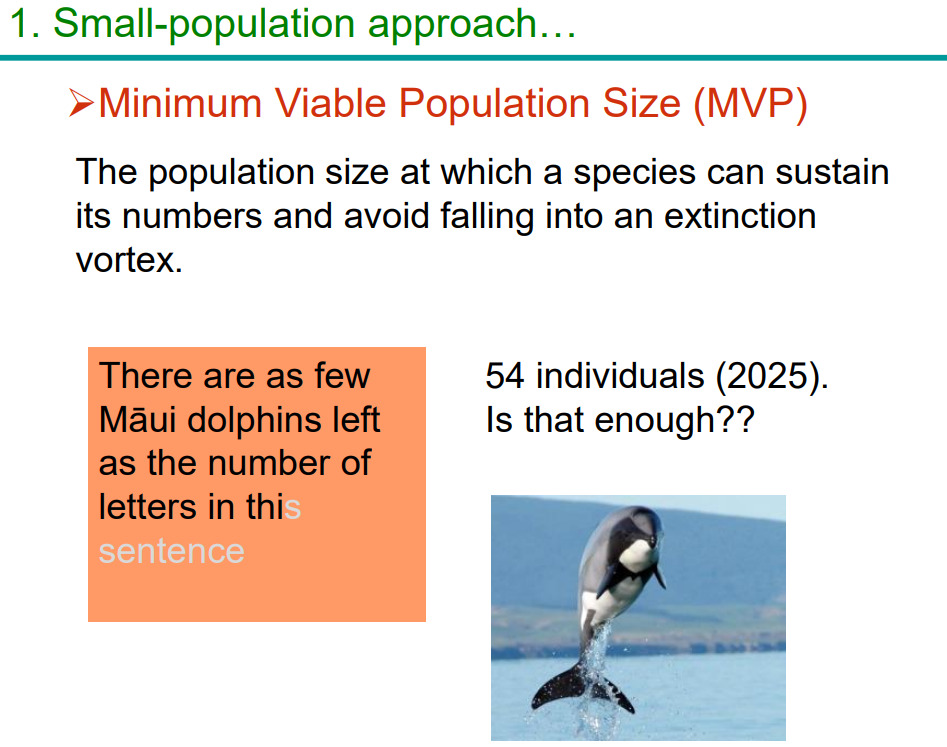
Minimum Viable Population Size (MVP): The population size at which a species can sustain its numbers and avoid falling into an extinction vortex.
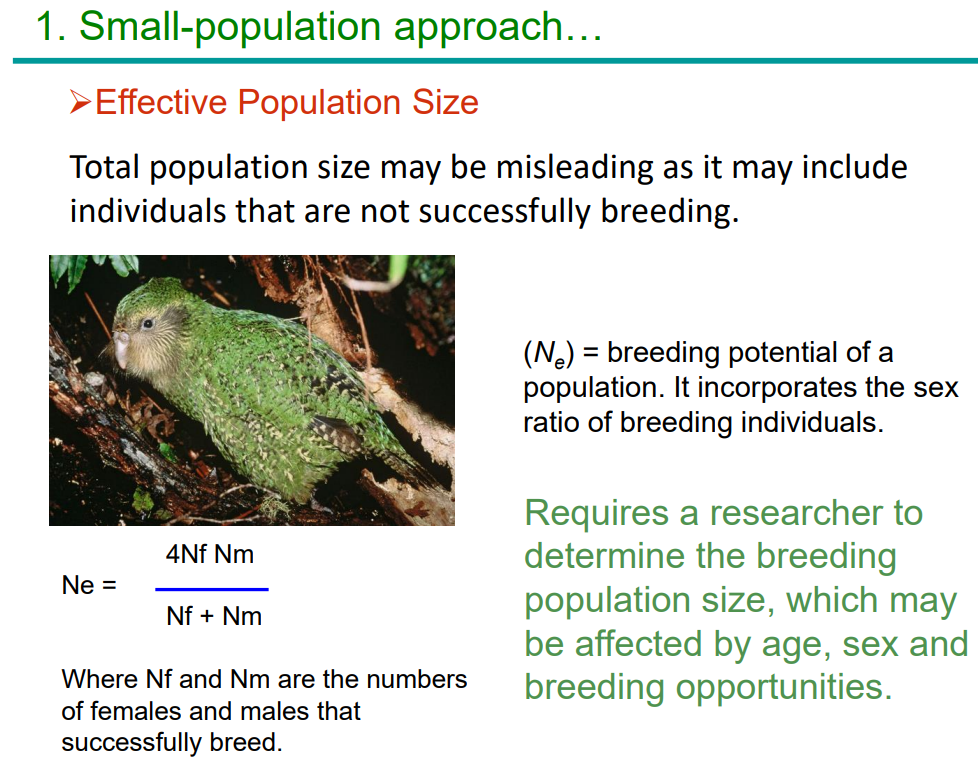
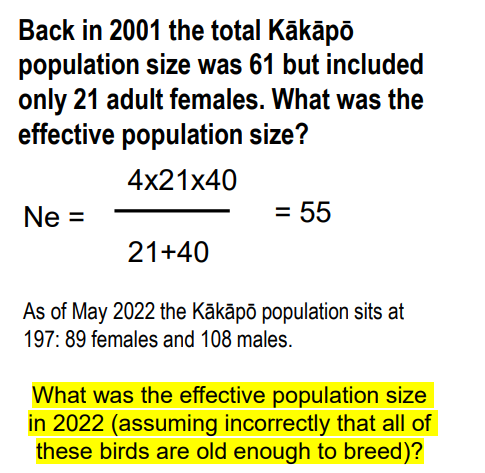
Effective Population Size (): Breeding potential of a population. It incorporates the sex ratio of breeding individuals.
, where and are the numbers of females and males that successfully breed.
Population Viability Analysis (PVA): Incorporates the probabilities of all known risks to population persistence. It predicts the probability of population persistence through time and is the basis for assessing different management tactics for a population.
2) Declining-Population Approach
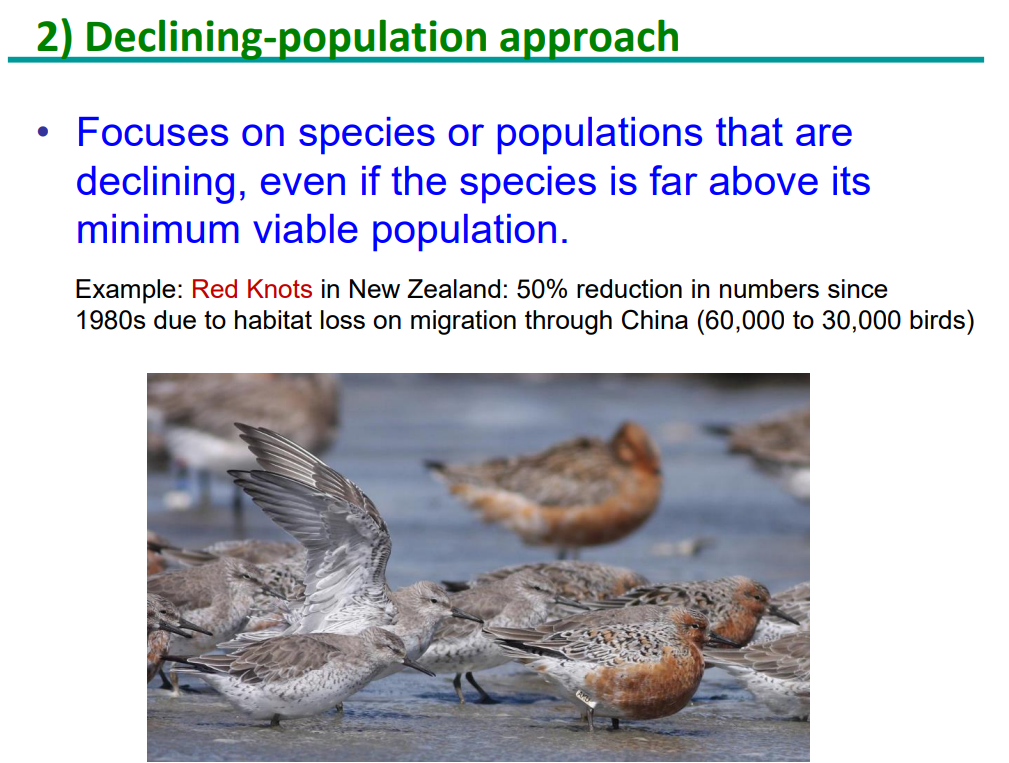
Focuses on species or populations that are declining, even if the species is far above its minimum viable population.
Landscape and Regional Conservation
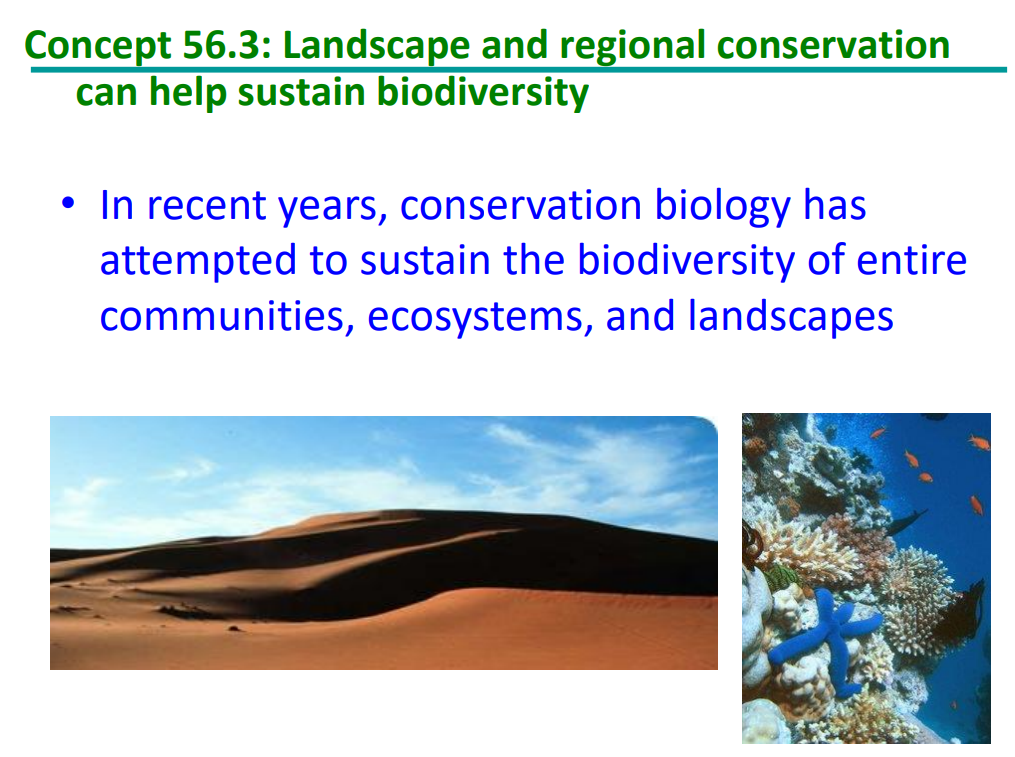
In recent years, conservation biology has attempted to sustain the biodiversity of entire communities, ecosystems, and landscapes.
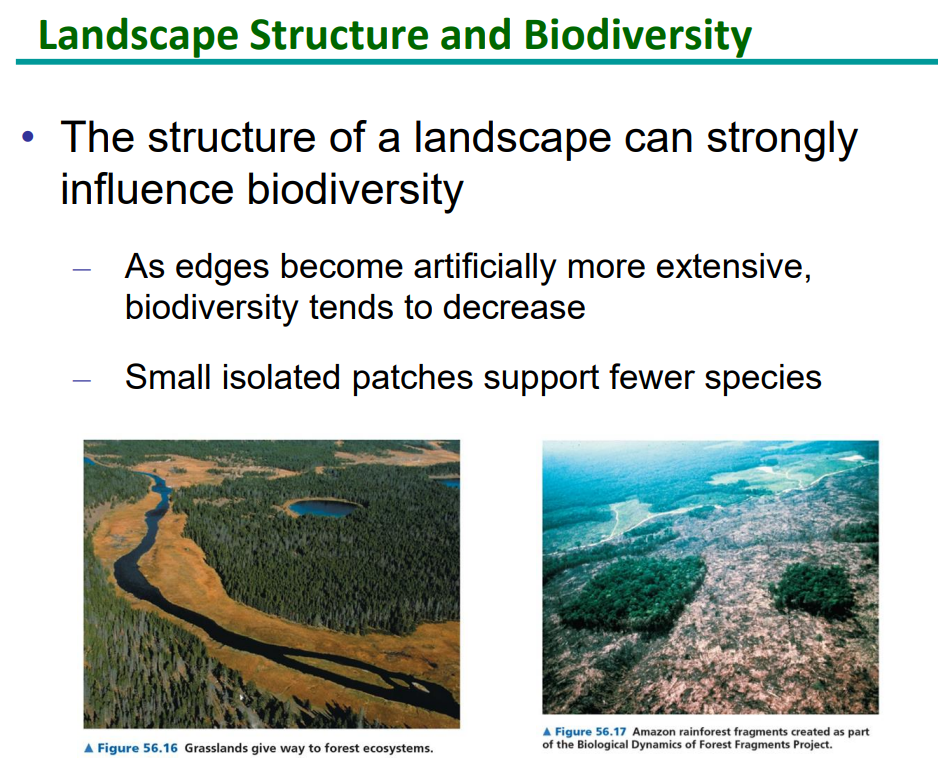
Landscape Structure and Biodiversity: The structure of a landscape can strongly influence biodiversity.
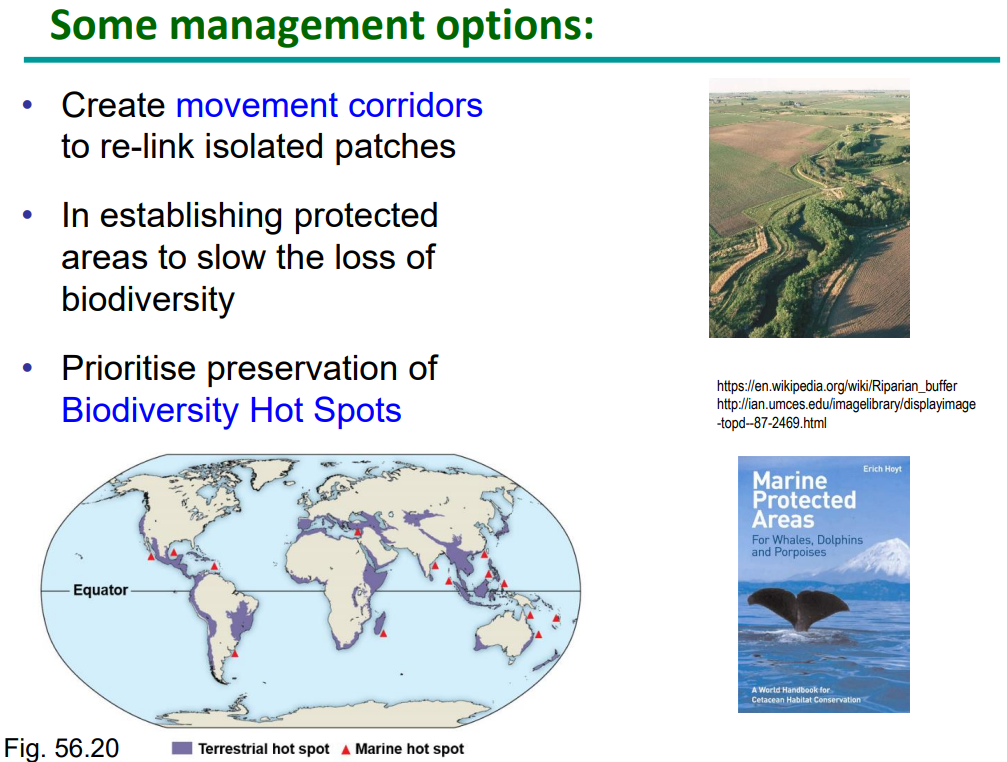
Conservation Strategies
Create movement corridors to re-link isolated patches.
Prioritize preservation of Biodiversity Hot Spots.
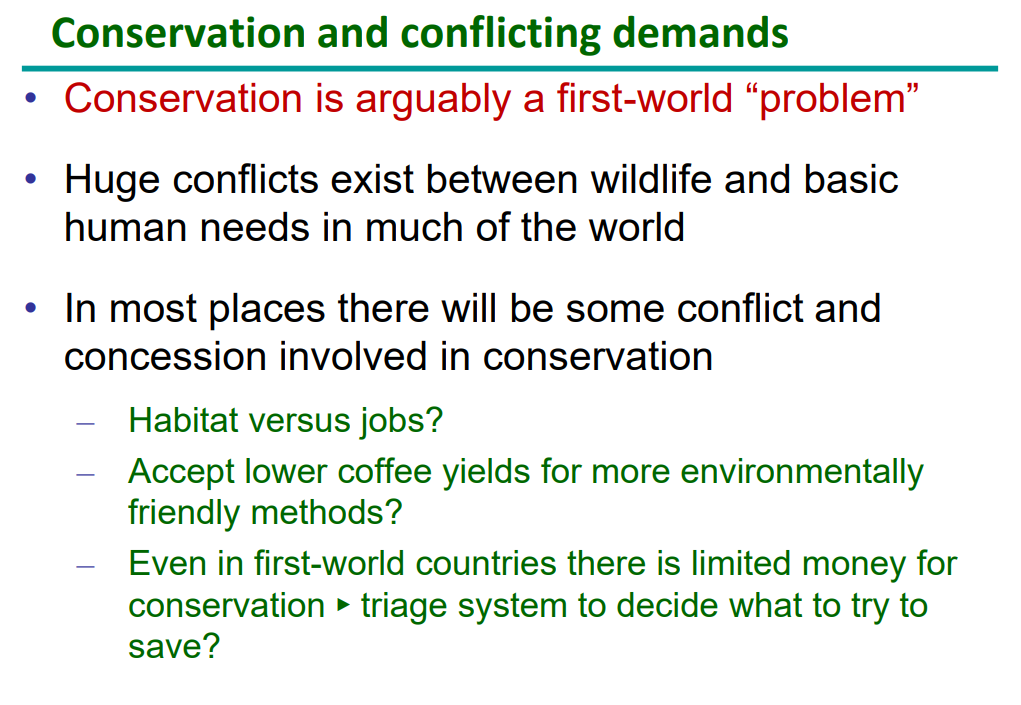
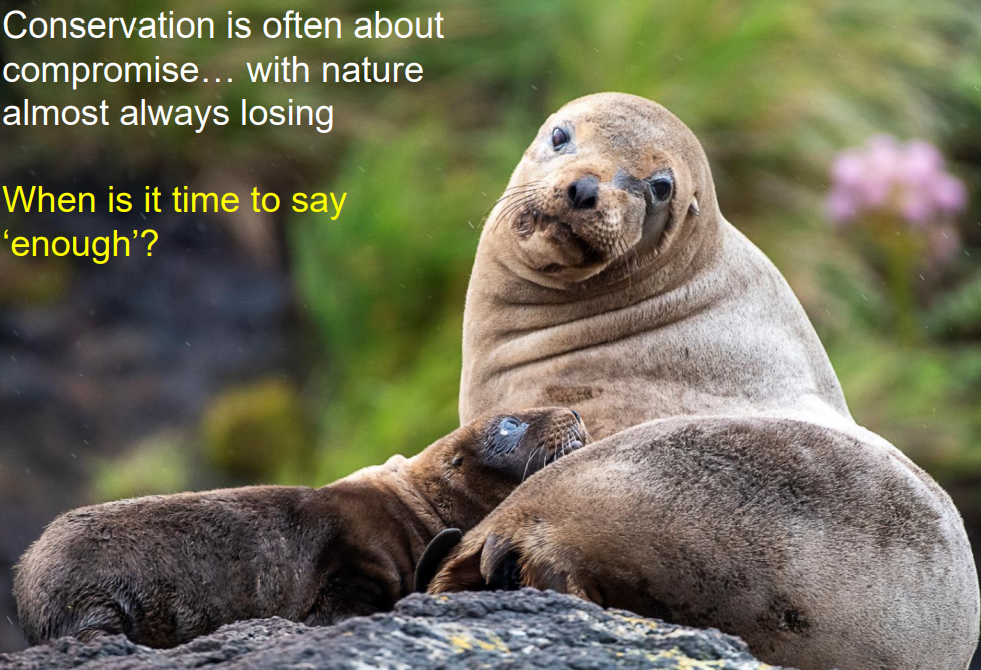
Conservation and Conflicting Demands
Conservation is arguably a first-world “problem.”
Huge conflicts exist between wildlife and basic human needs in much of the world.
In most places, there will be some conflict and concession involved in conservation.