Psychological explanation : cognitive explanation
Key terms
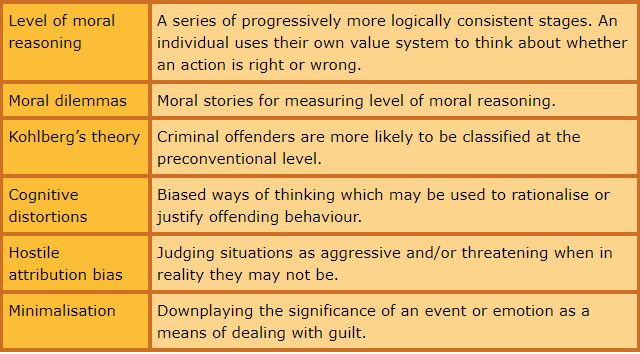
Level of moral reasoning - Moral reasoning refers to the process by which an individual draw upon their own value system to determine whether an action is right or wrong. Kohlberg attempted to objectify this process by identifying different levels of reasoning based on people’s answers to moral dilemmas.
Cognitive distortions - Faulty, biased and irrational ways of thinking that mean we perceive ourselves, other people and the world inaccurately and usually negatively.
Hostile attribution bias - The tendency to judge ambiguous situations, or the actions of other, as aggressive and/or threatening when in reality they may not be.
Minimisation - A type of deception that involves downplaying the significance of an event or emotion. A common strategy when dealing with feelings of guilt.
Cognitive explanations
Level of moral reasoning
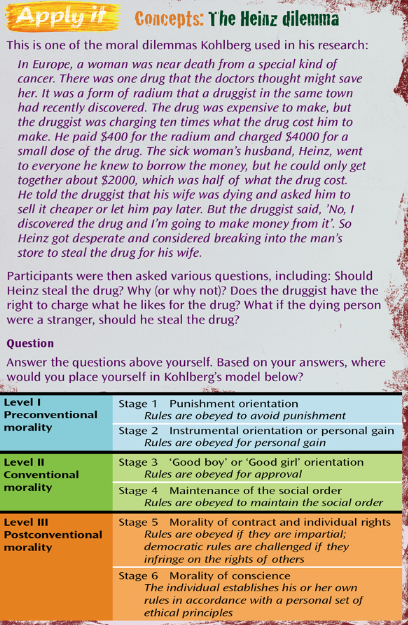
Lawrence Kohlberg was the first researcher to apply the concept of moral reasoning to criminal behaviour. Kohlberg proposed that people’s decisions and judgements on issues of right and wrong can be summarized in a stage of theory or moral development. The higher the stage, the more sophisticated the reasoning.
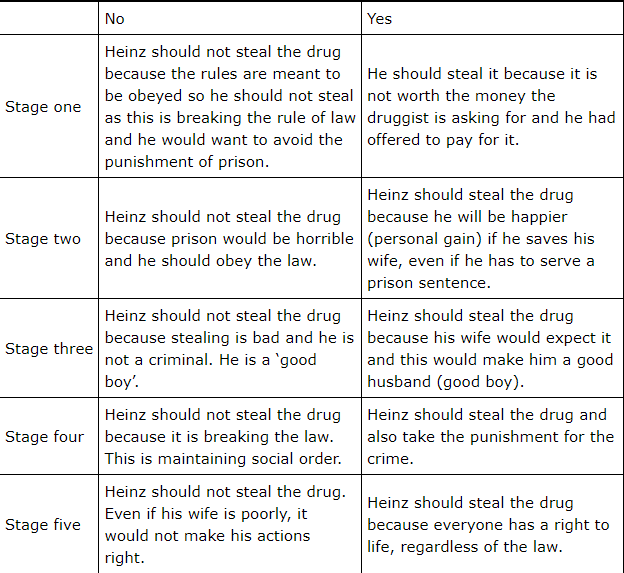
Kohlberg based is theory on people’s responses to a series of moral dilemmas, such as the Heinz dilemma. Many studies have suggested that criminals tend to show a lower level of moral reasoning than non-criminals. Kohlberg et al, using his moral dilemma technique, found that a group of violent youths were significantly lower in their moral development than non-violent youths - even after controlling their social background.
Kohlberg’s model and criminality
Criminal offenders are more likely to be classified at the preconventional level of Kohlberg’s model (stages 1 and 2), whereas non-criminals have generally progressed to the conventional level and beyond. The preconventional level is characterised by a need to avoid punishment and gain rewards, and is associated with less mature, childlike reasoning. Thus, adults and adolescents who reason at this level may commit crime if they can get away with it or gain rewards in the form of money, increased respect.
This assumption is supported by studies which suggest that offenders are often more egocentric (self-centred) and display poorer social perspective-taking skills than non-offender peers (e.g Chandler 1973) Individuals who reason at higher levels tend to sympathise more with the rights of others and exhibit more conventional behaviours such as honesty, generosity and non-violence.
Cognitive distortions - There are errors or biases in people’s information processing system characterised by faulty thinking. We all occasionally show evidence of faulty thinking when explaining our own behaviour (especially if the behaviour was unexpected or out of character) but research has linked this to the way in which criminals interpret other people’s behaviours and justify their own actions.
There are two examples of cognitive distortions
Hostile attribution bias
Minimalisation
Hostile attribution bias
Evidence suggests that a propensity for violence is often associated with a tendency to misinterpret the actions of other people - in other words, to assume others are being confrontations when they are not. Offenders may misread non-aggressive cues (like being looked at) and this may trigger a disproportionate often violent response.
Michael Schonenberg and Aiste Justye (2014) presented 55 violent offenders with images of emotionally ambiguous facial expressions. When compared with a non-aggressive matched control group, the violent offenders were significantly more likely to perceive the images as angry and hostile.
The roots of this behaviour may lie in childhood. Kenneth Dodge and Cynthia Frame (1982) showed children a video clip of an ‘ambiguous provocation’ (where the intention was neither clearly hostile nor clearly accidental) Children who had been identified as ‘aggressive’ and ‘rejected’ prior to the study interpreted the situation as more hostile than those classes as ‘non-aggressive’ and ‘accepted’
Minimalisation
This is an attempt to deny or downplay the seriousness of an offence and has elsewhere been referred to as the application of a ‘euphemistic label’ for behaviour (Bandura 1973).
For instance, burglars may describe themselves as ‘doing a job’ or ‘supporting their family’ as a way of minimising the seriousness of their offences. Studies suggest that individuals who commit sexual offences are particularly prone to minimisaltisation.
Howard Barbaree (1991) found amough 26 incarcerated rapists, 54% denied they had committed an offence at all and a further 40% minimised the hard they had caused to the victim.
Similarly, Nathan Pollock and Judith Hashmall (1991) reported that 35% of a sample of child molesters argued that the crime they had committed was non-sexual (they were just being affectionate) and 36% stated that the victim had consented.

Evaluation
Level of moral reasoning
Emma Palmer and Clive Hollin (1998) compared moral reasoning between 210 female non-offenders, 122 male non-offenders, and 126 convicted offenders using the Sociomoral Reflection Measure-Short Form (SRM-SF), which contains 11 moral dilemma-related questions such as not taking things that belong to others and keeping a promise to a friend.
all ages between 13 to 22 years old
male offenders showed poorer moral reasoning on 10/11 questions compared to male non-offenders
The delinquent group showed less mature moral reasoning than the non-delinquent group which is consistent with Kohlberg’s predictions.
Ronald Blackburn (1993) suggests that delinquents may show poor moral development due to a lack of role playing opportunities in childhood. Such opportunities to develop moral reasoning should therefore be provided.
Response bias
Kohlberg’s theory is based on the use of hypothetical dilemma tasks. It is likely due to social desirability bias people are unlikely to respond honestly, or even know how they would act. Meaning generalisability to real life offences is limited.
Kohlberg used an all male sample - GENDER BIAS
He developed his theory based on a all male sample, assuming his theory would apply to women, an example of beta bias. However, when women were tested, they appeared to be less morally developed. As men as significantly more likely to be offenders this suggests that Kohlberg’s ideas are not generalisable.
Gilligan (1982) argues Kohlberg’s entire theory is gender biased, focusing on male ideas on justice, not female ideas of ‘care.’
Alternative theories of moral reasoning
John Gibbs (1979) proposed a revised version of Kohlberg’s theory compromising of 2 levels of reasoning : mature and immature.
In the first level, moral decisions are guided by avoidance of punishment and personal gain.
In the second level, by empathy, social justice and one’s own conscience.
These stages are equivalent to Kohlberg’s post-conventional and conventional levels. Gibbs argued that Kohlberg’s post-conventional level should be abandoned because it was culturally biased (towards the Western culture) and did not represent a ‘natural’ maturational stage of cognitive development.
Gibbs’ view is supported by Jean Piaget’s theory of moral development, which suggests that child-like (criminal) reasoning is self-centred and egocentric which gives way to empathy and a concern for the needs of others and children get older.
Application of research
Understanding the nature of cognitive distortions has proven beneficial in the treatment of criminal behaviour. The dominant approach in which the rehabilitation of sex offenders is cognitive behaviour therapy which encourages offenders to ‘face up’ to what they have done and establish a less distorted view of their actions. Studies suggest that reduced incidence of denial and minimization in therapy is highly correlated with a reduced risk reoffending (as acceptance of one’s crimes is thought to be an important aspect of rehabilitations) and this is a key feature of anger management.
Extra
Individuals differences
The level of moral reasoning may depend on the type of offence. David Thornton and R.L Reid (1982) found that individuals who committed crimes for financial gain, such as robbery, were more likely to show pre-conventional moral reasoning than those convicted of impulsive crimes such as assault where reasoning of any kind tended not to be evident. Pre-conventional moral reasoning tends to associated with crimes in which offenders believe they have a good change of evading punishment.
Peter Langdon et al (2010) have suggested that intelligence may be a better predictor of criminality that moral reasoning. This would explain the finding that groups of people with very low intelligence are actually less likely to commit crimes (despite the fact they show lower levels of moral reasoning)
Langdon et al’s research challenges Kohlberg because this research found that people with very low intelligence who showed lower levels of moral reasoning were less likely to commit crime, and Kohlberg would suggest they should be more likely to if they are in the preconventional level.
Descriptive not explanatory
One key failing with the cognitive approach is that whilst it is good at describing the criminal mind, it is rather less successful when it comes to explaining it. Cognitive explanations are essentially ‘after the fact’ theories and , although they may be useful when predicting reoffending, they tend not to give us much insight into why the offender committed the crime in the first place.
Biological explanations are determinist and hence are concerned with identifying the cause of criminal behaviour, e.g. a criminal gene has caused the individual to offend or the fact that the person has reduced activity in their prefrontal cortex has caused them to commit a crime. Eysenck suggested personality causes offending behaviour and individuals with a extraverted, neurotic or psychotic personality are likely to commit crime.