Gas Exchange in Plants
The leaf
Structure of a typical leaf
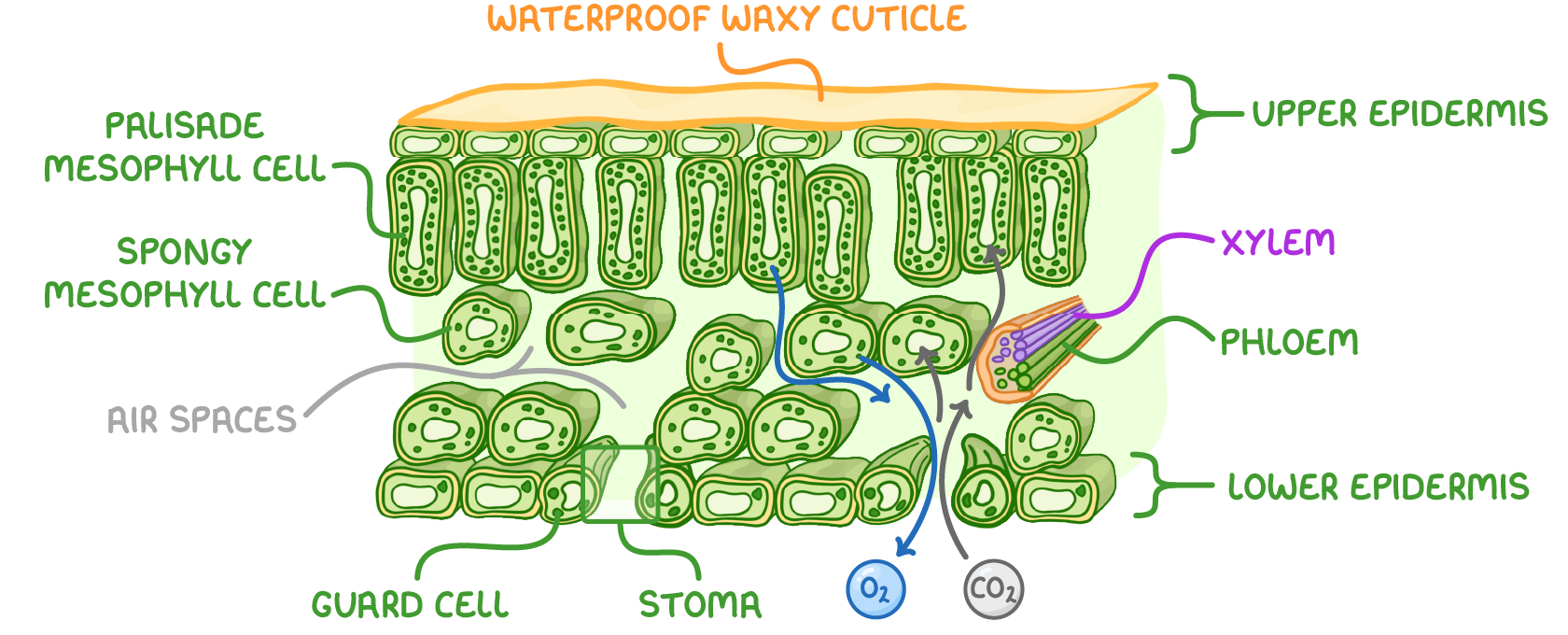
Some important structures include:
Upper epidermis with waxy cuticle
Reduces water loss from leaf surface
Air spaces
Interconnecting spaces that run throughout the mesophyll layer
Palisade mesophyll cells
Located beneath the upper epidermis
Carry out photosynthesis
Spony mesophyll cells
Dispersed cells located beteanth the palisade mesophyll
Carry out photosynthesis
Stomata
Small pores surrounded by guard cells on the underside of the leaves that open and close
Lower epidermis
Bottom layer of cells that contains the stomata and guard cells
Vascular tissue (xylem and phloem)
Transports water and nutrients
Adaptations of leaf structures for gas exchange:
Air spaces
Provides a network for gases to quickly diffuse in and out of the leaf and access photosynthesising cells
Mesophyll cells
Dispersed thoughtout the leaf
Provide a large surgacce area across which gases can diffuse
Stomata
Open when conditions are suitable for photosynthesis
Allow inward diffusion of carbon dioxide and outward diffusion of oxygen
Close to minimise water loss
How plants limit water loss
Plants require a large leaf surface area for photosynthesis.
But this could lead to lot of water being lost
Plants have teh following to limit water loss:
They have a waterproof waxy cuticle on their leaves
They have guard cells that can close stomata when needed
Xerophytes
Xerophytes are plants adapted to living in dry environments with limited water availability.
Without adaptations they would become desiccated (dry out) and die
Key adaptations
Thick waxy cuticle
Reduces wear loss through evaporation
Rolling/folding of leaves
Encloses the stomata on the lower surface to reduce air flow and evaporation of water
Hairs on leaves
Trap moist air against the leaf surface to reduce the diffusion gradient of water vapour
Sunken stomata in pits
Reduces air flow and Evaporation fo water
Small, needle-like leaves
Reduce the surface across from which water can be lost
Water storage organs
Conserve water for when it is in low supply